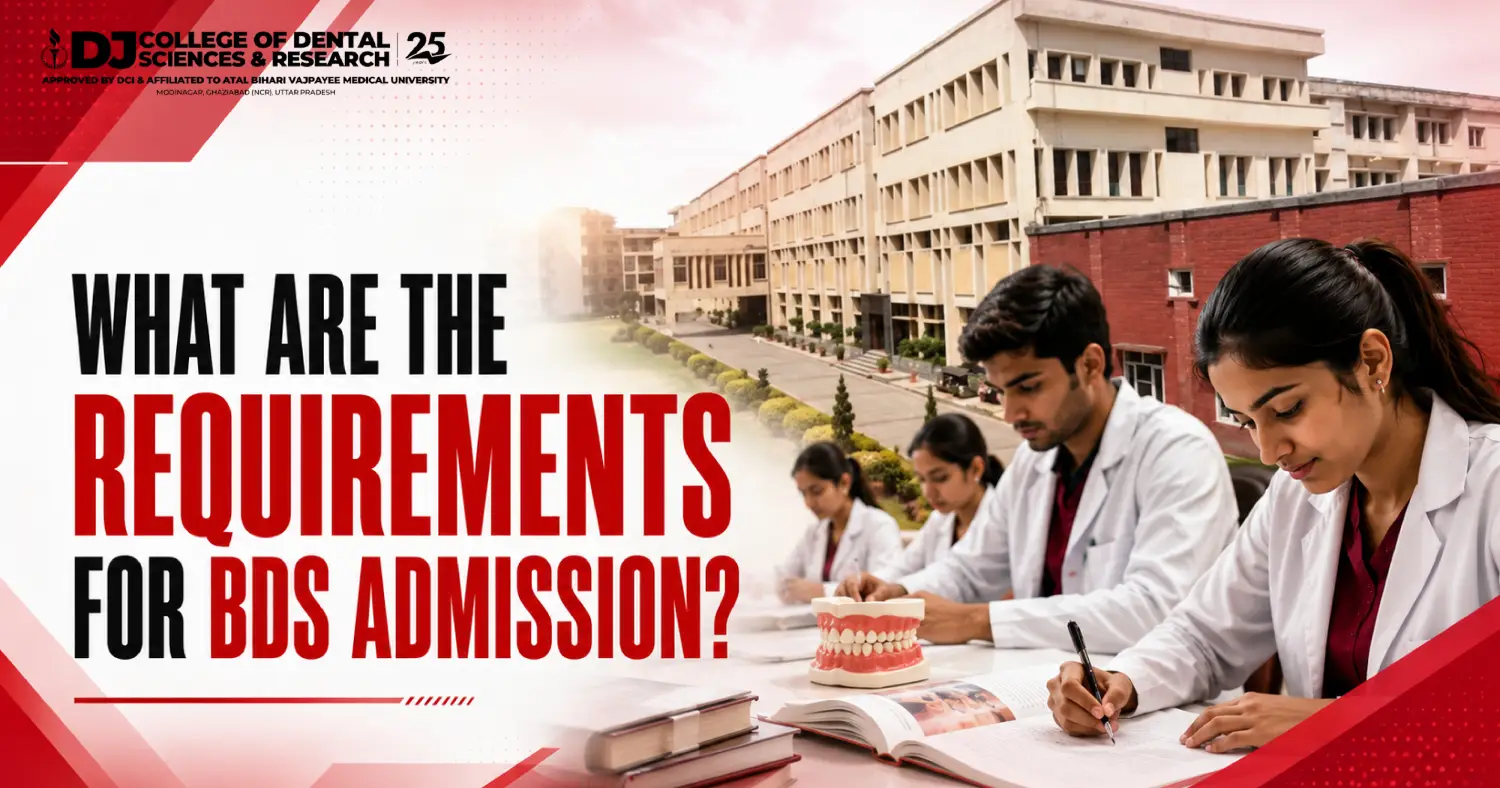
If you are interested in pursuing a career in dentistry, then you might be wondering what are the requirements for BDS admission. The BDS course mainly focuses on training and introducing students to the dental sciences and surgeries.
In this blog post, we will discuss the eligibility criteria for BDS admission, entrance exam, fees, syllabus and scope of BDS courses in India.
Therefore, in this blog, we have explored some simple tips to maintain good oral and dental hygiene and prevent these issues.
BDS Course Overview
BDS stands for Bachelor of Dental Surgery, which is a 5-year undergraduate program and also the only approved professional dental course in India. The course covers various subjects such as Dental Histology, Oral Pathology, Oral Surgery, Orthodontics, Periodontics, Prosthodontics, etc. It also involves a one-year compulsory rotating internship where students get hands-on experience in treating patients under the supervision of senior dentists.
The degree is regulated by the Dental Council of India (DCI), which is the apex body for dental education and profession in India. The students must register themselves with the DCI after completing their BDS education qualification so that they become eligible to practice their profession as dentists.
For an overview of more BDS course information, refer to the table below.
| Course Name | Bachelor of Dental Surgery (BDS) |
| Level | Undergraduate |
| Duration | 5 years |
| Eligibility Criteria | 50% or above in 10+2 with PCB |
| BDS Admission Process | Entrance Exam (NEET-UG) |
| Mode of Examination | Semester System |
| Average Course Fees | INR 1 – 6 Lakhs |
| Average Salary | INR 4 – 6 Lakhs |
BDS Eligibility Criteria
The basic eligibility criteria for BDS admission are as follows:
- The candidate must have passed a 10+2 or equivalent examination with Physics, Chemistry, Biology and English as compulsory subjects from a recognized board.
- The candidate must have secured at least 50% marks in aggregate in PCB subjects (40% for SC/ST/OBC candidates) in the qualifying examination.
- Candidates must have completed 17 years of age on or before 31st December of the year of their BDS admission.
BDS Entrance Exam
BDS admission is based on the performance of the candidates in the National Eligibility cum Entrance Test (NEET), which is conducted by the National Testing Agency (NTA) once a year. NEET is a national-level exam that tests the candidates’ knowledge and aptitude in Physics, Chemistry, Biology and General Knowledge.
NEET cut-off marks are the minimum marks required by the candidates to qualify for BDS admission. The cut-off marks vary every year depending on the difficulty level of the exam, the number of applicants, the number of seats available, etc. Generally, the cut-off marks are also different for different categories of candidates such as General, SC/ST/OBC, etc.
BDS Fees
The fees for BDS courses vary depending on the type of college, location, facilities, etc. In general, the fees for government colleges are lower than for BDS admission in private colleges. The average fees for the BDS course range from INR 1 lakh to INR 6 lakhs per annum. Some of the factors that affect the fees of the BDS course are:
- Reputation and ranking of the college
- Availability of scholarships and financial aid
- Infrastructure and facilities of the college
- Faculty and staff of the college
- Placement and alumni network of the college
BDS Syllabus
The syllabus for the BDS course covers both theoretical and practical aspects of dental sciences and surgeries and is divided into four years of classroom education and one year of internship. It is also updated regularly by the DCI to keep pace with the latest developments and innovations in the field.
The syllabus for BDS in private colleges and even government ones usually includes the following subjects:
| First Year | Second Year |
| Human Anatomy | General Pathology |
| Physiology | Microbiology |
| Biochemistry | Pharmacology |
| Dental Anatomy | Dental Histology |
| Dental Materials | Preclinical Prosthodontics |
| Third Year | Fourth Year |
| General Medicine | Orthodontics |
| Preclinical Conservative Dentistry | Oral Surgery |
| Oral Pathology | Prosthodontics |
| Oral Medicine | Conservative Dentistry |
| Periodontics | Public Health Dentistry |
| Pedodontics | Oral Radiology |
| General Surgery | Internship |
BDS Internship
During the internship period, the students have to work in various departments of dentistry such as Oral Surgery, Prosthodontics, Conservative Dentistry, Periodontics, Pedodontics, Orthodontics, etc. under the guidance of senior dentists. The internship helps the students to gain practical skills and confidence in treating patients with different dental problems.
BDS Scope
After completing the BDS course, the students can find lucrative career opportunities as dentists in various sectors such as:
- Government and private hospitals and clinics
- Dental colleges and universities
- Dental research institutes and organizations
- Dental equipment and material manufacturing companies
- Defence services and railways
- NGOs and social welfare organizations
The students can also opt for higher studies and specialisation in various branches of dentistry such as:
- MDS (Master of Dental Surgery)
- PhD (Doctor of Philosophy)
- Diploma and certificate courses
Some of the popular specialisations in dentistry that students can pursue their MDS at Divya Jyoti College of Dental Sciences and Research are:
- Oral and Maxillofacial Surgery
- Prosthodontics and Crown and Bridge
- Conservative Dentistry and Endodontics
- Periodontology and Implantology
- Pedodontics and Preventive Dentistry
- Orthodontics and Dentofacial Orthopedics
- Oral Medicine and Radiology
- Oral and Maxillofacial Pathology and Microbiology
The average salary of a dentist in India ranges from INR 4 lakhs to INR 10 lakhs per annum depending on the experience, qualification, specialization, location, etc. Salary packages also vary according to the type of employer such as government, private, corporate, etc.
Conclusion
BDS is a rewarding and challenging career option for students who are passionate about dentistry and want to make a difference in people’s lives. This course provides comprehensive knowledge and training in dental sciences and surgeries. The BDS admission process requires the students to sit for the NEET, which can be a hurdle but also opens up avenues for further studies and specialisation in dentistry, as well as a high-paying career as a dentist in various types of organisations.
FAQs
- Can I get BDS direct admission without qualifying for the cutoff marks of NEET?
No, since the BDS course is regulated by the DCI, securing above the cutoff marks in NEET is compulsory for all candidates if they want to pursue this course. Hence, no college can provide BDS direct admission if they want to be recognised by the DCI.
- Is English necessary for pursuing a BDS course?
Yes, English is necessary for pursuing a BDS course as instruction and all the course material is in that language. Some colleges like DJ Dental College also require candidates to have 50% in English at their 10+2 level exam as an eligibility criterion.
- Do dentists have demand abroad?
Yes, dentists are not only in high demand in India but also abroad, as more and more people are getting serious about oral and dental health and hygiene. The Gulf countries are especially an attractive option for BDS graduates who want to practice outside India.
- Can I practice independently after the BDS course qualification?
Yes, you may practice independently after completing your BDS course qualification. However, most dentists usually go for this option after completing their MDS and earning specialised knowledge and more experience as it helps bring in more patients.
Related Posts