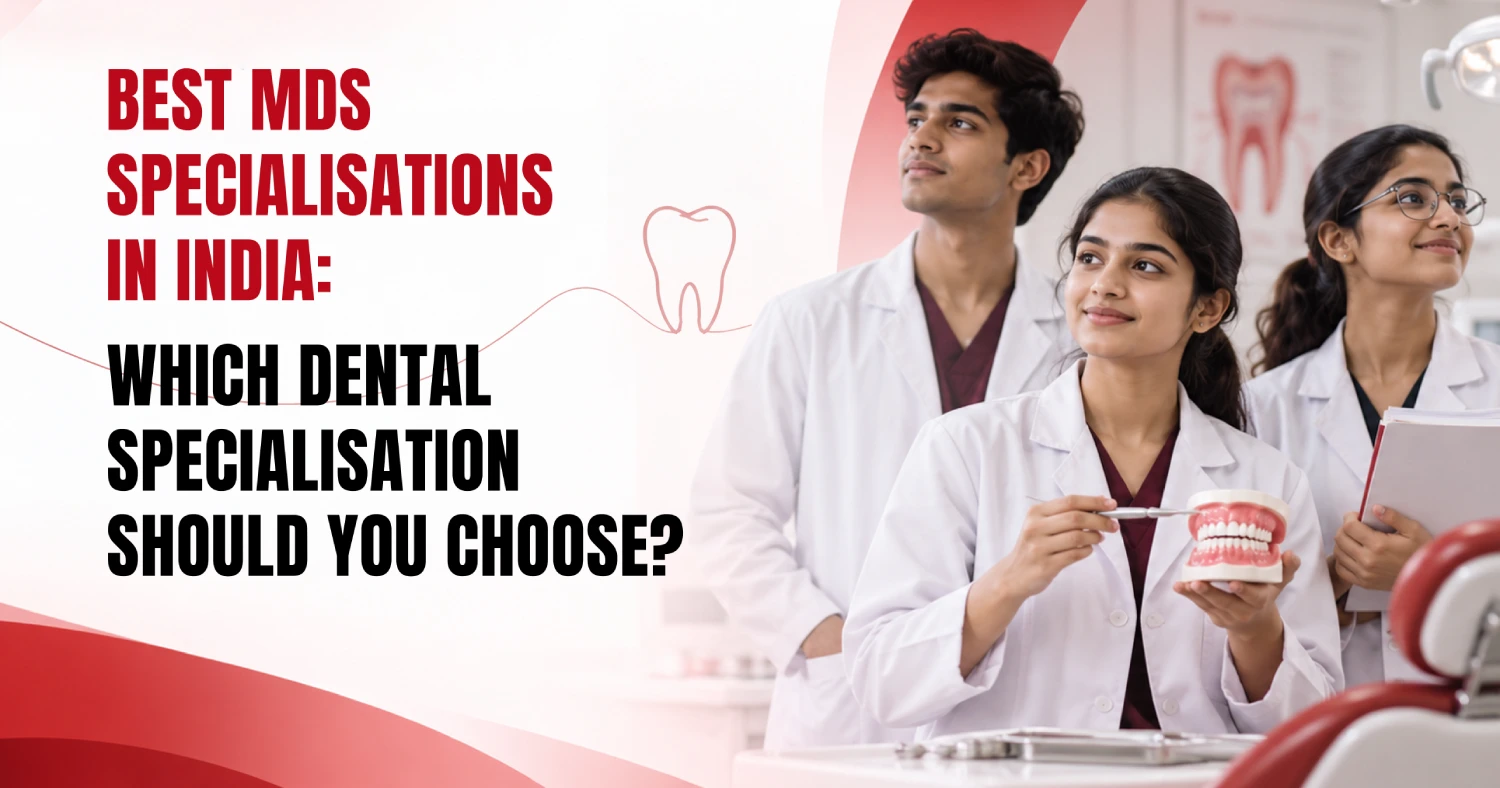
Every year, thousands of BDS graduates finish their internship and stare at the same question. Which branch of dentistry should they pick for the next three years of their life?
Here is the short answer. India recognises nine MDS dental specialisations, and the best one for a student depends on three simple things: the kind of work they enjoy, the patients they want to treat, and the practice they hope to run ten years from now.
One question that often comes up is whether one branch pays better than the rest. Money matters, of course. Yet ask any experienced dentist and they will tell you the same thing. The branch a student truly enjoys is usually the branch that pays them well in the long run.
This guide compares all nine branches side by side. It covers what each department does, who it suits, seat numbers, fee bands, salary ranges in India and abroad, and the career doors each branch opens. DJ College of Dental Sciences & Research in Modinagar, Ghaziabad, runs postgraduate departments in all nine of them, so students in Delhi NCR have every option on the table.
What Is MDS and Why Choose a Dental Specialisation?
MDS stands for Master of Dental Surgery. It is a three-year, full-time postgraduate degree that a dentist takes after BDS.
- The Dental Council of India (DCI) controls the course under the Dentists Act, 1948.
- Entry happens through NEET MDS, conducted by NBEMS. No state or college level exam is valid.
- A BDS graduate treats common dental problems. An MDS holder handles the difficult cases that other dentists refer.
- Specialists charge higher fees per case, teach in dental colleges and lead hospital departments.
- Teaching posts in Indian dental colleges are open only to MDS holders, which creates a second income route.
MDS course at a glance
| Point | Detail |
|---|---|
| Full form | Master of Dental Surgery |
| Course duration | 3 years, full time |
| Eligibility | BDS from a DCI-recognised college plus a completed 12-month internship and valid dental registration |
| Entrance exam | NEET MDS, conducted by NBEMS, single national test |
| NEET MDS 2026 exam date | 2 May 2026, computer based, 3 hours, 240 questions, 960 marks |
| NEET MDS 2026 application fee | Rs 3,500 for General, OBC and EWS; Rs 2,500 for SC, ST and PwD |
| Result date 2026 | 2 June 2026 |
| Recognised branches | 9 in total: 7 clinical and 2 non-clinical |
| Counselling bodies | MCC for All India Quota and deemed seats; state authorities for state quota |
MDS Specialisations Available in India
The DCI recognises nine branches. Seven of them involve daily patient treatment. Two are non-clinical and lean towards laboratory work, teaching and public health.
The nine MDS branches and what they actually do
| MDS Branch | Type | Main work |
|---|---|---|
| Orthodontics & Dentofacial Orthopaedics | Clinical | Braces, clear aligners, jaw growth correction |
| Oral & Maxillofacial Surgery | Clinical | Jaw fractures, impacted teeth, cysts, tumours, corrective jaw surgery |
| Prosthodontics, Crown & Bridge and Implantology | Clinical | Crowns, bridges, dentures, full-mouth rehabilitation, implants |
| Conservative Dentistry & Endodontics | Clinical | Root canals, fillings, veneers, smile correction |
| Periodontology & Oral Implantology | Clinical | Gum disease, bone support around teeth, implant placement |
| Paediatric & Preventive Dentistry (Pedodontics) | Clinical | Dental care for children, including special-needs children |
| Oral Medicine & Radiology | Clinical | Diagnosis without surgery, X-rays, CBCT scans, oral cancer screening |
| Oral Pathology & Microbiology | Non-clinical | Biopsy reading, microscope study, disease confirmation |
| Public Health Dentistry | Non-clinical | Camps, school programmes, surveys, health policy |
MDS Specialisations Compared at a Glance
Before picking a branch, it helps to know how small the postgraduate pool really is. India produces tens of thousands of BDS graduates each year, and only a fraction of them find an MDS seat.
MDS seat position in India, 2025-26
| Item | Number |
|---|---|
| Total MDS seats in India | 7,357 |
| DCI-approved colleges offering MDS | 276 |
| Government college seats | 977 (about 13.3 per cent) |
| Private college seats | 5,267 |
| Deemed university seats | 1,113 |
| MDS seats in Uttar Pradesh | 815 across 25 colleges |
| State with the most seats | Karnataka, 1,206 seats |
| Seats filled through MCC counselling | About 2,200, including roughly 1,326 All India Quota seats |
| Registered dentists in India | About 3.7 lakh |
The numbers explain the pressure. Around 7,357 postgraduate seats sit against a registered dentist population of about 3.7 lakh. That is why a specialist stays a small and much-needed group in every Indian city.
Branch-by-branch comparison for students
| Branch | Patient contact | Setup cost | Daily work style | Suits students who |
|---|---|---|---|---|
| Orthodontics | High, long term | High | Long chair sittings | are patient and plan ahead |
| Oral & Maxillofacial Surgery | High, surgical | Very high | Theatre and emergency hours | like surgery and hospital duty |
| Prosthodontics | Moderate to high | High, needs a lab | Lab plus chair work | enjoy design and precision |
| Conservative & Endodontics | High, daily | Moderate | Fine work under a microscope | have steady hands and sharp eyes |
| Periodontology | High | Moderate | Surgery plus follow-up visits | like long-term patient care |
| Paediatric Dentistry | High, children | Moderate | Short, lively sittings | are calm and friendly with kids |
| Oral Medicine & Radiology | Moderate | Low to moderate | Diagnosis and imaging rooms | like solving medical puzzles |
| Oral Pathology | Low | Low | Microscope and lab reports | prefer research and teaching |
| Public Health Dentistry | Community level | Low | Field visits and planning | like data, surveys and policy |
Which MDS Specialisation Matches Your Interests?
A simple way to decide is to look back at the BDS internship. The postings a student looked forward to say a lot.
Interest to branch matching guide
| If a student enjoys… | The branch to look at |
|---|---|
| Neat, artistic work with the hands | Conservative Dentistry & Endodontics |
| Long treatment plans and slow, visible results | Orthodontics & Dentofacial Orthopaedics |
| Surgery, trauma cases and hospital shifts | Oral & Maxillofacial Surgery |
| Digital scanning, implants and smile design | Prosthodontics, Crown & Bridge |
| Talking to patients and repeat follow-up care | Periodontology & Oral Implantology |
| Working with children and their parents | Paediatric & Preventive Dentistry |
| Reading X-rays and spotting early disease | Oral Medicine & Radiology |
| Microscopes, slides and writing papers | Oral Pathology & Microbiology |
| Health camps, surveys and government schemes | Public Health Dentistry |
Source: Career counselling notes used by Indian dental colleges, mapped against the DCI postgraduate syllabus.
A Closer Look at Each MDS Dental Branch
MDS in Orthodontics and Dentofacial Orthopaedics
- Works with braces, clear aligners and the growth of the jaws in children and adults.
- Treatment runs for 12 to 24 months, so the same patient returns many times.
- Adult aligner demand has grown sharply in Indian metros over the last few years.
- Suits students with patience, a steady eye and an interest in facial balance.
MDS in Oral and Maxillofacial Surgery
- Handles impacted wisdom teeth, jaw fractures, cysts, tumours and corrective jaw surgery.
- Works with hospital teams and often takes emergency calls at odd hours.
- It is the highest paid dental branch in the United States, with a median of about USD 352,220 a year (US Bureau of Labor Statistics, May 2025).
- Suits students who felt at home in the surgery posting during BDS.
MDS in Prosthodontics and Crown & Bridge
- Replaces missing teeth using crowns, bridges, dentures and dental implants.
- Intra-oral scanners and 3D printing have changed the way this branch works.
- An ageing population keeps the demand for tooth replacement steady across India.
- Suits students who care about shape, shade matching and laboratory detail.
MDS in Conservative Dentistry and Endodontics
- Covers root canal treatment, fillings, veneers and smile correction.
- Root canal treatment reports one of the highest average pay figures among dental skills in India, at around Rs 6 lakh a year (Collegedunia salary data).
- Daily work uses dental operating microscopes, magnification loupes and rotary systems.
- Suits students with very steady hands and strong attention to small detail.
MDS in Periodontology and Oral Implantology
- Treats gum disease, bone loss around teeth and places dental implants.
- India carries about 20.3 per cent of the world’s severe periodontal disease cases (WHO Global Oral Health Status Report, 2019 data), so patient numbers are huge.
- Mixes minor surgery with long counselling sessions on home care.
- Suits students who enjoy teaching patients and watching slow recovery.
MDS in Paediatric and Preventive Dentistry
- Treats children, including toddlers and children with special needs.
- India reported around 98 million cases of decay in milk teeth, the highest caseload in the world (WHO, 2019 data).
- Involves behaviour handling, parent counselling and early preventive care.
- Suits calm, cheerful students who genuinely like being around children.
MDS in Oral Medicine and Radiology
- Diagnoses oral disease without a scalpel, using history, X-rays and CBCT scans.
- Screens for oral cancer, a heavy burden in India because of tobacco and paan use.
- Clinic setup cost is lower than in the surgical branches.
- Suits students who like reasoning their way to an answer.
MDS in Oral Pathology and Microbiology
- Studies biopsy samples under the microscope and confirms the final diagnosis.
- One of the two non-clinical branches, so most roles sit in colleges, labs and research units.
- Closing ranks are usually easier than the clinical branches.
- Suits students aiming at a teaching post or a research career.
MDS in Public Health Dentistry
- Plans dental camps, school programmes, surveys and government projects.
- Connects directly with the National Oral Health Programme, running in India since 2014.
- Roles open up in government health units, NGOs, universities and policy bodies.
- Suits students who like planning, field work and working with numbers.
How to Choose the Right MDS Specialisation?
A student holding an MDS dental seat letter for three years cannot switch mid-way. So the choice deserves a few honest weeks of thought.
- Look back at the internship. The cases a student enjoyed are the truest signal.
- Be practical about the NEET MDS rank and the branches actually within reach.
- Compare the course fee against the earning start of that branch, not against a dream figure.
- Study the department, not only the college name. Faculty strength and daily patient numbers decide learning.
- Think about where the branch is practised. Surgery needs a hospital. Orthodontics needs a city clinic.
- Speak to two seniors in that branch, one in private practice and one in teaching.
Fee and stipend bands by seat type
| Seat type | Yearly tuition (approx.) | Monthly stipend |
|---|---|---|
| Government dental college | Rs 20,000 to Rs 1,00,000 | Rs 15,000 to Rs 30,000 |
| Private dental college | Rs 4,50,000 to Rs 8,50,000 | Varies by state and college |
| Deemed university | Rs 8,00,000 to Rs 25,00,000 | Usually not paid |
Which MDS Dental Branch Has the Toughest Competition?
- Clinical branches close at much better ranks than non-clinical ones.
- Orthodontics, Conservative Dentistry and Oral & Maxillofacial Surgery usually fill in the first counselling round.
- Oral Pathology, Public Health Dentistry and Oral Medicine often have seats open in later rounds.
- Closing ranks shift every year, so students should read the round-wise MCC and state data before locking a choice.
Career Opportunities After Different MDS Specialisations
An MDS opens three broad doors: private practice, hospital or corporate practice, and teaching. Government service adds a fourth.
Career roles branch by branch
| Branch | Common career roles |
|---|---|
| Orthodontics | Clinic owner, aligner consultant, visiting orthodontist, college faculty |
| Oral & Maxillofacial Surgery | Hospital consultant, trauma unit surgeon, implant surgeon, defence services |
| Prosthodontics | Full-mouth rehabilitation specialist, implant prosthodontist, dental lab lead |
| Conservative & Endodontics | Endodontist in a multi-speciality clinic, microscope-based practice, faculty |
| Periodontology | Periodontist, implantologist, gum care unit head, faculty |
| Paediatric Dentistry | Children’s dental clinic, school health programme lead, hospital pedodontist |
| Oral Medicine & Radiology | Diagnostic centre consultant, oral cancer screening unit, tele-radiology |
| Oral Pathology | Laboratory consultant, professor, research fellow, forensic odontology |
| Public Health Dentistry | Government dental officer, NGO programme lead, epidemiologist, policy adviser |
Beyond these, MDS holders apply to the Armed Forces Dental Corps, Railways, ESIC hospitals, corporate dental chains and overseas licensing routes.
MDS Specialisation and Salary Expectations
Salary depends on the city, the number of chairs, and whether a dentist works as an employee or owns the clinic. The tables below show published averages, not promises.
Average salary in India by MDS branch
| Role after MDS | Average annual salary (Rs) | Entry level (Rs) | After 5+ years (Rs) |
|---|---|---|---|
| Orthodontist | 6,00,000 | 6,30,000 | 12,00,000 to 13,00,000 |
| Endodontist | 6,00,000 to 7,00,000 | 5,00,000 | 12,00,000 to 14,00,000 |
| Prosthodontist | 4,90,000 to 5,00,000 | 5,00,000 | 12,50,000 to 14,00,000 |
| Periodontist | 4,10,000 to 6,40,000 | 4,20,000 | 12,00,000 to 13,50,000 |
| Oral & Maxillofacial Surgeon | 5,70,000 to 6,00,000 | 5,20,000 | 10,00,000 to 12,00,000 |
| Paediatric Dentist | 5,60,000 to 6,00,000 | 5,00,000 | 10,00,000 to 12,00,000 |
| Oral Pathologist | 4,00,000 | 5,00,000 | 9,00,000 to 10,00,000 |
| Dental college faculty | 5,00,000 | 5,00,000 | 9,00,000 to 10,00,000 |
Many Indian graduates also look overseas, which is why the next table converts foreign pay into rupees in a separate column.
United States median pay for dental specialists, converted to Indian rupees
| Speciality | Median pay in the USA (USD, May 2025) | Same amount in INR | In rupee crore |
|---|---|---|---|
| Oral & Maxillofacial Surgeons | USD 352,220 | Rs 3,32,49,568 | About Rs 3.32 crore |
| Prosthodontists | USD 311,180 | Rs 2,93,75,392 | About Rs 2.94 crore |
| Orthodontists | USD 289,140 | Rs 2,72,94,816 | About Rs 2.73 crore |
| Dentists, all other specialists | USD 224,990 | Rs 2,12,39,056 | About Rs 2.12 crore |
| General dentists | USD 170,950 | Rs 1,61,37,680 | About Rs 1.61 crore |
Two points stand out from the salary tables. First, mds dental specialists in India start close to a general dentist and pull ahead sharply after the fifth year. Second, the branch matters less than the practice a dentist builds around it.
MDS Dental Colleges in Delhi NCR: What Students Should Check
Delhi NCR draws postgraduate students from across north India. Patient numbers are high, travel links are easy, and referral practice grows faster in a large city.
- Uttar Pradesh alone offers 815 MDS seats across 25 colleges (DCI, 2025-26), and several of these sit inside Delhi NCR.
- Check DCI approval and the university affiliation before anything else.
- Ask for department-wise daily patient numbers. A postgraduate learns from case volume.
- Count the faculty in the chosen department, not in the whole college.
- Look at published papers from that department. Research output shows an active unit.
Among the MDS dental colleges in Delhi NCR, DJ College of Dental Sciences & Research is one of the older private institutions and runs postgraduate teaching in all nine branches.
DJ College of Dental Sciences & Research at a glance
| Point | Detail |
|---|---|
| Established | 1999, over 25 years of dental education |
| Location | Modinagar, Ghaziabad, Delhi NCR, Uttar Pradesh |
| Approval | Dental Council of India (DCI) |
| Affiliation | Atal Bihari Vajpayee Medical University, Lucknow |
| Campus | 75-acre campus |
| Programmes | BDS and MDS |
| MDS departments | All 9 branches, from Orthodontics to Public Health Dentistry |
| Daily patient load | 100+ patients per department every day |
| Student mix | Students from 17+ countries |
| Support | Scholarships, career support and academic mentoring |
Choosing the Right MDS Path
There is little doubt that every branch of dentistry has good years ahead. India carries one of the heaviest oral disease burdens in the world, and specialist care is still thin outside the big cities.
- No single branch is best for everyone. The best branch is the one a student will still enjoy at forty.
- Match four things: interest, NEET MDS rank, family budget and the working life wanted later.
- Clinical branches suit students who want patients. Non-clinical branches suit students who want research and teaching.
- Check the department and the patient numbers before the brochure and the brand.
A student who lines up those four points will pick the right MDS dental path, and the fees, the ranks and the long study hours will all feel worth it.
FAQs About MDS Specialisations
1. What is the MDS course duration in India?
An mds dental course runs for three years, full time, after BDS. It is a postgraduate degree recognised by the Dental Council of India.
2. Which MDS specialisation is best in India?
There is no single best branch. Orthodontics, Oral and Maxillofacial Surgery, Conservative Dentistry and Prosthodontics see the highest demand from students. The right branch for any student is the one that matches interest, NEET MDS rank and budget.
3. What is the eligibility for MDS in India?
A BDS degree from a DCI-recognised college, a completed 12-month internship, valid registration with the DCI or a State Dental Council, and a qualifying NEET MDS score.
4. How many MDS seats are there in India?
About 7,357 MDS seats across 276 DCI-approved dental colleges for 2025-26. Of these, 977 sit in government colleges, 5,267 in private colleges and 1,113 in deemed universities.
5. Which MDS branch has the highest salary?
In India, Orthodontics, Endodontics and Oral and Maxillofacial Surgery report the highest averages. In the United States, oral and maxillofacial surgeons top the list at a median of USD 352,220 a year, which is about Rs 3.32 crore.
6. Is NEET MDS compulsory for MDS admission?
Yes. NEET MDS is the only valid entrance test for MDS admission in India. No state level or college level exam is accepted.
7. Which MDS branches are non-clinical?
Oral Pathology and Microbiology, and Public Health Dentistry. Both suit students who plan a career in teaching, research or health policy.
8. Which MDS specialisations does DJ College of Dental Sciences & Research offer?
All nine branches: Oral Medicine and Radiology; Conservative Dentistry and Endodontics; Prosthodontics, Crown & Bridge and Implantology; Periodontology and Oral Implantology; Oral Pathology and Microbiology; Orthodontics and Dentofacial Orthopaedics; Paediatric and Preventive Dentistry; Oral and Maxillofacial Surgery; and Public Health Dentistry.
9. Can an MDS graduate work abroad?
Yes, after clearing the licensing route of that country. Common examples are the INBDE and the ADA advanced standing route in the United States, and the Overseas Registration Exam in the United Kingdom.
10. Which MDS branch is easiest to get?
Non-clinical branches such as Oral Pathology and Public Health Dentistry usually close at lower ranks. Closing ranks change every year, so students should read the round-wise MCC and state counselling data.
Related Posts