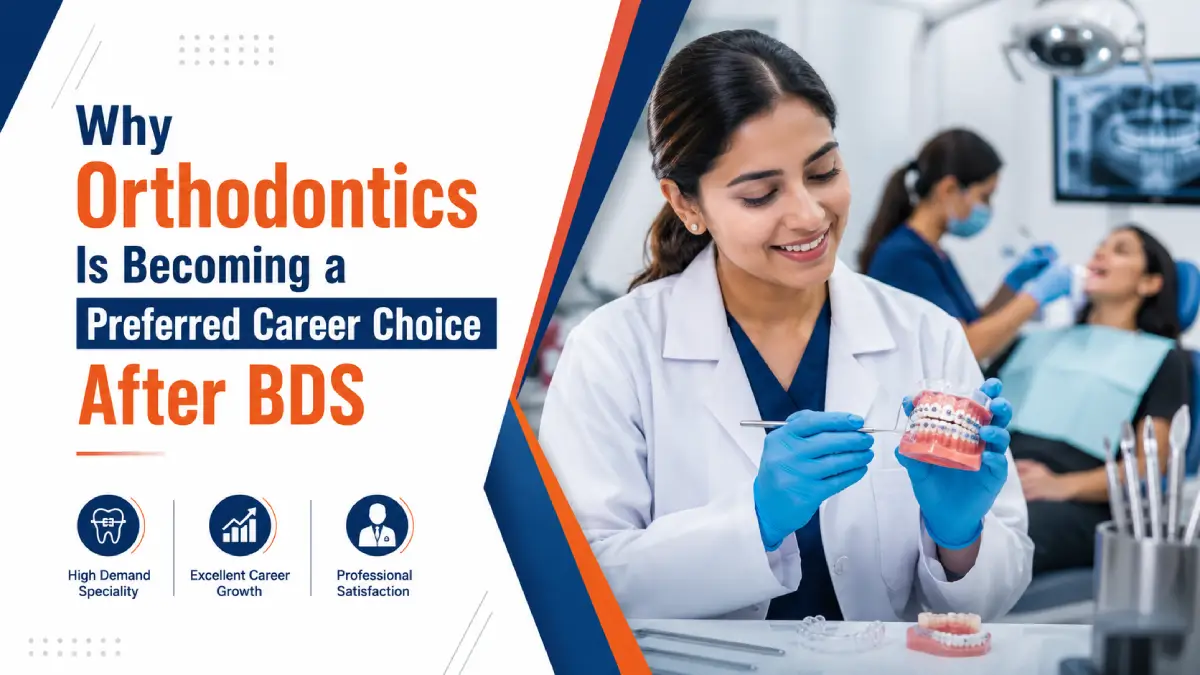
Every year, thousands of BDS graduates in India reach the same fork in the road: general practice, or a specialisation that sets them apart for the next thirty years of their working life. Increasingly, the answer is orthodontics. An orthodontics career after BDS now draws some of the strongest NEET-MDS scorers in the country, and the reasons are not just about straighter teeth they are about patient volume, income ceiling, and how the dental market itself is changing. This piece looks at why a career after BDS orthodontics has become so competitive, what the numbers actually show, and how a dental college’s infrastructure shapes whether that specialisation pays off in real clinical skill.
What’s Driving the Shift Toward Orthodontics?
Orthodontics corrects the position of teeth and jaws crowding, gaps, and bite problems using braces, aligners, and other appliances. At the postgraduate level this is the MDS in Orthodontics and Dentofacial Orthopaedics, a three-year programme after BDS. Several forces are pushing more graduates to choose it.
| Driver | What It Means for a Graduate |
| Rising aesthetic demand | Adults, not just teenagers, now seek treatment, widening the patient base. |
| Clear aligner adoption | Aligners have made orthodontic treatment socially easier to accept, encouraging more patients who once avoided visible braces. |
| Steady, repeat patient flow | Orthodontic treatment typically lasts several months to years, providing clinics with predictable, recurring revenue. |
| High specialist standing | Orthodontists are widely recognised as senior dental specialists by both patients and fellow professionals. |
| Private practice viability | Orthodontics is one of the most suitable dental specialisations for establishing a successful independent practice. |
Know More: Clear Aligners or Traditional Braces: What Should Future Dentists Know?
Is the Demand for an Orthodontics Career After BDS Backed by Data?
The market numbers explain much of the pull. India’s clear aligner segment was valued at roughly USD 96 million in 2022 and is projected to reach close to USD 967 million by 2030, a compound annual growth rate above 30%, according to industry research. That growth is underpinned by a simple clinical fact: studies estimate malocclusion, or poorly aligned teeth, affects roughly a third of Indian children aged 8 to 15.
| Data Point | Approximate Figure |
| India clear aligner market, 2022 | USD 96 million |
| India clear aligner market, 2030 (projected) | USD 967 million |
| Projected annual growth rate | 30%+ |
| Malocclusion prevalence (children, 8–15 years) | ~35% |
A patient base of this size is exactly why an orthodontics career after BDS looks financially sound over a 20–30 year working life, even though it means three additional years of study and a higher upfront course fee than general practice. The shift is also generational: patients who grew up with visible metal braces as teenagers are now, as adults, more willing to pay for discreet correction, and social media has normalised orthodontic treatment as routine self-care rather than a childhood-only procedure. That combination of adult demand and youth demand is unusual among dental specialisations and is a large part of why orthodontics now competes with oral surgery for the top NEET-MDS ranks.
MDS in Orthodontics: Course, Duration and Entry
Admission to MDS in Orthodontics is through NEET-MDS. Candidates need a BDS degree from a DCI-recognised college and completion of the mandatory one-year rotatory internship. The programme itself runs three years and covers diagnosis, treatment planning, appliance therapy, and hands-on patient management. Because seats in orthodontics are limited at most colleges often three to six per institution, competition for this specialisation route is consistently sharper than for several other MDS specialisations. Strong clinical exposure during the BDS years, not just NEET-MDS marks, is what tends to separate successful applicants from the rest.
Know More: The Future of Dentistry in India: Why BDS Remains a Smart Career Choice in 2026
What Can an Orthodontist Earn in India?
Income varies by city, experience, and whether the orthodontist works in a hospital, a corporate dental chain, or an independent clinic. The ranges below are indicative and vary significantly by location and patient volume.
| Experience Level | Approximate Annual Income |
| Entry level (0–2 years) | ₹4 lakh – ₹6 lakh |
| Mid-level (3–6 years) | ₹7 lakh – ₹12 lakh |
| Senior (7+ years) | ₹12 lakh – ₹20 lakh+ |
| Established private practice | Can exceed ₹20 lakh, depending on patient volume and city. |
Career Paths Open to an MDS Orthodontist
An MDS in Orthodontics does not lead to a single job type; it opens several tracks, and many orthodontists combine more than one over a career.
| Career Path | Typical Setting | Main Focus |
| Private practice | Own or partner clinic | Braces, aligners, retainers |
| Hospital orthodontist | Multispeciality hospital | Complex cases, interdisciplinary care |
| Academics | Dental college faculty | Teaching and research |
| Corporate dental chains | Clinic networks | High patient volume, structured roles |
| Aligner and dental-tech companies | Product and treatment-planning teams | Digital treatment planning, R&D |
Know More: How BDS Colleges in Delhi Shape Modern Dental Technology?
How Much Does MDS in Orthodontics Cost?
Private dental colleges typically charge more for MDS in Orthodontics than for several other specialisations, given the equipment and chair-time involved. Fees generally run higher than the BDS programme itself, and vary by college and state fee committee, students comparing options should always confirm the current, official figure directly with each college’s admissions office rather than relying on aggregator estimates, which frequently disagree with one another.
How DJ College of Dental Sciences & Research Supports Orthodontics Aspirants
For students planning a career after BDS orthodontics, the college chosen for BDS matters almost as much as the MDS seat itself, since early patient exposure shapes how competitive an NEET-MDS application eventually looks. DJ College of Dental Sciences & Research (DJCDSR), Modinagar, has offered dental education for over 25 years and holds recognition from the Dental Council of India.
| DJCDSR Snapshot for Orthodontics Aspirants | Detail |
| Established | 1999 — over 25 years of dental education |
| MDS specialisations offered | 9, including Orthodontics & Dentofacial Orthopedics |
| Orthodontics MDS seats | 6 |
| Affiliation | Atal Bihari Vajpayee Medical University (ABVMU), Lucknow |
| Attached hospital | 300-bed multispeciality hospital with daily patient inflow across departments |
| Clinical infrastructure | CBCT and CAD/CAM lab, digital diagnostics, dedicated skill labs |
| Faculty & research | 110+ faculty members; 800+ published research papers |
| Global reach | Students from 17 countries |
The Orthodontics & Dentofacial Orthopedics department page has details on faculty and the specific clinical exposure available to both BDS and MDS students in the department.
Know More: What Sets the Best Private Dental Colleges in UP Apart?
Is an Orthodontics Career After BDS Right for You?
Before committing to the NEET-MDS route, weigh it against these questions:
| Question to Ask Yourself | Why It Matters |
| Am I comfortable with long, multi-visit treatment plans? | Orthodontic cases run months to years, unlike single-sitting procedures |
| Do I enjoy detailed, precision-based work? | Appliance therapy rewards patience and fine motor accuracy |
| Can I commit to three additional years of study and cost? | MDS fees and forgone income add up before practice begins |
| Is my BDS college’s patient exposure strong enough to build a competitive NEET-MDS profile? | Hands-on case experience matters as much as marks |
Know More: What to Do After a BDS in UP? A Complete Guide to Career Possibilities
Frequently Asked Questions
Why is orthodontics becoming a preferred career after BDS?
Rising aesthetic demand, clear aligner adoption, and steady repeat patient flow have made an orthodontics career after BDS one of the more financially stable specialisations, alongside the professional standing that comes with a recognised specialty.
How many years does an orthodontics career after BDS require in additional study?
MDS in Orthodontics and Dentofacial Orthopaedics runs three years after BDS, on top of the five-year BDS programme including internship.
Is the demand for orthodontists genuinely growing in India?
Yes. India’s clear aligner market alone is projected to grow from roughly USD 96 million in 2022 to close to USD 967 million by 2030, reflecting a rapidly widening patient base for orthodontic treatment.
What entrance exam is required for a career after BDS orthodontics?
Admission to MDS in Orthodontics is through NEET-MDS, and requires a BDS degree from a DCI-recognised college plus completion of the mandatory internship.
Does DJ College of Dental Sciences & Research offer MDS in Orthodontics?
Yes. DJCDSR offers MDS in Orthodontics & Dentofacial Orthopedics among its 9 MDS specialisations, alongside a 300-bed attached hospital for clinical exposure.
Is orthodontics a better career after BDS than general dentistry?
An orthodontics career after BDS typically brings higher income potential and professional standing than general practice, but it requires three more years of study and a higher course investment; general dentistry offers a faster, lower-cost route to independent practice.
In Short
An orthodontics career after BDS is gaining ground because the numbers support it: a growing patient base, rising acceptance of clear aligners, and a specialisation that commands both income and professional respect. A career after BDS orthodontics is not a decision to make on demand data alone, though the BDS college a student attends first should offer enough patient exposure and clinical infrastructure to make a competitive NEET-MDS application realistic. DJ College of Dental Sciences & Research, with over 25 years of dental education and 6 MDS Orthodontics seats attached to a 300-bed hospital, is built around exactly that kind of exposure.
Related Posts