A bright smile can lift a person’s mood. But can it also build a strong career? For thousands of students across India, the answer in 2026 is a simple yes. Dentistry is growing fast. Better tools, more patients, and higher pay have made the Bachelor of Dental Surgery, known as BDS, one of the most respected paths in healthcare. Stepping into the field of dentistry sounds good, and the curiosity about the future and job options often stays on the minds of young aspirants and their parents. Many families begin their search by looking up dental colleges in Delhi and the wider Delhi NCR belt, where some of North India’s oldest dental institutions are based. This blog explains why BDS is still a smart pick, what the future holds, and how a college such as DJ College of Dental Sciences and Research prepares students for real clinical work. The short answer is this. The demand is real, the technology is exciting, and skilled dentists are in a good place.
Why is dentistry a growing career in India?
Dentistry is growing because India has a large need for oral care and a market that keeps getting bigger. Studies show that dental decay affects a big share of people in the country. At the same time, awareness about healthy teeth is rising, and more families now spend on dental treatment. This is one big reason why students choose dentistry as a career. It also explains why so many aspirants look at dental colleges in Delhi and other big cities.
The numbers below show how the field looks now.
| Indicator | Figure (latest) | Source |
| Dental colleges in India | Around 329 | Dental Council of India |
| BDS seats each year | Over 27,600 | Dental Council of India |
| Registered dentists | 3,76,721 | Dental Council of India via ORF |
| Dentist to population ratio | About 1 : 3,846 | ORF, 2025 |
| India dental services market, 2024 | About USD 29.6 billion | Market Research Future |
| Projected market by 2035 | About USD 58.7 billion | Market Research Future |
There is another side to this story. India now has many dentists, so cities can be competitive. The best jobs go to dentists with strong clinical skills and, often, a postgraduate degree. Government efforts such as the National Oral Health Programme, growth in dental insurance, and rising demand for cosmetic work also add fresh openings. India has even become a well known place for dental tourism, as patients from abroad come here for good care at lower cost.
Know More: How BDS Colleges in Delhi Shape Modern Dental Technology?
What is BDS and who can study it?
BDS is the main undergraduate degree in dentistry. The course runs for five years. This includes four years of study and one year of paid internship. The programme is regulated by the Dental Council of India.
To join, a student must pass Class 12 with Physics, Chemistry, and Biology, and score at least 50 percent in these subjects. A valid NEET UG score is a must for admission. Students who explore dental courses in Delhi and Delhi NCR will find BDS as the first step, with MDS for specialisation later. It is worth noting that when people search for dental colleges in Delhi, they usually mean the whole Delhi NCR region, which includes areas such as Ghaziabad, Noida, and Meerut.
The early years cover basic science, such as anatomy, physiology, and dental materials. The later years move to real patients, where students learn to diagnose and treat under expert care.
Know More: What is Preventive Dentistry? Knowing Common Dental Problems That Can Be Prevented
How is dental technology changing the future of BDS?
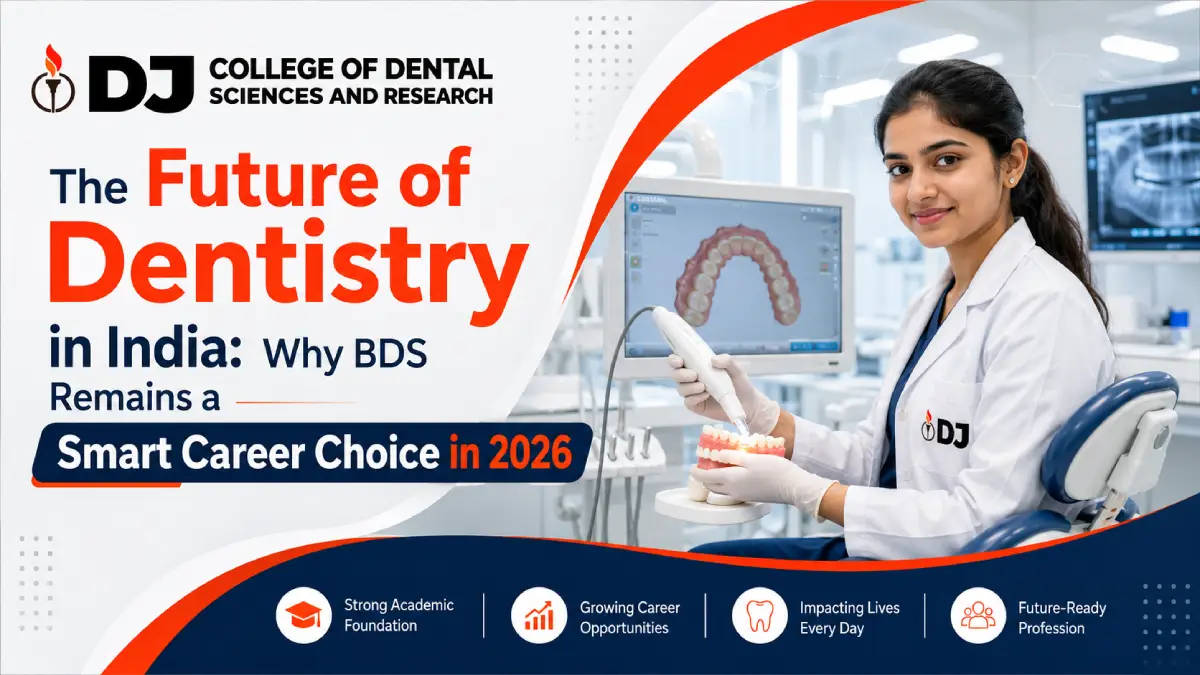
Dental technology has changed a lot, and this shapes the BDS future in a good way. Clinics now use digital X-rays, mouth scanners, and computer guided tools. These make treatment faster, safer, and more accurate.
Reports show that India’s dental equipment market is set to grow at a healthy rate, and the use of artificial intelligence in dentistry is rising even faster. AI can now help spot early decay in X-rays. So new dentists must learn on modern machines to stay ahead.
| Task | Older method | Newer method in 2026 |
| Dental X-ray | Film based | Digital radiography |
| Taking impressions | Putty moulds | Intraoral scanners |
| Crowns and bridges | Manual lab work | CAD and CAM with 3D printing |
| Treatment planning | Manual notes | AI supported software |
| Braces | Metal only | Clear aligners as an option |
This is why the choice of college matters. A college with modern labs gives students real practice with the tools they will use at work. DJ College of Dental Sciences and Research provides CAD and CAM machines, digital radiography, and simulation labs for this reason.
Know More: What Sets the Best Private Dental Colleges in UP Apart?
What career paths can a BDS graduate choose?
A BDS degree opens many doors. A graduate is not limited to one type of job. The table below shows the common paths and what each one looks like.
| Career path | What the work looks like | Indicative early pay per year |
| Private clinic | Own or join a local clinic | About 3 to 6 lakh |
| Corporate dental chain | Work with chains like Clove Dental | About 5 to 12 lakh |
| MDS specialist, after PG | Ortho, surgery, prostho, and more | About 15 lakh and above |
| Government, defence, railways | Public hospitals and services | As per pay scale |
| Teaching and research | Colleges and institutes | As per role |
| Practice abroad | UK, US, or Australia after exams | Varies by country |
Many students also move into MDS after BDS. A specialist in fields such as orthodontics or oral surgery can earn much higher fees. Others work in government service, the defence forces, railways, teaching, or public health. Some dentists clear licensing exams and practise in the UK, the US, or Australia.
Know More: What to Do After a BDS in UP? A Complete Guide to Career Possibilities
Why do students choose DJ College of Dental Sciences and Research?
Among the dental colleges in Delhi and its NCR region, DJ College of Dental Sciences and Research stands out for its long record and strong clinical training. These are the main reasons students and parents pick this college.
A legacy built over 25 years
The college has served dental education since 1999. That is over twenty five years of steady work.
• Established in 1999 and recognised by the Dental Council of India.
• Affiliated with Atal Bihari Vajpayee Medical University, Lucknow.
• Counted among the top dental colleges in Uttar Pradesh and the Delhi NCR region.
• A Sikh minority institute with a strong value system.
A large campus with real patient exposure
Good dentists are made through practice on real cases. This college gives students plenty of it.
• A large residential campus spread across seventy five acres.
• Over 100 patients per department each day, which means rich clinical exposure.
• Advanced labs with digital academic support.
• A hospital setup that gives wide case variety.
Faculty, research, and global reach
Learning improves with good teachers and a research mindset. The college supports both.
• Experienced and well qualified faculty across departments.
• An active research and publication culture, including the college journal.
• A global student presence, with students from 17 or more countries.
• Notable memberships, such as the American Academy of Developmental Medicine and Dentistry.
Support that helps students grow
Money and guidance should not block a good student. The college offers help on both fronts.
• Scholarships of up to one lakh rupees for deserving students.
• Career and placement support with known dental recruiters.
• BDS and MDS programmes with nine specialisations.
• A holistic approach that looks after overall growth.
Know More: Why Do BDS Graduates Prefer DJ College of Dental Sciences for Postgraduate Study?
How should students compare dental colleges in Delhi and Delhi NCR?
A college name alone should not decide the choice. Families comparing dental colleges in Delhi and Delhi NCR should look at clear factors. The checklist below can help.
| What to check | Why it matters | At DJ College |
| DCI recognition | Keeps your degree valid | Recognised by the DCI since 1999 |
| Patient volume | More cases build better skills | Over 100 patients per department each day |
| Campus and labs | Modern tools shape learning | 75 acre campus, CAD and CAM, digital radiography, simulation labs |
| Faculty | Good mentors build good dentists | Experienced and qualified faculty |
| Specialisations | Room to grow after BDS | BDS and MDS in nine specialties |
| Support | Fees help and career guidance | Scholarships up to one lakh rupees and placement help |
Among the dental colleges in Delhi and its NCR region, several well known names come up, such as ITS Dental College, IDST, Inderprastha Dental College, Santosh Dental College, Subharti Dental College, and KD Dental College. The wise step is to compare them on clinical exposure, faculty, labs, and results, and then decide.
Which BDS specialisations can students pursue?
After BDS, a student can pick a specialisation through MDS. Among dental courses in Delhi NCR, BDS is the main undergraduate route and MDS is the postgraduate one. DJ College offers MDS in nine fields. The table shows what each one covers.
| Specialisation | Focus area |
| Oral Medicine and Radiology | Diagnosis and dental imaging |
| Conservative Dentistry & Endodontics | Fillings and root canals |
| Prosthodontics, Crown & Bridge & Implantology | Replacing missing teeth |
| Periodontology & Oral Implantology | Gums and implants |
| Oral Pathology & Microbiology | Study of disease in the mouth |
| Orthodontics & Dentofacial Orthopaedics | Braces and alignment |
| Paediatric & Preventive Dentistry | Dental care for children |
| Oral & Maxillofacial Surgery | Surgery of the mouth and jaw |
| Public Health Dentistry | Community oral health |
Know More: Why Is Dental Education in Uttar Pradesh Booming in 2026?
Is BDS a smart choice in 2026?
Yes. The demand for dental care is rising, the technology is modern, and the pay for skilled dentists is fair. For students who compare dental colleges in Delhi and Delhi NCR, the mix of steady demand, new tools, and strong clinical training makes BDS a wise pick. A college such as DJ College of Dental Sciences and Research, with its long record and large patient base, gives new dentists a solid start. The future of dentistry in India looks bright, and BDS remains a smart way to be part of it.
Frequently Asked Questions (FAQs)
Is BDS a good career in 2026?
Yes. Dentistry is growing, and skilled dentists find good work in clinics, chains, government service, and abroad. A postgraduate degree can raise pay further.
What is the future of dentistry in India?
The future looks strong. The dental market is growing, new tools like AI and 3D printing are common, and demand for cosmetic and preventive care keeps rising.
What is the eligibility for BDS?
A student needs Class 12 with Physics, Chemistry, and Biology, at least 50 percent marks in these subjects, and a valid NEET UG score.
How long is the BDS course?
BDS takes five years. This is four years of study plus one year of paid internship.
Is NEET required for BDS admission?
Yes. NEET UG is a must for BDS admission in India, in both government and private colleges.
What can a student do after BDS?
A graduate can start a clinic, join a dental chain, sit for MDS, work in government or defence, teach, do research, or practise abroad after exams.
How is technology changing dentistry?
Clinics now use digital X-rays, mouth scanners, CAD and CAM machines, 3D printing, and AI tools. These make care faster and more accurate.
Is DJ College of Dental Sciences and Research recognised by the DCI?
Yes. The college is recognised by the Dental Council of India and is affiliated with Atal Bihari Vajpayee Medical University, Lucknow.
Where is DJ College of Dental Sciences and Research located?
It is located in Modinagar, in the Ghaziabad district of Uttar Pradesh, within the Delhi NCR region.
What specialisations does DJ College offer?
The college offers MDS in nine fields, including orthodontics, oral surgery, prosthodontics, periodontology, and more.
Are scholarships available at DJ College?
Yes. The college offers scholarships of up to one lakh rupees for deserving students.
How should a student choose among dental colleges in Delhi NCR?
Compare colleges on DCI recognition, patient volume, labs, faculty, specialisations, and support, rather than name alone.
Related Posts