Every year, thousands of students in India dream of wearing a white coat and helping people smile again. But dentistry is not the field it was ten years ago. New machines, digital scans, and smart software have changed how future dentists learn and practise. This shift is one big reason why so many families now compare BDS colleges in Delhi and the wider National Capital Region before they pick a seat.
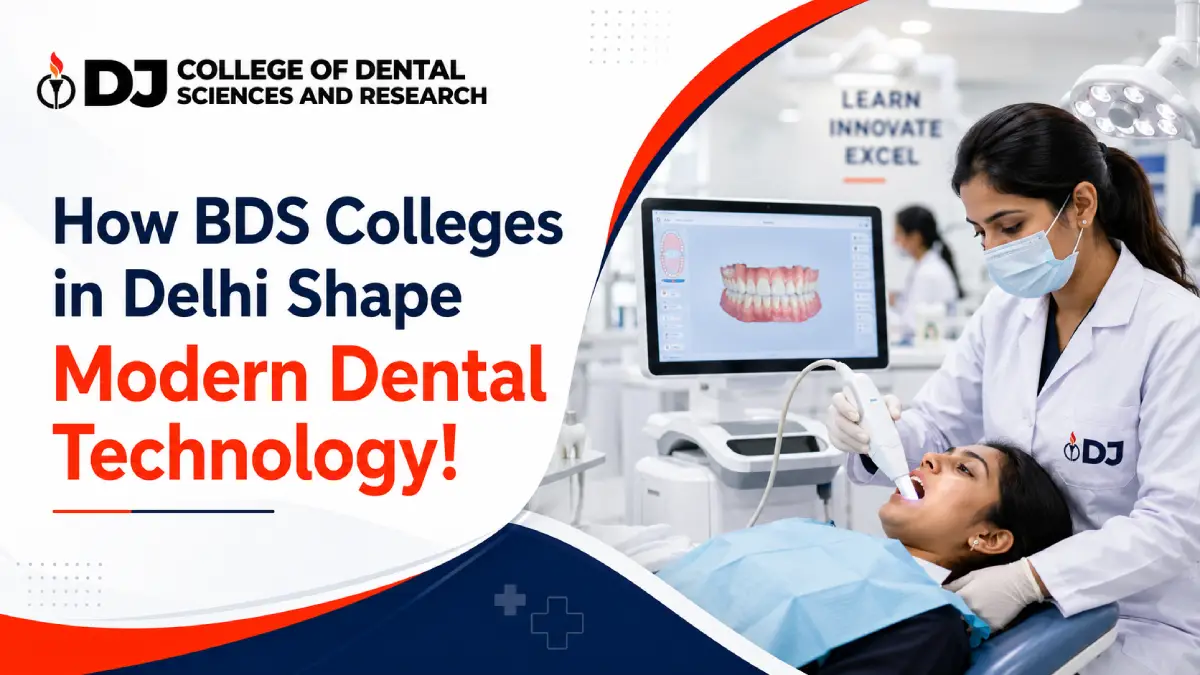
So, what does modern dental technology mean for a BDS student in Uttar Pradesh? In simple terms, it means learning on the same tools that real clinics already use. Students scan teeth on a screen, plan treatment in 3D, and see results in minutes, not days. This makes them ready for work much sooner.
This article looks at how new dental technology is changing dental education in UP. It also shows what students and parents should check before they choose a college, and why DJ College of Dental Sciences & Research keeps its name among the well-known dental colleges in the region. Curious about the future of a BDS career? Read on.
Why Do So Many Students Pick Dentistry as a Career?
Dentistry mixes science, skill, and care for people. A dentist can run a clinic, join a hospital, teach, or take up research. The path is also clear. A student finishes a five-year BDS degree, and then works or studies further.
There is one more reason why students choose dentistry. India already has one of the largest groups of dentists in the world. Yet good dental care still does not reach many rural areas. This gap means skilled dentists are still needed where people have few options. Strong training, not luck, decides who does well.
Know More: What is Preventive Dentistry? Knowing Common Dental Problems That Can Be Prevented
How Is New Dental Technology Reshaping Dental Education?
Old dental training leaned on plaster moulds, hand tools, and long waits for lab work. Modern dental education is faster and more visual. Students now use digital X-rays, 3D scanners, and design software from their early years. The table below shows how the old way compares with the digital way.
| Area | Old way | Digital way |
| Taking impressions | Plaster moulds and trays | Intraoral scanners on a screen |
| X-rays and imaging | Film X-rays | Digital X-rays and CBCT 3D scans |
| Making crowns and caps | Sent to an outside lab, long wait | CAD/CAM design and same-visit milling |
| Practice before patients | A few plaster models | Simulation labs that copy real cases |
| Treatment planning | On paper, by hand | 3D software with clear visuals |
These tools help students learn quicker and make fewer mistakes. Reports also note that artificial intelligence now supports dentists as they read scans and spot problems early. Money tells its own story too. Spending on digital dental tools in India keeps rising each year.
Know More: What Sets the Best Private Dental Colleges in UP Apart?
Digital dentistry growth in India and the world
| Measure | Value | Source |
| India digital dentistry market (2023) | About USD 47.6 million | iData Research |
| India dental CAD/CAM market (2024 to 2035) | USD 66 million to USD 148 million | Market Research Future |
| Global digital dentistry market (2026 to 2031) | USD 10.53 billion to USD 16.67 billion | Mordor Intelligence |
| Rise in cosmetic dental work in India (5 years) | Around 30 percent | Indian Academy of Aesthetic Dentistry |
Asia is the fastest-growing region for these tools, and India is a large part of that rise. For a BDS student, that means one thing. The colleges that teach on modern equipment give a real head start.
What Should You Look For in BDS Colleges in Delhi and the NCR Belt?
Many students type BDS colleges in Delhi into a search bar. In real life, most good dental colleges near the capital sit in the wider National Capital Region. This belt covers Ghaziabad, Greater Noida, Meerut, and nearby towns in Uttar Pradesh.
So what matters when you compare BDS private colleges in Delhi and the NCR? A few points stand out:
● Recognition by the Dental Council of India (DCI), so your degree stays valid
● Modern labs with CAD/CAM, CBCT, and simulation units
● High patient numbers, which give real clinical practice
● Skilled and qualified faculty
● Scholarships and steady career support
The table below puts dental education in India and Uttar Pradesh side by side.
Dental education in India and Uttar Pradesh at a glance
| Point | India | Uttar Pradesh |
| Dental colleges | Around 329 | 27 |
| BDS seats (approx.) | Around 27,900 per year | About 2,403 |
| Share in private colleges | About 82 percent | 22 of 27 are private |
| Registered dentists (India) | Over 3.7 lakh | Part of the national pool |
Know More: Why Do BDS Graduates Prefer DJ College of Dental Sciences for Postgraduate Study?
What Makes DJ College of Dental Sciences & Research Stand Out?
DJ College of Dental Sciences & Research sits in Modinagar, Ghaziabad, inside the Delhi NCR belt. It opened in 1999 and is one of the oldest and largest private dental colleges in Uttar Pradesh. This is one reason it ranks among the better-known BDS colleges in Delhi NCR. The points below show why students from many states and countries pick it.
A Legacy That Speaks for Itself
The college has built its name over more than two decades.
● Over 25 years of work in dental education, since 1999
● Recognised by the Dental Council of India (DCI)
● Counted among the top dental colleges in UP and Delhi NCR
● A global student mix from over 17 countries
A Campus Built for Hands-On Learning
Good tools make a big difference in a clinical course.
● A large 75-acre campus with room to grow
● Advanced labs with CAD/CAM machines, CBCT, and digital X-rays
● Modern simulation labs and smart classrooms
● Strong digital support for study and research
Real Patients and Real Practice
Nothing beats practice on real cases.
● Over 100 patients per department each day
● Highly experienced and qualified faculty
● Nine clinical departments across all main specialities
● A steady culture of research and publication
Support Beyond the Classroom
Learning also needs care and guidance.
● Scholarships of up to ₹1,00,000 for deserving students
● Career support and holistic growth for every student
● BDS and MDS options with many specialisations
● A friendly, safe, and well-planned residential campus
Know More: What to Do After a BDS in UP? A Complete Guide to Career Possibilities
Which Departments Will You Study During BDS?
BDS covers many parts of dental care. At DJ College, students rotate through nine clinical departments. Each one builds a different skill.
BDS departments and what they cover
| Department | What you learn |
| Oral Medicine & Radiology | Reading scans and spotting oral disease |
| Conservative Dentistry & Endodontics | Fillings and root canal work |
| Prosthodontics, Crown & Bridge & Implantology | Caps, bridges, and dental implants |
| Periodontology & Oral Implantology | Gum health and implant support |
| Oral Pathology & Microbiology | Study of oral diseases and germs |
| Orthodontics & Dentofacial Orthopaedics | Braces and jaw alignment |
| Paediatric & Preventive Dentistry | Dental care for children |
| Oral & Maxillofacial Surgery | Surgery of the mouth, jaw, and face |
| Public Health Dentistry | Community dental care and awareness |
What Career Paths Can You Explore After BDS?
Stepping into the field of dentistry sounds good, and questions about the future and career hover in the minds of aspirants. The good news is that a BDS opens many doors.
A BDS graduate can treat patients, study further, teach, or work with the government. New dental technology has also created fresh roles in digital dentistry and clinic management. Students from the top BDS colleges in Delhi and NCR often move into these paths with confidence. The field is competitive, so strong clinical skill and modern training give graduates a real edge.
Career paths after BDS
| Path | Where you work | Scope |
| Clinical practice | Own clinic or dental chains | Steady demand, urban and rural |
| Higher study (MDS) | Colleges and specialities | Deeper skills, better pay |
| Government and defence | Public hospitals, army, railways | Stable jobs |
| Teaching and research | Dental colleges | Good for those who enjoy study |
| Corporate dental chains | Large clinic groups | Growing city market |
| Work abroad | UK, USA, Australia, Gulf | Needs local exams |
A strong BDS future depends on skill and modern practice. Colleges with good tools and high patient numbers help students stay ready for these roles.
Know More: Why Is Dental Education in Uttar Pradesh Booming in 2026?
How Do BDS Colleges in the Delhi NCR Belt Compare?
When students study BDS colleges in Delhi and the NCR, the same names come up again and again. Most of them sit close to each other in Uttar Pradesh. The table below shows where a few well-known BDS private colleges in Delhi NCR are placed.
Where some BDS colleges in the Delhi NCR belt are located
| College | City / Area | Region |
| DJ College of Dental Sciences & Research | Modinagar, Ghaziabad | Delhi NCR (UP) |
| ITS Dental College | Greater Noida | Delhi NCR (UP) |
| Institute of Dental Studies & Technologies (IDST) | Modinagar, Ghaziabad | Delhi NCR (UP) |
| Inderprastha Dental College & Hospital | Ghaziabad | Delhi NCR (UP) |
| Santosh Dental College | Ghaziabad | Delhi NCR (UP) |
| Shree Bankey Bihari Dental College & Research Centre | Ghaziabad belt | Delhi NCR (UP) |
| Subharti Dental College | Meerut | Western UP |
| K D Dental College | Mathura | Western UP |
All of these colleges are recognised by the DCI. Campus size, patient flow, lab facilities, and faculty often help students make the final choice. Please check each college’s current details before you apply, as seats and facilities change year to year.
Final Thoughts: A Smart Choice for Future Dentists
Dentistry now runs on both skill and smart tools. New dental technology has changed how BDS students in Uttar Pradesh learn, from digital scans to same-visit crowns. For families comparing BDS colleges in Delhi and the NCR, the message is clear. Look for DCI recognition, modern labs, real patient practice, and steady support. DJ College of Dental Sciences & Research brings these together on a large campus with over 25 years behind it. A smart choice now can shape a strong BDS career for many years to come.
Frequently Asked Questions (FAQs)
Q1. What is the BDS course?
BDS, or Bachelor of Dental Surgery, is a five-year dental degree in India. It has four years of study and one year of internship. NEET UG is needed for admission.
Q2. How is modern dental technology changing BDS education?
It lets students learn on digital scanners, 3D imaging, and CAD/CAM tools. This makes learning faster, more visual, and closer to real clinic work.
Q3. Which are some well-known BDS colleges in Delhi and the NCR?
The Delhi NCR belt has several BDS colleges in Uttar Pradesh, such as DJ College of Dental Sciences & Research in Modinagar, along with colleges in Greater Noida, Ghaziabad, and Meerut.
Q4. Is DJ College of Dental Sciences & Research recognised by the DCI?
Yes. The college is recognised by the Dental Council of India and offers both BDS and MDS courses.
Q5. Where is DJ College of Dental Sciences & Research located?
It is in Modinagar, Ghaziabad district, in Uttar Pradesh. It falls inside the Delhi NCR region.
Q6. What technology will I use during BDS at a modern college?
You may use intraoral scanners, digital X-rays, CBCT machines, CAD/CAM units, and simulation labs.
Q7. What career can I have after BDS?
You can run a clinic, study MDS, teach, join the government or defence, work with dental chains, or work abroad after local exams.
Q8. Are BDS private colleges in Delhi NCR a good choice?
Yes, if the college has DCI recognition, modern labs, high patient numbers, and skilled faculty. These points matter more than the address.
Q9. How many dental colleges are there in Uttar Pradesh?
Uttar Pradesh has around 27 dental colleges, with about 2,403 BDS seats. Most of these seats are in private colleges.
Q10. Why do students choose dentistry?
Dentistry offers steady work, many career paths, and the chance to help people. New technology also makes the field more exciting.
Related Posts