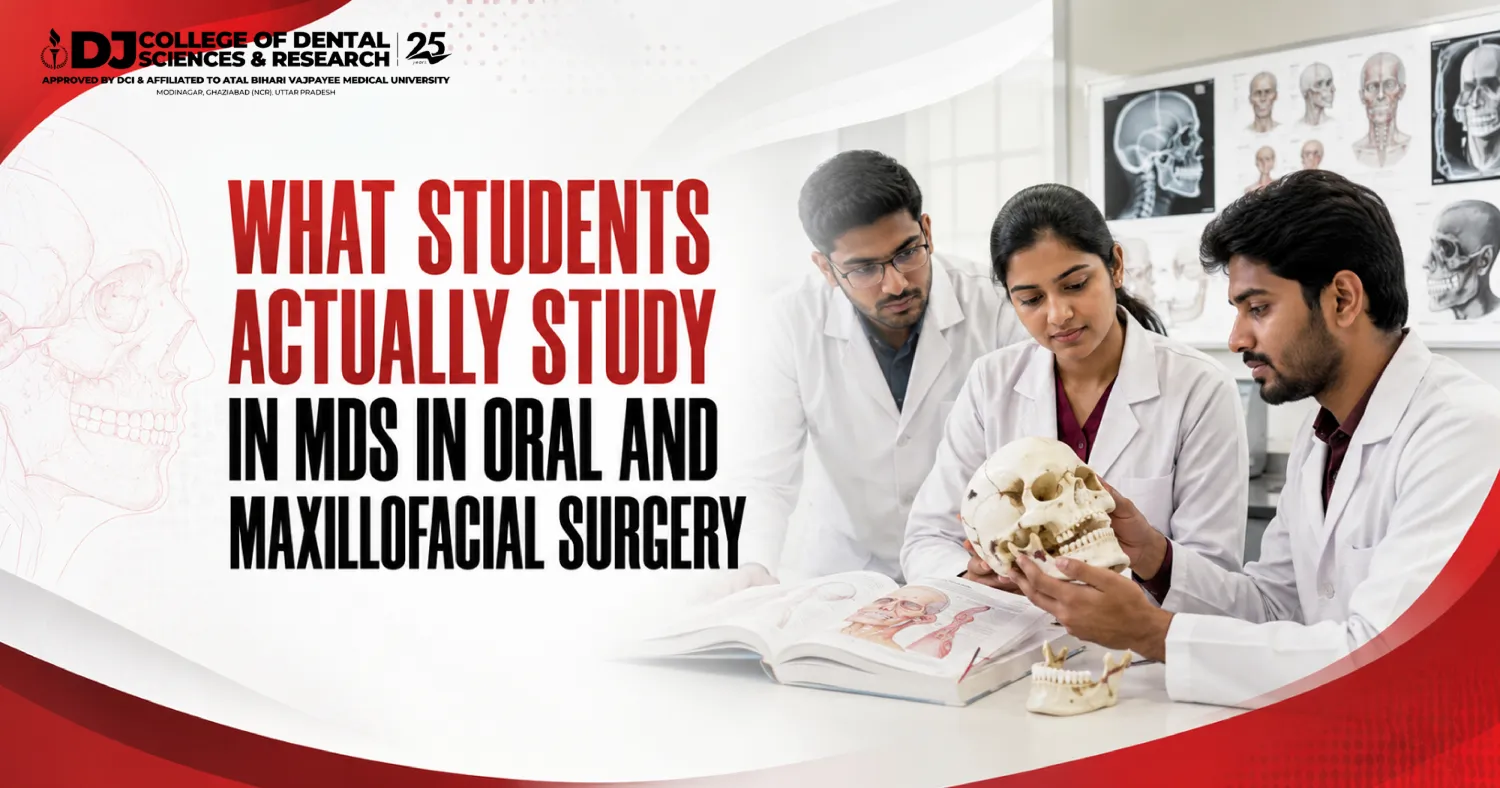
An MDS in Oral and Maxillofacial Surgery drops a young dentist straight into the world of complicated jaw fractures, facial reconstruction, difficult tooth removals, oral cancers, and even sleep apnoea correction. This is the team in any large dental hospital that handles the cases nobody else will touch, and the degree is built to train you for exactly that.
The branch sits at a rare crossroads of dentistry, general surgery, and facial aesthetics. It rewards patience, steady hands, and a strong stomach. It also rewards the kind of student who enjoys planning a case for weeks and then watching a patient walk out with a normal face, a normal bite, and a normal life waiting on the other side of recovery.
Most Indian students reach this branch after their Bachelor of Dental Surgery (BDS), and they usually arrive with one big question: What does the course actually teach, day after day, across three full years? The honest answer is far richer than the bullet points in any syllabus document.
Before you sit for your next counselling round or open another college shortlist, spend a few minutes with this guide for a ground-level view of what really happens inside the operating theatre and the seminar room.
What Is MDS Maxillofacial Surgery All About?
An MDS Maxillofacial Surgery is a three-year postgraduate dental degree that shapes a BDS graduate into a full-fledged oral and maxillofacial surgeon. The branch deals with diseases, injuries, and defects of the mouth, jaws, face, and neck. Training covers everything from a routine impacted wisdom tooth extraction to reconstructing a jaw destroyed by oral cancer or a highway accident.
Why Do Students Pick This Specialisation?
The branch attracts a particular kind of dental student — one who prefers the long hours of an operating theatre to a regular outpatient chair. The pull is genuine, and the reasons are usually practical:
- Surgical Focus: A strong inclination towards surgical work, anaesthesia management, and trauma cases.
- High Demand: Steady demand in hospitals, dental colleges, corporate set-ups, and private surgical clinics.
- Earning Potential: Income levels that consistently rank among the top three Master of Dental Surgery branches in India.
- Interdisciplinary Work: The chance to work shoulder to shoulder with ENT, plastic surgery, and oncology teams in major medical centres.
- Advanced Pathways: A clear runway towards fellowships in cleft and craniofacial surgery, head and neck oncology, and aesthetic facial work, both within India and overseas.
Many students also like that the results are visible quickly. A fracture is set, a tumour is removed, a deformed jaw is corrected, and the patient sees the difference within a few weeks.
How Long Is the Course and Who Can Apply?
The Master of Dental Surgery in this branch follows a three-year full-time format set by the Dental Council of India (DCI). Admission runs through the NEET MDS examination, a national-level entrance test held once every year and conducted by the National Board of Examinations in Medical Sciences (NBEMS).
| Detail | Specification |
| Course Duration | 3 years, full-time |
| Qualifying Degree | BDS from a DCI-recognised institution |
| Entrance Exam | NEET MDS |
| Internship | Completed 1-year rotating internship post-BDS |
| Registration | Valid State Dental Council registration |
How Is the Curriculum Built Over Three Years?
The structure moves from theory and observation in the early months to independent surgical work by the final year. The pace is steady, the workload is heavy, and the learning is largely hands-on.
The syllabus for an MDS in Oral and Maxillofacial Surgery is dense, surgical, and clinically loaded. Postgraduates spend a major chunk of their hours in operating theatres, casualty wards, and intensive care unit (ICU) rotations. The rest goes into seminars, journal clubs, dissection halls, cadaver workshops, and thesis writing under the guidance of senior faculty.
Core subjects cover applied anatomy of the head and neck, general surgery rotations, general medicine postings, anaesthesia training, oral pathology, oral medicine, oral and maxillofacial radiology, principles of trauma care, and basic plastic surgery techniques.
Year-Wise Build-Up in MDS Maxillofacial Surgery
Practical training is layered carefully — from minor procedures under local anaesthesia in the first year, to assisting in major surgeries through the second year, and finally to performing independent reconstructive work under general anaesthesia by the third year.
| Year | Main Focus Areas |
| Year 1 | Basic sciences, surgical anatomy, minor oral surgery, anaesthesia rotation, library work |
| Year 2 | Trauma management, orthognathic basics, cleft surgery exposure, thesis preparation |
| Year 3 | Major reconstructions, oncology cases, dental implants, distraction osteogenesis, thesis defence |
What Career Options Open Up After This Degree?
A qualified oral and maxillofacial surgeon has a wider runway than most other Master of Dental Surgery graduates. The skill set travels well across hospitals, academics, defence services, and private practice:
- Consultant Surgeon in a multi-specialty hospital or trauma centre.
- Assistant Professor in an academic dental college setting.
- Head of the Maxillofacial Unit handling acute cases in a trauma centre.
- Private Practitioner running a focused specialized surgical clinic.
- Clinical Researcher working on advanced craniofacial conditions.
A growing number of graduates also choose to move straight into highly specialised fellowships in cleft surgery, head and neck oncology, facial aesthetics, or advanced dental implantology.
Why Choose DJ College of Dental Sciences and Research?
DJ College of Dental Sciences & Research has spent over two and a half decades shaping graduates and postgraduates who now practise across India and abroad. The campus stretches across 75 acres with a 300-bedded teaching hospital attached to it, which gives Master of Dental Surgery students a steady flow of real cases from day one of their training.
A quick look at what the institution offers postgraduate aspirants:
- Legacy of Excellence: 30+ years of focused dental education with a record of consistent academic results.
- Top-Tier Ranking: Ranked among the leading dental colleges in Uttar Pradesh and the Delhi National Capital Region (NCR).
- Full Recognition: Complete recognition from the Dental Council of India for every running programme.
- High Patient Footfall: Around 100+ patients every single working day, translating to rich clinical exposure.
- Comprehensive Specialisations: Multiple MDS specialisations under one roof, with oral and maxillofacial surgery being one of the most active departments.
- Expert Faculty: Mentors with strong academic backgrounds, regular research publications, and active surgical practices.
- Modern Infrastructure: Advanced laboratories, simulation units, and digital academic support for postgraduate research.
- Global Exposure: A global student community drawn from 17+ countries, keeping the campus culture diverse.
- Career Growth: Scholarships, structured career mentorship, and a holistic approach to student development.
Conclusion
An MDS in Oral and Maxillofacial Surgery requires three years, sharp surgical instincts, and a willingness to handle cases that no other dental branch will take on. In return, it hands a graduate a skill set that stays in demand across hospitals, academic posts, and focused private practice for an entire career.
For students weighing their next move, a campus visit and an unhurried conversation with the faculty often answer questions that no brochure ever can. The admissions team at DJ College of Dental Sciences and Research can walk you through the current intake, the application window, and the documentation needed for the upcoming academic session.
Frequently Asked Questions (FAQs)
Q1. Is the MDS in maxillofacial surgery a tough branch to pursue?
The branch is demanding, featuring long surgical hours and intensive care unit exposure, but it remains well within reach for any focused BDS graduate who enjoys hands-on, high-impact clinical work.
Q2. Does DJ Dental College offer the MDS programme in oral and maxillofacial surgery?
Yes, the DJ College of Dental Sciences and Research runs Master of Dental Surgery programmes across multiple specialisations, including Oral and Maxillofacial Surgery, with full Dental Council of India recognition.
Q3. Can international students apply for the BDS or MDS programmes at DJ Dental?
The college already hosts students from over 17 countries and runs a structured international admissions process for both the Bachelor of Dental Surgery and Master of Dental Surgery programmes.
Q4. What is the basic eligibility for MDS admission at DJ Dental College?
A candidate must hold a BDS degree from a DCI-recognised institution, must have completed the mandatory one-year rotating internship, and must qualify for the NEET MDS entrance examination for the relevant academic year.
Related Posts