BDS Course Details: Duration, Eligibility, Course Subjects and Career Opportunities
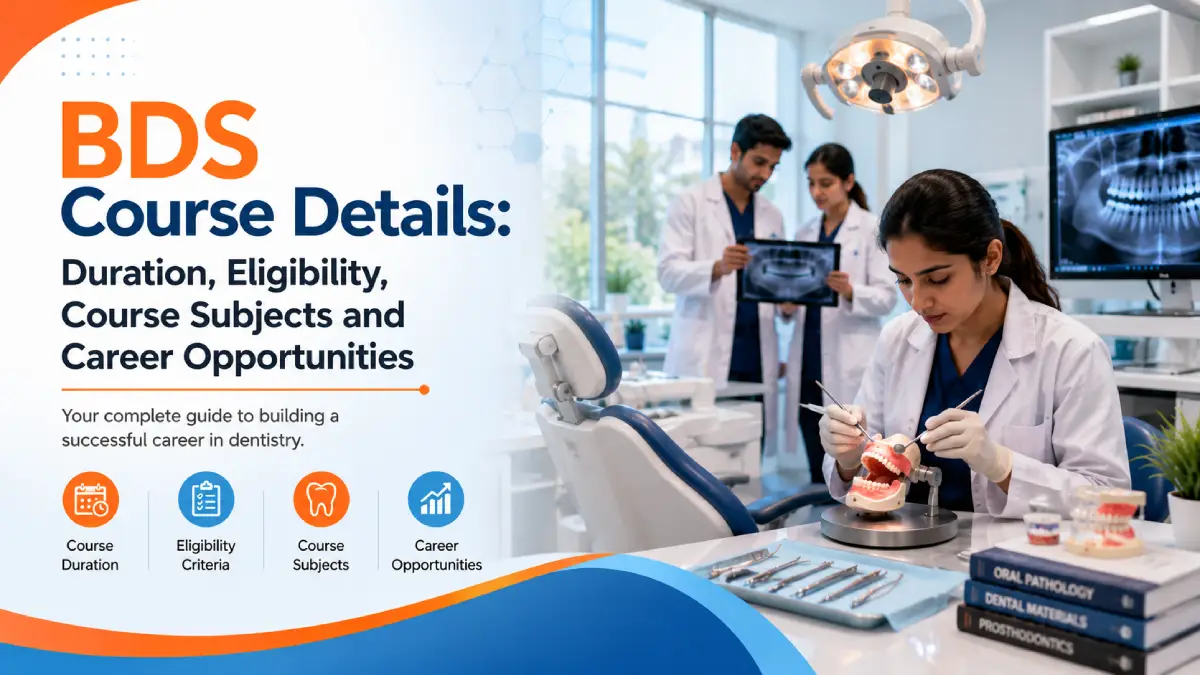
Every year, thousands of students finish Class 12 with one question on their mind. What should they study next if they love science and want to help people? For many, the answer is dentistry. The Bachelor of Dental Surgery, or BDS, is the first step towards becoming a dentist in India. It is a five-year professional degree that mixes classroom study with real patient care.
Parents often ask if the course is worth the time and money. Students want to know what they will study, how hard it is, and what kind of job they can get later. This guide answers all of that in plain words.
It covers BDS duration, BDS eligibility, BDS subjects and the many career paths that open after the degree. It also looks closely at BDS colleges in Delhi NCR, a region that has grown into a strong hub for dental education, and shows how DJ College of Dental Sciences and Research fits into that picture.
What is BDS?
BDS (Bachelor of Dental Surgery) is a five-year dental degree, that is four years of study plus one year of internship. To join, a student needs Class 12 with Physics, Chemistry and Biology and a valid NEET-UG score. After the degree, a graduate can work as a dentist, open a clinic, join the government, or study MDS for a specialisation.
What Is the BDS Course, and Why Do So Many Students Pick It?
BDS stands for Bachelor of Dental Surgery. It is the only recognised undergraduate degree in India that allows a person to work as a dentist. After finishing the course and one year of internship, a graduate can register with the State Dental Council and treat patients.
Students pick BDS for a few clear reasons. The need for oral care keeps rising in every town and city. The course opens both a job route and a business route, because many dentists later run their own clinic. It also takes less time than an MBBS degree, yet it still leads to a respected doctor title.
Admission to every dental college in the country runs through one exam. That exam is NEET-UG. No college, whether government, private or deemed, can admit a BDS student without a valid NEET score.
How Long Is the BDS Course, and What Happens in Each Year?
The BDS course runs for five years. This includes four years of academic study and one year of paid rotatory internship. The early years focus on basic science. The later years move into clinics, where students treat real patients under senior doctors.
| Year | Main focus | What students learn |
| First year | Basic sciences | General human anatomy, physiology, biochemistry and dental anatomy |
| Second year | Pre-clinical work | Dental materials, pharmacology, pathology, microbiology and lab practice |
| Third year | Clinical start | General medicine, general surgery, oral pathology and first patient contact |
| Fourth year | Full clinical training | Orthodontics, periodontics, prosthodontics, oral surgery and child dental care |
| Fifth year | Rotatory internship | Rotations across all departments with hands-on patient treatment |
Know More: Why Should You Choose Oral Medicine and Radiology? Know the Future!
Who Can Apply? BDS Eligibility Made Simple
The rules for BDS eligibility are the same across India. A student must clear Class 12 with the right subjects and qualify NEET-UG. The table sets out the main points.
| Requirement | Detail |
| Qualifying exam | Passed 10+2 or an equivalent examination |
| Compulsory subjects | Physics, Chemistry, Biology or Biotechnology, and English |
| Minimum marks | 50% in PCB for General, 40% for SC/ST/OBC, 45% for PwD |
| Entrance exam | Valid NEET-UG score (mandatory for all colleges) |
| Minimum age | 17 years on or before 31 December of the admission year |
| Upper age limit | No upper age cap for NEET-UG |
What Will Students Study During the BDS Course?
The BDS subjects grow harder each year, moving from books to the dental chair. The course covers around sixteen subjects across the four academic years. These subjects match the specialist departments found in a good dental college.
At DJ College of Dental Sciences and Research, teaching runs through nine departments. Each one handles a different part of oral health.
| Study area (department) | What it covers |
| Oral Medicine and Radiology | Diagnosis of oral disease and dental X-rays |
| Conservative Dentistry and Endodontics | Fillings, root canal work and tooth repair |
| Prosthodontics, Crown, Bridge and Implantology | Dentures, crowns, bridges and dental implants |
| Periodontology and Oral Implantology | Gum health and the support structure of teeth |
| Oral Pathology and Microbiology | Study of oral diseases and germs |
| Orthodontics and Dentofacial Orthopaedics | Braces and correction of tooth alignment |
| Paediatric and Preventive Dentistry | Dental care for children |
| Oral and Maxillofacial Surgery | Surgery of the mouth, jaw and face |
| Public Health Dentistry | Community dental health and awareness |
Know More: Why Is Orthodontics Becoming a Preferred Career Choice After BDS?
Why Do So Many Students Choose BDS Colleges in Delhi NCR?
There is a general notion that a degree from a well-known region carries extra weight, and Delhi NCR sits high on that list for dental studies. The area around Ghaziabad, Meerut, Modinagar and Mathura holds several old and reputed dental institutions.
A few points make BDS colleges in Delhi NCR a popular pick. The region has a large population, so students get a heavy flow of patients for practice. Road and metro links to Delhi are strong. Many colleges sit close to big hospitals, which adds to clinical exposure. For students who want the best dental colleges in Delhi NCR, this mix of patient volume and connectivity matters a lot.
Fathoming the value of this fact, private institutions in the region have expanded their campuses and labs to attract students from across the country and let them explore the possibilities in dentistry.
How Does DJ College of Dental Sciences and Research Compare With Other BDS Colleges in Delhi NCR?
DJ College of Dental Sciences and Research sits in Modinagar, Ghaziabad. It started in 1999 under the Jassar Dental Medical Education Health Foundation. That gives it over 25 years of work in dental education. It is approved by the Dental Council of India and affiliated with Atal Bihari Vajpayee Medical University, Lucknow.
The table below places DJ College next to seven other well-known BDS colleges in Delhi NCR and nearby areas. It compares the points that students care about the most.
| College | Location | Est. | Affiliating university | BDS seats | MDS programmes | Recognition |
| DJ College of Dental Sciences & Research | Modinagar, Ghaziabad | 1999 | ABVMU, Lucknow | 100 | 45 seats, 9 specialisations | DCI, NAAC, UGC |
| ITS Dental College | Muradnagar, Ghaziabad | 2000 | ABVMU, Lucknow | 100 | 9 specialisations | DCI, NAAC ‘A’ |
| Institute of Dental Studies & Technologies (IDST) | Modinagar, Ghaziabad | 2000 | ABVMU, Lucknow | 100 | 8 specialisations | DCI, NAAC |
| Inderprastha Dental College & Hospital | Sahibabad, Ghaziabad | ABVMU, Lucknow | 100 | 27 seats, 5 specialisations | DCI | |
| Santosh Dental College | Pratap Vihar, Ghaziabad | 1995 | Santosh Deemed University | 100 | 27 seats | DCI, UGC (deemed) |
| Shree Bankey Bihari Dental College & Research Centre | Masuri, Ghaziabad | 2004 | CCS University, Meerut / ABVMU | 100 | 28 seats, 8 specialisations | DCI |
| Subharti Dental College | Meerut | 1996 | Swami Vivekanand Subharti University | 100 | 43 seats (approx) | DCI, NAAC ‘A’ |
| KD Dental College & Hospital | Mathura | 2001 | ABVMU, Lucknow | 100 | 36 seats, 9 specialisations | DCI, NAAC |
One point stands out at once. Almost every college here offers 100 BDS seats, so seat count alone will not separate them. Students should look past the seat number to campus size, patient flow, legacy and MDS choice. Compared with other BDS colleges in Delhi NCR, the 75-acre campus and nine MDS specialisations of DJ College of Dental Sciences and Research give it a wide, well-rounded profile.
Know More: The Future of Dentistry in India: Why BDS Remains a Smart Career Choice in 2026
What Makes DJ College of Dental Sciences and Research Stand Out?
Among the many BDS colleges in Delhi NCR, DJ College builds its name on scale and student support. Its campus spreads across 75 acres, which is large for a dental college in the region. Its attached hospital gives students a steady flow of patients across every department.
| Strength | What it means for a BDS student |
| Over 25 years of experience (since 1999) | A long, steady record in dental teaching |
| DCI approval and ABVMU affiliation | A degree valid for dental practice across India |
| 75-acre campus with an attached hospital | Space, labs and heavy clinical exposure |
| Over 100 patients per department each day | Plenty of real cases to learn from |
| BDS plus MDS in 9 specialisations | A clear path to higher study on the same campus |
| Global student mix (17+ countries) | A diverse, wider learning circle |
| Scholarships and career support | Financial help and job guidance |
Know More: BDS Colleges in UP 2026: Fees, Seats, Rankings & How to Choose the Right Dental College
What Career Paths Can Students Explore After the BDS Course?
Stepping into the field of dentistry sounds good, and the curiosity pertaining to the future and career possibilities hovers in the mind of aspirants. The good news is that BDS Jobs are wide and varied. A graduate can treat patients, teach, join the government, or start a clinic.
| Career path | What the role involves |
| Clinical dentist | Treats patients in a clinic or hospital |
| Own dental practice | Runs a private clinic as a business |
| Government dental officer | Works in public hospitals and health schemes |
| Defence and Railways dentist | Serves in the Army, Navy, Air Force or Indian Railways |
| Lecturer or academic | Teaches in a dental college after higher study |
| Dental researcher | Works on dental products and research studies |
| Corporate chain dentist | Joins large dental clinic chains and hospital groups |
| Work abroad | Practises overseas after clearing local licensing exams |
Indicative income after BDS in India (by experience)
| Experience level | Monthly income (approx) | Yearly income (approx) |
| Fresher (0 to 2 years) | Rs 20,000 to Rs 40,000 | Rs 3 to Rs 5 lakh |
| Mid-level (3 to 5 years) | Rs 50,000 to Rs 70,000 | Rs 6 to Rs 9 lakh |
| Senior (over 5 years) | Rs 1,00,000 and above | Rs 12 lakh and above |
What Is the Future Scope of Dentistry in India?
The scope for dentistry keeps growing. Oral care awareness is rising, and newer fields like cosmetic dentistry, implants and clear aligners are in demand. The numbers show how large the field has become.
| Measure | Figure |
| Dental colleges in India | Around 320 and above |
| Total BDS seats | Around 27,600 |
| Government BDS seats | Around 3,958 |
| Private and deemed BDS seats | Around 23,660 |
| Total MDS seats | Around 7,357 |
With so many seats and rising demand for oral care, a well-chosen dental college can set a student up for a stable, respected career.
Know More: Clear Aligners or Traditional Braces: What Should Future Dentists Know?
Final Thoughts
The BDS course offers a stable and respected path for students who love science and care for others. It blends study, skill and service across five full years. For those comparing BDS colleges in Delhi NCR, the region brings strong patient exposure, good links to Delhi, and a set of reputed institutions. Among these, DJ College of Dental Sciences and Research stands as one of the best dental colleges in Delhi NCR, backed by a large campus, wide specialisations and over 25 years of teaching. A careful choice now can shape a bright dental career ahead.
Frequently Asked Questions
Q. What is the BDS course?
BDS, or Bachelor of Dental Surgery, is the main undergraduate dental degree in India. It trains students to become dentists. After the course and a one-year internship, a graduate can register and treat patients.
Q. What is the duration of the BDS course?
The BDS course lasts five years. This covers four years of academic study and one year of paid rotatory internship.
Q. What is the eligibility for BDS?
A student must pass Class 12 with Physics, Chemistry, Biology and English, with at least 50% marks in PCB for the General category (40% for SC/ST/OBC). A valid NEET-UG score is also needed.
Q. Is NEET compulsory for BDS admission?
Yes. NEET-UG is the only entrance exam accepted for BDS in India. No government, private or deemed college can admit a student without a valid NEET score.
Q. What subjects are taught in BDS?
BDS subjects include anatomy, physiology, biochemistry, dental materials, pharmacology, oral pathology, periodontics, prosthodontics, orthodontics, oral surgery and public health dentistry, among others.
Q. What is the minimum age for BDS admission?
A student must be at least 17 years old on or before 31 December of the year of admission.
Q. Which are the top BDS colleges in Delhi NCR?
Well-known BDS colleges in Delhi NCR and nearby areas include DJ College of Dental Sciences and Research, ITS Dental College, IDST, Santosh Dental College, Subharti Dental College and KD Dental College.
Q. Is DJ College of Dental Sciences and Research approved by DCI?
Yes. DJ College of Dental Sciences and Research is approved by the Dental Council of India and affiliated with Atal Bihari Vajpayee Medical University, Lucknow.
Q. How many BDS seats does DJ College of Dental Sciences and Research offer?
DJ College offers 100 BDS seats. It also runs MDS programmes across nine specialisations.
Q. What is the salary after BDS in India?
A fresh BDS graduate usually earns about Rs 20,000 to Rs 40,000 per month. Income rises with experience, an MDS degree or a busy private clinic, and can cross Rs 1,00,000 per month for senior dentists. These figures are indicative.
Q. What are the career options after BDS?
BDS Jobs include working as a clinical dentist, running a private clinic, joining the government or defence services, teaching, research and corporate dental chains.
Q. Can a BDS graduate work abroad?
Yes. A BDS graduate can work abroad after clearing the licensing exam of that country. Gulf and Western nations often pay higher salaries than India.
Related Posts