Ask a room of ten people what they fear at the dentist. Nine will say the same thing, and that is the sound of the drill.
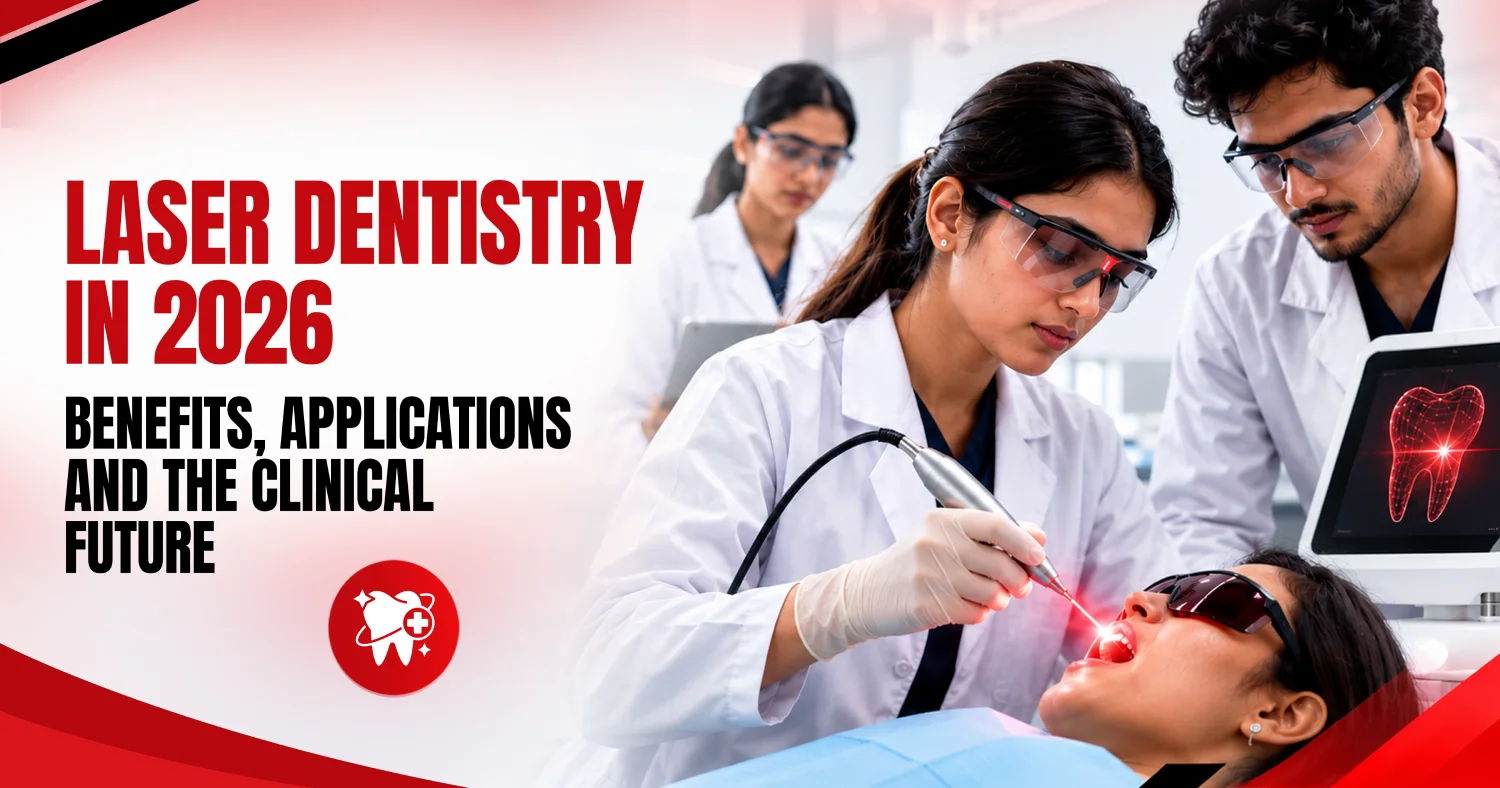
That sound is slowly going quiet in some clinics. Here is the short answer first. Laser dentistry uses a narrow beam of light to cut, clean or shape tissue in the mouth. Different lasers suit different jobs. Diode and CO2 lasers work on gums. Erbium lasers can cut enamel and dentine. In many small procedures the patient needs less anaesthesia, bleeds less and heals faster.
Lasers do not replace every drill or every blade. They are a second set of tools, and a dentist has to be trained to pick the right one.
For students, this matters in a different way. India already has a large number of dentists. A skill that most graduates do not have is what sets a career apart. That is why families comparing a dental institute in Delhi now ask a newer question. Not only what the college teaches, but what equipment students actually touch.
This guide covers how lasers work, where they are used, the real benefits and risks, what the market data says, and the career paths that follow a laser dentistry course.
What is laser dentistry, and how does it actually work?
A laser produces one single colour of light in a very narrow beam. Every tissue in the mouth absorbs certain colours of light far better than others. Water absorbs some. Pigment and blood absorb others. Tooth mineral absorbs others again.
A dentist picks the laser whose light the target tissue soaks up best. The energy turns into heat in that tissue only. Nearby tissue is left alone. That is the whole idea in one sentence.
Four things can happen when laser light meets tissue. It can bounce off, scatter sideways, pass straight through, or be absorbed. Only absorbed light does any work. That is why water content matters so much. Gum tissue holds plenty of water and blood. Enamel holds mineral and very little water. A laser tuned for one is close to useless on the other.
Which lasers do dentists use, and what is each one for?
Main dental lasers, wavelengths and uses
| Laser type | Wavelength | Absorbed best by | Tissue | Common procedures |
|---|---|---|---|---|
| Diode | 810 to 980 nm, newer units to 1470 nm | Pigment and haemoglobin | Soft tissue | Gum contouring, frenectomy, crown lengthening, control of bleeding |
| Nd:YAG | 1,064 nm | Pigment and haemoglobin, penetrates deeply | Soft tissue | Periodontal pocket therapy, soft tissue surgery |
| Er,Cr:YSGG | 2,780 nm | Water and tooth mineral | Hard and soft tissue | Cavity preparation, bone procedures |
| Er:YAG | 2,940 nm | Water, the highest absorption of all dental lasers | Hard and soft tissue | Cavity preparation, removal of enamel and dentine |
| CO2 | 10,600 nm | Water, shallow penetration | Soft tissue | Removal of lesions, biopsy, surface tissue vaporisation |
| Argon | About 488 nm | Pigment | Soft tissue and curing | Curing of sealants and composite restorations |
Source: dental laser classification in peer reviewed reviews, Dimensions of Dental Hygiene and EC Dental Science, 2017 to 2026.
Not everyone is aware that the first dental laser sold commercially arrived only in 1989. The big change came in the mid 1990s, when erbium lasers made it possible to cut tooth structure and not only gum. The situation has changed considerably over the last few years, mostly because equipment prices have fallen.
What are the clinical applications of lasers in dentistry?
Almost every dental speciality has found a use for them. The table below maps lasers to the nine departments a full dental college runs.
Where lasers are used, department by department
| Department | Typical laser use | Laser usually chosen |
|---|---|---|
| Conservative Dentistry and Endodontics | Cavity preparation and disinfection inside root canals | Er:YAG, Er,Cr:YSGG, diode |
| Periodontology and Oral Implantology | Pocket therapy, gum contouring, care of infected implant sites | Diode, Nd:YAG, Er:YAG |
| Oral and Maxillofacial Surgery | Frenectomy, biopsy, removal of soft tissue lesions | CO2, diode |
| Prosthodontics, Crown and Bridge and Implantology | Tissue retraction before impressions, implant site preparation | Diode, Er,Cr:YSGG |
| Oral Medicine and Radiology | Relief in oral ulcers and lichen planus | Diode, low level laser therapy |
| Orthodontics and Dentofacial Orthopaedics | Uncovering impacted teeth, removal of bonded attachments | Diode, Er:YAG, CO2 |
| Paediatric and Preventive Dentistry | Small cavity work with less drilling, curing of sealants | Er:YAG, argon |
| Oral Pathology and Microbiology | Collection of laser assisted biopsy samples | CO2, diode |
| Public Health Dentistry | Teaching and screening around less invasive care | Not applicable |
Source: published laser dentistry reviews mapped against the standard nine department structure of an Indian dental college. General clinical practice, not a claim about any single college.
What is low level laser therapy, and how is it different?
Not every dental laser cuts. Low level laser therapy, also called photobiomodulation, uses far weaker light. Nothing is removed and nothing is heated in any real sense. The aim is to calm inflammation and speed up healing. Dentists use it for mouth ulcers, jaw joint pain, and soreness after extractions or orthodontic adjustments. It is worth noting that this is the quietest part of laser dentistry, and the part patients notice least, because there is no cutting to watch.
What are the advantages and disadvantages of lasers on soft tissue?
Soft tissue is where lasers have the longest track record. The ability of certain lasers to cut or remove gum tissue cleanly is not seriously disputed.
Lasers on soft tissue, both sides
| Advantages | Disadvantages |
|---|---|
| Bleeding is reduced because the beam seals small vessels | Equipment costs far above a scalpel, and the cost is per wavelength |
| Many small procedures need little or no injection | The dentist loses the touch feedback a blade gives |
| Less swelling and less scarring afterwards | Pulsed lasers can leave a less even cut in visible front areas |
| Healing is generally faster | Nd:YAG penetrates deeply and can affect tissue further away |
| The beam reduces bacteria in the treated area | Large lesions may still be better removed with a blade |
| Stitches are often avoided | Formal training and eye protection are required for everyone in the room |
Source: literature review on diode lasers in oral soft tissue lesions, Journal of Clinical and Experimental Dentistry, and comparative laser cutting studies.
What are the advantages and disadvantages of lasers in hard tissue surgery?
Hard tissue is the harder problem, and the honest picture is mixed. Erbium lasers can remove enamel and dentine. They cannot do everything a drill does.
Lasers on hard tissue, both sides
| Advantages | Disadvantages |
|---|---|
| No drill vibration and no drill noise, which helps anxious patients | Slower than a rotary drill on large cavities |
| Small cavities can often be done without an injection | Old metal fillings cannot be removed with a laser |
| Decayed tissue can be removed selectively, sparing sound tooth | Crowns and inlays still need conventional shaping |
| Fewer micro cracks than high speed rotary cutting | One in vitro study measured enamel loss of 0.13 to 0.17 mm with Er:YAG, close to 9 per cent of enamel thickness in the affected area, when settings were not controlled |
| Water spray keeps the tooth cool during cutting | Purchase and maintenance costs are high for a single clinic |
| Useful in children, where cooperation is short | Poor technique can cause heat damage to the pulp |
Source: in vitro comparison of diode, Er:YAG and CO2 lasers in enamel, Photonics (MDPI), 2025, and clinical laser reviews.
What are the real benefits and risks of laser treatment for a patient?
Many parents and students still believe a laser is automatically safer than a drill. The reality on the ground is somewhat different. A laser in trained hands is gentle. The same machine at the wrong setting can burn.
Patient benefits and patient risks
| Benefit | Matching risk to know about |
|---|---|
| Less pain during and after many procedures | Heat damage to the pulp if power or cooling is wrong |
| Less bleeding, so the dentist sees the field clearly | Slower cutting can mean longer time in the chair |
| Lower chance of infection at the treated site | Eye injury if protective eyewear is not worn by everyone present |
| Faster healing and fewer follow up visits | Treatment charges are usually higher than conventional care |
| Fewer injections, which helps children and nervous adults | Not every clinic has staff trained on the wavelength it owns |
| Quieter, which lowers dental anxiety | Not suitable for every case, so a drill or blade is still needed |
Source: American Dental Association and American Academy of Periodontology guidance summarised in Dimensions of Dental Hygiene, plus clinical safety literature.
Patients rarely know what to ask. Three questions cover most of it. Which laser does this clinic own, and is it the right one for my procedure? How many of these cases has the dentist treated with a laser? Will I still need an injection? A clinic attached to a teaching hospital usually answers all three without hesitation. That is one reason a busy college hospital is a sensible place to be treated, and an even better place to learn.
What does the clinical future of laser dentistry look like?
A closer look at the industry shows steady growth rather than a sudden jump. Market estimates differ between research houses, which is worth saying plainly, so two independent sets are given below.
Dental laser market data, converted into INR
| Measure | Figure | INR equivalent | Source |
|---|---|---|---|
| Global dental lasers market, 2025 | USD 415.44 million | About INR 3,614 crore | Precedence Research, June 2026 |
| Global market, 2035 forecast | USD 865.08 million at 7.61 per cent a year | About INR 7,526 crore | Precedence Research, June 2026 |
| Global market, 2025, second estimate | USD 371.54 million | About INR 3,232 crore | Emergen Research, June 2026 |
| Same estimate, 2035 forecast | USD 637.40 million at 5.5 per cent a year | About INR 5,545 crore | Emergen Research, June 2026 |
| Asia Pacific market, 2025 | USD 77.85 million, about 20.96 per cent of world demand | About INR 677 crore | Fortune Business Insights, 2026 |
| Share held by soft tissue procedures, 2025 | About 49 to 58 per cent of revenue | Not applicable | Emergen Research, 2026 |
| Fastest growing application | Implantology, about 11.67 per cent a year | Not applicable | Emergen Research, 2026 |
| India and China purchase growth, 2025 | Double digit growth in dental laser purchases | Not applicable | Emergen Research, 2026 |
Converted at USD 1 = INR 87, rounded, August 2026. Market research houses use different scopes, so figures for the same year do not match.
Three shifts are likely over the next decade. Prices keep falling, so smaller clinics can afford a diode unit. Software now suggests laser settings from scan data. Implant work is pulling laser demand upward faster than any other application.
Training is the part that lags behind the machines. A clinic can buy a diode unit in a week. Building the judgement to use it well takes far longer. Software now reads scan data and suggests power settings, which helps, though it does not replace a trained hand. Ask any experienced professional in the field, and they will tell you that the machine is the easy part.
How does a student compare a dental institute in Delhi with colleges across Delhi NCR and UP?
Search volume tells a story here. Thousands of students each year look for a dental institute in Delhi, then discover that most of the teaching hospitals serving the capital region actually sit in Ghaziabad, Greater Noida, Gurugram and Meerut. Delhi itself has very few dental colleges. The wider Delhi NCR belt, and the dental colleges in UP just beyond it, hold most of the seats.
From a student’s perspective, that changes the shortlist completely.
The practical checklist is short. Count the departments running MDS programmes, because a college with more specialisations gives an undergraduate wider clinical range. Ask how many patients each department treats daily. Ask which equipment students handle themselves rather than watch from behind. A family narrowing down a dental institute in Delhi will find that the honest answers come from the hospital, not from the prospectus.
Dental colleges across Delhi NCR and western UP
| Institution | Location | State | Type |
|---|---|---|---|
| DJ College of Dental Sciences and Research | Modinagar, Ghaziabad | Uttar Pradesh | Private, minority institution |
| Inderprastha Dental College and Hospital | Sahibabad, Ghaziabad | Uttar Pradesh | Private |
| Institute of Dental Studies and Technologies | Modinagar, Ghaziabad | Uttar Pradesh | Private |
| ITS Dental College | Muradnagar, Ghaziabad | Uttar Pradesh | Private |
| ITS Dental College | Greater Noida | Uttar Pradesh | Private |
| Sharda University, School of Dental Sciences | Greater Noida | Uttar Pradesh | Private university |
| Subharti Dental College | Meerut | Uttar Pradesh | Private university |
| Kalka Dental College | Meerut | Uttar Pradesh | Private |
| SGT University, Faculty of Dental Sciences | Gurugram | Haryana | Private university |
Source: institutional websites and dental college directories, read August 2026. Seat numbers and approval status change each cycle and should be checked on the National Dental Commission portal.
Dental education and workforce data in India
| Indicator | Figure | Why a student should care | Source |
| Registered dentists in India | 376,721 | Competition after BDS is real, so a distinct skill matters | Observer Research Foundation, November 2025 |
| Dentist to population ratio in India | About 1 dentist per 3,846 people | Well above the WHO norm of 1 per 7,500 for developing countries | Observer Research Foundation, November 2025 |
| Dental colleges in India | 329 | Seat supply is wide, so college quality separates graduates | Dental Council of India records, 2025 |
| BDS seats in India each year | 27,618 | About 82 per cent sit in private institutions | Dental Council of India records, 2025 |
| MDS seats in India | About 6,965 | Postgraduate seats are far scarcer than BDS seats | Dental Council of India records, 2025 |
| BDS seats in Uttar Pradesh | 2,403 across 27 colleges, 5 government and 22 private | UP is one of the largest dental education states | State seat matrix, 2025 |
| Regulator | National Dental Commission, in force from 19 March 2026 | The Dentists Act 1948 was repealed and the DCI dissolved on the same date | Ministry of Health and Family Welfare notification, March 2026 |
Existing college recognitions granted under the Dental Council of India continue during the transition to the National Dental Commission.
What career paths open after a laser dentistry course?
Stepping into the field of dentistry sounds good, and the curiosity pertaining to the future and career possibilities hovers in the mind of aspirants. The workforce data above answers part of it. India does not lack dentists. It lacks dentists with a named extra skill.
Laser training is usually taken after BDS, as a certificate or fellowship, or built into an MDS through the department that uses it most.
Jobs after laser dentistry specialisations
| Career route | What the work involves | What it usually needs |
| Laser assisted private practice | Gum contouring, frenectomy and small restorative work in own clinic | BDS plus a certified laser course |
| Periodontics with laser therapy | Pocket therapy and care of infected implant sites | MDS in Periodontology plus laser training |
| Endodontics with laser disinfection | Root canal disinfection and retreatment | MDS in Conservative Dentistry and Endodontics |
| Paediatric laser dentistry | Less invasive cavity work for children | MDS in Paediatric and Preventive Dentistry |
| Oral surgery and lesion management | Biopsy and removal of soft tissue lesions | MDS in Oral and Maxillofacial Surgery |
| Implant practice | Implant site preparation and peri-implant tissue care | MDS plus implantology and laser certification |
| Teaching and academics | Clinical teaching in a dental college | MDS, with research output preferred |
| Clinical trainer with equipment brands | Training dentists on laser units | BDS or MDS plus laser certification |
| Research in laser dentistry | Trials on ablation, healing and disinfection | MDS or PhD, with publications |
Source: Indian dental postgraduate and laser certification pathways, and published laser dentistry career literature, August 2026.
Building the skill follows a simple order. Finish BDS. Pick the department whose work genuinely interests you. Take a certified laser course during or after MDS. Then log cases, because the number of laser procedures performed is what employers and patients actually judge. Students weighing a dental institute in Delhi against campuses in Ghaziabad or Meerut should ask how many of a college’s own postgraduates use lasers as routine practice.
Why do students searching for a dental institute in Delhi look at DJ Dental College?
One question that often comes up is why a Modinagar campus keeps appearing in searches aimed at the capital. The answer is patient volume. A dental student learns by treating people, and the number of cases a department sees each day decides how much practice each student gets. That is the measure worth comparing when a family lines up the best dental colleges in Delhi against options across Delhi NCR and UP.
What makes DJ College of Dental Sciences and Research different?
The college sits at Ajit Mahal, Niwari Road, Modinagar, in Ghaziabad district of Uttar Pradesh, inside the Delhi NCR belt. It was founded in 1999 and is part of the DJ Group of Institutions. Let’s have a glance at the table below so that we can realise why this DJ college of Dental Sciences and Research quite different from other dental institutions in Uttar Pradesh.
| Point | Detail |
| Years in dental education | Over 25 years, founded in 1999, among the first five private dental colleges in Uttar Pradesh |
| Approval and affiliation | Approved under the Dental Council of India, whose functions passed to the National Dental Commission in March 2026. Affiliated to Atal Bihari Vajpayee Medical University, Lucknow. NAAC accredited |
| Programmes | BDS and MDS, with multiple MDS specialisations across nine departments |
| Departments | Oral Medicine and Radiology, Conservative Dentistry and Endodontics, Prosthodontics, Periodontology, Oral Pathology and Microbiology, Orthodontics, Paediatric and Preventive Dentistry, Oral and Maxillofacial Surgery, Public Health Dentistry |
| Daily patient load | Reported at over 100 patients per department each day |
| Campus | 75 acre campus shared across the DJ Group, with a 100 bed hospital providing round the clock specialty care |
| Faculty | Experienced and qualified teaching staff across all nine departments |
| Laboratories and academic support | Advanced laboratories with digital academic support |
| Research | An active research and publication culture |
| International student mix | Students drawn from 17 countries |
| Student support | Scholarships and career support, with an all round approach to student development |
For a subject like laser dentistry, patient numbers carry greater weight than any brochure line. A student who watches a hundred cases a day in a department sees laser assisted work as routine practice, not as a demonstration.
For families comparing a dental institute in Delhi with campuses across the wider NCR belt, that combination of daily volume and speciality range is the point worth weighing.
Conclusion: How should a student choose?
Laser dentistry is not magic and it is not a gimmick. It is a set of tools that do certain jobs very well, cost more, and need proper training. Any honest clinic will say the same.
For a student, the lesson is simple. The BDS degree opens the door. The extra skill decides what happens after. Families comparing a dental institute in Delhi should look past rankings and ask three plain questions. How many patients does each department treat daily? What equipment do students actually handle? How many MDS specialisations run on campus?
A campus that answers all three well will serve a student better than a postcode. Students and parents can explore the BDS and MDS programmes, eligibility and admission details on the DJ College website, or speak to the admissions team directly.
FAQs:
Q1. What is laser dentistry?
Laser dentistry uses a narrow beam of light of one wavelength to cut, clean, shape or disinfect tissue in the mouth. The tissue absorbs the light and turns it into heat in that spot only. Different lasers suit gums, teeth or both.
Q2. Is laser treatment painful?
Most patients report less pain than with a drill or blade. Many small procedures need little or no injection. Discomfort can still happen, and the treatment is not painless in every case.
Q3. Which laser is used for gums and which for teeth?
Diode, Nd:YAG and CO2 lasers are used mainly on soft tissue such as gums. Erbium lasers, that is Er:YAG at 2,940 nm and Er,Cr:YSGG at 2,780 nm, can cut enamel and dentine as well as soft tissue.
Q4. Can a laser replace the dental drill completely?
No. Lasers cut slowly on large cavities, cannot remove old metal fillings and cannot shape a tooth for a crown. Most clinics use lasers alongside conventional instruments rather than instead of them.
Q5. Are dental lasers safe?
They are safe when the operator is trained and the settings are correct. The main risks are heat damage to the tooth pulp from wrong power or cooling, and eye injury if protective eyewear is not worn by everyone in the room.
Q6. Is laser dental treatment more expensive?
Usually yes. The equipment costs far above a scalpel or a drill, and a clinic often needs separate units for soft and hard tissue work. That cost is reflected in treatment charges.
Q7. What is a laser dentistry course and who can take it?
Laser training in India is generally taken after BDS, as a certificate course, a fellowship, or as part of an MDS in the department that uses lasers most, such as Periodontology, Endodontics or Oral Surgery. A BDS degree is the entry point.
Q8. What jobs follow a laser dentistry specialisation?
Laser assisted private practice, periodontics with laser therapy, endodontics with laser disinfection, paediatric laser dentistry, oral surgery, implant practice, teaching, clinical training roles with equipment brands, and research.
Q9. Which are the best dental colleges in Delhi NCR?
Delhi itself has very few dental colleges. Most seats serving the capital region sit in Ghaziabad, Greater Noida, Gurugram and Meerut. A student searching for a dental institute in Delhi should compare campuses across Delhi NCR and western Uttar Pradesh, including DJ College of Dental Sciences and Research, Inderprastha, IDST, ITS, Sharda, Subharti, Kalka and SGT.
Q10. Who regulates dental education in India now?
The National Dental Commission, in force from 19 March 2026. The National Dental Commission Act 2023 repealed the Dentists Act 1948 and the Dental Council of India was dissolved on the same date. Recognitions granted earlier continue during the transition.
Related Posts