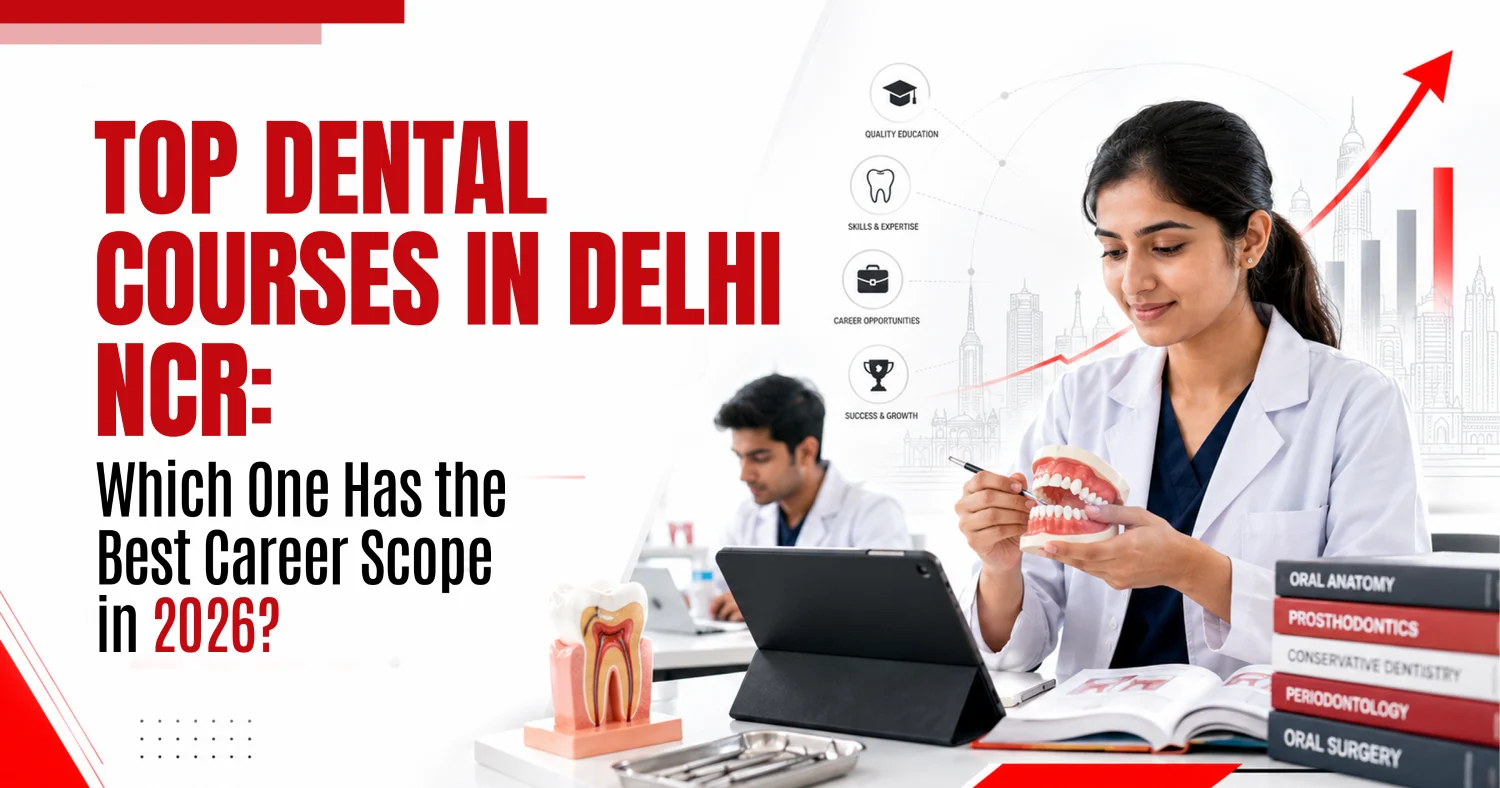
At some point, most students staring at a NEET scorecard ask the same thing. Which dental course actually pays off?
The question sounds simple. The answer is not, because dentistry in 2026 has stopped being one road. It is a degree, then a fork, then several smaller forks after that.
Delhi sits oddly in all of this. The National Capital Territory runs four government dental colleges holding 162 BDS seats, and it has no private dental college at all. Its postgraduate position is thinner still, with only 38 MDS seats across those four colleges, the lowest average per college of any state or union territory in India. Cross the border into Ghaziabad, Greater Noida, Meerut or Gurugram, and the picture changes completely. Uttar Pradesh alone carries 2,513 BDS seats across 26 colleges and 815 MDS seats across 25 colleges, which places it third in the country for postgraduate dental capacity.
This is why families searching for dental courses in Delhi NCR almost always end up looking at colleges in Ghaziabad, Greater Noida or Gurugram rather than inside Delhi itself. Not everyone is aware of that split before they start filling in preference forms.
What follows sets out which courses exist, which ones students search for most in 2026, what each one leads to in career terms, and how to judge a college before committing five years to it.
Why Is Delhi NCR the Hub for Advanced Dental Education?
Because the patients, the referral chains and the teaching hospitals sit close together, while the seats sit just outside the city line.
A dental student learns by repetition. Repetition needs a full waiting room, and the NCR belt supplies one. A college in Ghaziabad or Meerut draws patients from the town it sits in, from the villages around it and from the overflow of Delhi patients who cannot get an appointment at a government dental hospital. The result is a case mix that a small-town college rarely sees and a Delhi government college rarely has room to give each student.
There is a second reason, and it rarely gets mentioned. The NCR belt carries a dense chain of specialist clinics, dental laboratories and implant suppliers. A student who trains here sees what a finished crown looks like when it comes back from a good laboratory, meets the representatives who sell aligner systems, and watches how a referral moves between a general dentist and a surgeon. Those are working habits, and they are picked up by being nearby rather than by being taught.
The seat distribution below explains the geography better than any brochure line.
Dental education capacity across the Delhi NCR states, 2025-26
| Region | Dental colleges | BDS seats | MDS seats | What this means for a student |
| Delhi (NCT) | 4 government colleges, plus one Army and one ESIC institution | 162 across the government colleges | 38, all government | Very few seats and no private option, so competition is severe |
| Uttar Pradesh (includes Ghaziabad, Greater Noida, Meerut) | 26 colleges, of which 22 are private | 2,513 | 815 across 25 colleges | Third largest postgraduate dental state in India and the real supply base for the NCR |
| Haryana (includes Gurugram, Faridabad) | 8 colleges across government, private and deemed | Refer to the current seat matrix | 224 | Smaller but steady, with deemed university seats outnumbering government seats |
| India, for reference | About 319 to 329 dental colleges | About 27,900 | 7,357 across 276 colleges | Roughly one MDS seat exists for every four BDS graduates |
Sources: Dental Council of India and National Dental Commission seat records, 2025-26; state-wise BDS and MDS seat compilations, 2026. Figures change every session and should be checked against the current counselling seat matrix.
Why Is the Demand for Skilled Dentists Rising Across Delhi NCR?
Answer first: because the disease load is enormous, treatment now goes well past pain relief, and the money following dentistry has changed shape.
The Ministry of Health and Family Welfare has recorded that dental caries affects over 60 per cent of the Indian population and periodontal disease close to 85 per cent. The World Health Organization places the number of people living with an oral disease at close to 3.7 billion worldwide, and untreated tooth decay in permanent teeth remains the single most common health condition on the planet. India also carries one of the heaviest oral cancer burdens in the world.
A closer look at the industry shows that patient behaviour has shifted too. Ten years ago most Indian patients walked into a clinic only when something hurt. In 2026 a large share of clinic revenue in the NCR comes from braces, aligners, implants, whitening and smile design, which are planned treatments that people book in advance and pay for willingly.
The demand signals behind dental careers in 2026
| Indicator | Figure | Source |
| Indians affected by dental caries | Over 60 per cent of the population | Ministry of Health and Family Welfare, cited by Grand View Research |
| Indians affected by periodontal disease | Close to 85 per cent | Ministry of Health and Family Welfare, cited by Grand View Research |
| People worldwide living with an oral disease | Close to 3.7 billion | WHO Oral Health fact sheet, 2025 |
| Share of the world population affected | About 45 per cent, or 3.5 billion people | WHO Global Oral Health Status Report, 2022 |
| WHO benchmark dentist-to-population ratio | 1 dentist for every 7,500 people | World Health Organization |
| Urban India dentist-to-population ratio | About 1 for every 10,000 people | State dental council reporting, 2024 |
| Rural India dentist-to-population ratio | Between 1:50,000 and 1:2,50,000 | Indian dental workforce reporting, 2025 |
| Malocclusion among Indian children aged 8 to 15 | About 35.4 per cent | NCBI study cited in India clear aligner market research |
Sources: World Health Organization; Ministry of Health and Family Welfare; Grand View Research; Indian dental workforce studies. Full links appear in the sources list below.
It would not be wrong to say that the gap is not in the number of dentists but in where they sit. Urban NCR is competitive. The towns thirty kilometres beyond it are not.
Which Dental Courses Do Students Search For Most in 2026?
Search behaviour in 2026 splits into three groups. Students before NEET look for BDS. Interns and young dentists look for MDS branches. Practising dentists look for short fellowships that add one billable skill without another three years of study.
What Are the Main Degree-Level Dental Courses in Delhi NCR?
The degree ladder is short and well defined. Everything else sits alongside it. Let’s have a quick glance at the table below.
| Course | Duration | Entry route | What it allows |
| BDS (Bachelor of Dental Surgery) | 4 years plus 1 year compulsory rotatory internship | NEET UG | Registration as a dentist and independent general practice |
| MDS (Master of Dental Surgery) | 3 years | NEET MDS after BDS and internship | Specialist practice in one of nine branches, plus teaching eligibility |
| Diploma in Dental Hygiene | 2 years | Class 12 with science, through the state dental council | Chairside support role in scaling, prophylaxis and patient education |
| Diploma in Dental Mechanics | 2 years | Class 12 with science, through the state dental council | Dental laboratory work on dentures, crowns and appliances |
| MSc in Dental Sciences or allied subjects | 2 years | Graduate entry, varies by university | Research and academic roles rather than clinical practice |
| MPH or MHA after BDS | 2 years | Graduate entry | Public health programmes, hospital management and policy roles |
| PhD in dental subjects | 3 years or longer | MDS with entrance and interview | Senior academic and research positions |
Sources: Dental Council of India and National Dental Commission course regulations; university programme listings, 2026.
Which Short Courses Do Dentists Add to Their Dental Courses in Delhi NCR?
This is where things become interesting. Only about one BDS graduate in four secures an MDS seat, so the short-course route has grown into a parallel career ladder. Ask any practitioner running a busy clinic, and they will tell you that a well-chosen fellowship often changes monthly income faster than a second degree.
| Course | Usual length | Why dentists take it |
| Fellowship or certificate in Oral Implantology | 3 months to 1 year | Implants carry the highest fee per case in general practice |
| Certificate in Clear Aligner and Orthodontic Therapy | 3 to 12 months | Aligner demand in India is growing at over 30 per cent a year |
| Certificate in Aesthetic and Cosmetic Dentistry | 3 to 6 months | Veneers, smile design and whitening are cash-paying treatments |
| Certificate in Laser Dentistry | 1 to 6 months | Faster soft-tissue work and a clear point of difference for a clinic |
| Endodontic microscopy and rotary endodontics | 1 to 3 months | Higher success rates and higher fees on root canal cases |
| Digital dentistry, CAD/CAM and intraoral scanning | 1 to 3 months | Same-day crowns and digital records are becoming the clinic standard |
| Forensic odontology certification | 6 months to 1 year | Consultancy work with police, courts and disaster response teams |
| Overseas licensing preparation (INBDE, ORE, ADC, NDEB) | 1 to 2 years alongside practice | Registration to practise in the United States, United Kingdom, Australia or Canada |
Sources: Programme listings from Indian dental academies and university continuing education departments, 2026; overseas dental licensing bodies.
What Career Possibilities Open Up After BDS?
For many students, BDS feels like a single job title. In practice it behaves more like a base qualification that several different careers are built on top of. From an employer point of view, a dental graduate arrives as a trained clinician, a small business operator and a science graduate at the same time.
Career Tracks at a Glance:
| Career track | What the work involves | Reported entry earnings |
| Associate dentist in a private clinic | General chairside dentistry under an owner dentist, the usual first job | Rs 20,000 to Rs 40,000 a month |
| Own dental practice | Setting up a clinic, building a patient base, running the business | Rises with patient flow, usually from the third year |
| Corporate dental chain dentist | Protocol-driven practice at organised chains with a fixed case flow | Salaried, varies by chain and city |
| Government dental surgeon | Posting at a primary health centre, community health centre or district hospital | About Rs 40,000 to Rs 50,000 a month at entry |
| Dental officer in the Armed Forces | Short service commission entry into the Army, Navy or Air Force dental branch | Service pay scales |
| Public health dentistry and NGO work | Surveys, school programmes and work under the National Oral Health Programme | Project-based |
| Dental industry and medical affairs | Clinical roles at implant, aligner and dental material companies | Varies by employer |
| Clinical research associate | Trials on oral care products, materials and treatment protocols | Varies by employer |
| Hospital administration after MHA or MBA | Operations and management roles in hospitals and clinic chains | Varies by employer |
| Teaching after MDS | Tutor, lecturer and reader roles in a dental college | As per university and commission scales |
| Licensed practice abroad | Practice after clearing INBDE, ORE, LDS, ADC or the NDEB route | Destination country pay scales |
Sources: PayScale India 2026; AmbitionBox self-reported salary data; published Indian dentist salary compilations, 2026; National Dental Commission registration rules.
What Career Possibilities Open Up After MDS Specialisations?
MDS is where dentistry stops being general and starts being priced. A specialist charges per procedure rather than per appointment, and the fee gap between a routine filling and an implant or a full orthodontic case is very wide.
There are nine recognised MDS branches. They are not equally available, and they are not equally in demand.
The nine MDS specialisations, seats and career direction
| Specialisation | Approximate national MDS seats | What the specialist does | What is driving demand |
| Conservative Dentistry and Endodontics | About 1,083 | Root canal treatment, aesthetic restorations, microscope endodontics | Highest case volume in everyday practice |
| Prosthodontics, Crown and Bridge and Implantology | About 1,045 | Crowns, bridges, dentures and implant-supported replacements | Implant demand and an ageing population |
| Orthodontics and Dentofacial Orthopaedics | About 1,024 | Braces, clear aligners, jaw growth correction | Aligner adoption growing at over 30 per cent a year in India |
| Periodontology and Oral Implantology | About 904 | Gum disease treatment, flap surgery, implant placement and upkeep | Periodontal disease affects close to 85 per cent of Indians |
| Oral and Maxillofacial Surgery | About 796 | Impacted teeth, facial trauma, corrective jaw surgery, tumour work | Hospital-based practice with the highest reported earnings |
| Paediatric and Preventive Dentistry | About 770 | Children dentistry, behaviour management, preventive programmes | Parents booking early check-ups far more often than before |
| Oral Medicine and Radiology | Smaller intake nationally | Diagnosis, CBCT reporting, oral cancer screening | Rising use of CBCT and early cancer detection drives |
| Oral Pathology and Microbiology | About 297, the smallest branch | Biopsy reporting and laboratory diagnosis | Laboratory and academic roles rather than clinic practice |
| Public Health Dentistry | Smaller intake nationally | Surveys, camps, policy and programme management | Government oral health programmes and NGO work |
Sources: Dental Council of India MDS seat records as compiled by admission trackers, 2026; NBEMS NEET MDS 2026 information. Branch-wise counts vary slightly between compilations and should be confirmed against the MCC and state counselling seat matrix.
Choosing between them is where most candidates get stuck. In practical terms three things decide it: the NEET MDS rank, the branch that felt natural during the internship, and the city the candidate expects to practise in later. A branch with more seats is easier to enter but harder to stand out in. A smaller branch such as Oral Pathology is easier to secure and leads to steady laboratory and teaching work rather than clinic income. Neither answer is wrong, provided the candidate knows which one they picked.
Earnings after MDS deserve a careful look, because published figures disagree sharply. The reason is simple. Survey firms polling hospital employers capture salaried specialists in large cities, while self-reporting platforms capture younger dentists in smaller clinics. Both are correct about different people.
Reported specialist earnings, and why the figures differ
| Source | Reported figure | Who it measures |
| PayScale India, 2026 | Average dentist salary of about Rs 4,00,000 a year | General dentists across India, mostly early career |
| AmbitionBox | Rs 0.3 lakh to Rs 6.0 lakh a year, average Rs 2.6 lakh across 501 reports | Self-reported general dentist salaries, skewed towards juniors |
| Salary compilations, 2026 | MDS specialists at Rs 80,000 to Rs 1,50,000 a month, or about Rs 12 to 20 lakh a year | Established specialists in private practice |
| PayScale, via career portals | MDS in Oral and Maxillofacial Surgery at Rs 4.5 lakh to Rs 11.5 lakh a year | Salaried surgeons at an early to mid stage |
| ERI SalaryExpert, 2026 | Oral and maxillofacial surgeon average of about Rs 29.6 lakh a year, entry level about Rs 20.1 lakh | Employer survey data, weighted towards hospital posts in metros |
| Government MDS stipend | About Rs 40,000 a month in the first year, rising each year | Postgraduate residents in government dental colleges |
Sources: PayScale India 2026; AmbitionBox; ERI SalaryExpert 2026; published Indian dentist salary compilations, 2026. Figures are reported ranges, not guarantees, and vary heavily by city, employer and case mix.
Which Dental Treatments Are Pulling the Money in 2026?
| Segment | Figure as published | Converted to INR | Source |
| India clear aligners market, 2025 | USD 223.6 million | About Rs 2,124 crore | Grand View Research Horizon |
| India clear aligners market by 2033 | USD 2,059.2 million | About Rs 19,562 crore | Grand View Research Horizon |
| India clear aligners growth rate, 2026 to 2033 | 31.7 per cent a year | Not applicable | Grand View Research Horizon |
| India dental implants and prosthetics market, 2026 | USD 193.8 million | About Rs 1,841 crore | MarketsandMarkets |
| India dental implants and prosthetics market by 2031 | USD 300.1 million | About Rs 2,851 crore | MarketsandMarkets |
| India dental implants growth rate against the global average | 9.1 per cent a year, against 6.7 per cent globally | Not applicable | MarketsandMarkets |
| India dental services market, 2024 | USD 2.5 billion | About Rs 23,750 crore | Nexdigm |
| India dental tourism market by 2030 | USD 4.6 billion | About Rs 43,700 crore | Nexdigm |
| Global economic burden of dental disease, 2024 | USD 710 billion | About Rs 67,45,000 crore | Journal of Dental Research, cited by Grand View Research |
Sources: Grand View Research; MarketsandMarkets; Nexdigm; Journal of Dental Research. Conversions calculated at Rs 95 per USD, 7 August 2026.
Read those three lines together and the course advice writes itself. Aligners, implants and aesthetic work are growing faster than general dentistry, which is why Orthodontics, Prosthodontics with Implantology and Periodontology draw the heaviest competition at NEET MDS counselling every year.
What Core Skills Do the Best Dental Colleges in Delhi NCR Build?
A degree certificate is the smaller half of what a student takes away. The larger half is a set of skills that only repetition can produce.
The skills a dental course should leave a graduate with:
| Skill | How a college builds it | How a student can test the claim |
| Manual precision | Wax carving, typodont drilling and cavity preparation across the first two years | Ask how many laboratory hours are scheduled each week |
| Diagnostic judgement | Daily case history taking, examination and radiograph reading | Ask how many new cases each department sees in a day |
| Speed under supervision | Fixed clinical quotas of restorations, extractions, scalings and dentures | Ask to see the log book requirement for the final year |
| Digital workflow | Intraoral scanning, CBCT viewing, CAD/CAM and 3D printed guides | Ask in which year students first operate the equipment themselves |
| Patient communication | Consent conversations, treatment plan explanation, paediatric handling | Ask whether students speak to patients directly or only observe |
| Surgical confidence | Supervised extractions and minor oral surgery from the third year | Ask how many extractions a final-year student typically completes |
| Research literacy | Undergraduate projects, journal clubs and publication support | Ask how many student papers were published last year |
| Practice sense | Community postings, camps and internship rotation across departments | Ask how many camps the college ran last year and where |
Source: Dental Council of India BDS Course Regulations and clinical quota requirements; departmental structure published by DJ College of Dental Sciences & Research.
It is worth noting that every question in the third column has a number as its answer. A college that gives a clear number is usually confident about it. A college that answers with adjectives is often answering about the brochure rather than the clinic.
Why Does DJ College of Dental Sciences & Research Stand Out?
DJ College of Dental Sciences & Research sits at Ajit Mahal, Niwari Road, Modinagar, in Ghaziabad district, roughly an hour from east Delhi. It was founded in 1999 by Ajit Singh Jassar and was among the first five private dental colleges in Uttar Pradesh. The college is affiliated to Atal Bihari Vajpayee Medical University, Lucknow, and holds recognition granted by the Dental Council of India, whose regulatory functions now rest with the National Dental Commission.
The short version of what separates it is patient volume, nine working departments and a hospital on the same campus.
DJ College of Dental Sciences & Research at a Glance:
| Strength | Detail |
| Years in dental education | Teaching since 1999, over 25 years of continuous dental education |
| Campus | 75-acre DJ Group of Institutions campus at Modinagar, Ghaziabad district, Uttar Pradesh |
| Programmes | BDS at undergraduate level and MDS across multiple specialisations |
| Clinical departments | Nine, each running as a separate clinic with its own patient queue |
| Daily patient load | Over 100 patients per department every day |
| On-campus hospital | A multi-speciality hospital with 13 departments, ICUs and operation theatres, open around the clock |
| Recognition and affiliation | Recognised by the Dental Council of India, now under the National Dental Commission; affiliated to Atal Bihari Vajpayee Medical University, Lucknow; NAAC accredited |
| Faculty strength | Over 110 faculty members, several with national and international publications |
| International student presence | Students drawn from 17 or more countries |
| Professional membership | The only dental college in Asia holding membership of the American Academy of Developmental Medicine and Dentistry |
| Student support | Merit and category scholarships, career support and an IDA student branch on campus |
How Should a Student Compare Dental Courses in Delhi NCR Before Applying?
Ghaziabad, Greater Noida, Meerut and Gurugram hold most of the private capacity in the region. The names below are the ones that come up most often in a shortlist.
| Institution | Location | State |
| DJ College of Dental Sciences & Research | Modinagar, Ghaziabad district | Uttar Pradesh |
| Inderprastha Dental College and Hospital | Sahibabad, Ghaziabad | Uttar Pradesh |
| Institute of Dental Studies and Technologies | Ghaziabad | Uttar Pradesh |
| I.T.S Dental College | Greater Noida | Uttar Pradesh |
| I.T.S Centre for Dental Studies and Research | Muradnagar, Ghaziabad | Uttar Pradesh |
| Sharda University, School of Dental Sciences | Greater Noida | Uttar Pradesh |
| Subharti Dental College and Hospital | Meerut | Uttar Pradesh |
| Kalka Dental College | Meerut | Uttar Pradesh |
| SGT University, Faculty of Dental Sciences | Gurugram | Haryana |
Final Thought
There is no single best course. There is a best sequence, and it usually runs the same way. Finish BDS at a college with a heavy patient load, use the internship year to find out which department feels natural, then either take an MDS seat in that branch or add a fellowship that turns the same interest into a billable skill.
Orthodontics, Prosthodontics with Implantology and Oral and Maxillofacial Surgery carry the strongest earning curve in 2026, and the market data behind aligners and implants supports that. Conservative Dentistry and Endodontics carries the highest everyday case volume. Public Health Dentistry and Oral Pathology lead to steadier academic and government work rather than clinic income.
Anyone comparing dental courses in Delhi NCR should therefore judge the college before the branch. Among the dental colleges in Delhi NCR belt, DJ College of Dental Sciences & Research has been teaching since 1999, runs nine separate departments, keeps a multi-speciality hospital on the same campus and sees over a hundred patients per department every day. That last number is the one that decides how a graduate feels on the first morning of independent practice.
Admissions for the 2026-27 BDS and MDS sessions at DJ College of Dental Sciences & Research are open to NEET qualified candidates. Eligibility, counselling and scholarship details are available on the official website, djdentalcollege.com, or from the admissions office directly.
FAQs:
Q1. Which dental course has the best career scope in 2026?
MDS in Orthodontics, Prosthodontics with Implantology or Oral and Maxillofacial Surgery carries the strongest earning curve, because aligners and implants are the fastest growing treatment segments in India. For everyday case volume, Conservative Dentistry and Endodontics leads. BDS remains the compulsory first step for all three.
Q2. How many dental colleges are there in Delhi NCR?
Delhi itself has four government dental colleges, plus one Army and one ESIC institution, and no private dental college. The surrounding NCR districts of Uttar Pradesh and Haryana hold most of the private capacity, spread across Ghaziabad, Greater Noida, Meerut and Gurugram.
Q3. How many BDS and MDS seats does Delhi have?
Delhi has 162 BDS seats across its government dental colleges and only 38 MDS seats across four colleges, which is the lowest average per college of any state or union territory in India. Uttar Pradesh, by contrast, offers 2,513 BDS seats and 815 MDS seats.
Q4. Is MDS compulsory after BDS?
No. Only about one BDS graduate in four secures an MDS seat, since India has roughly 27,900 BDS seats against 7,357 MDS seats. Many dentists build strong practices through fellowships in implantology, aligner therapy, laser dentistry or aesthetic dentistry instead.
Q5. Which MDS specialisation has the most seats in India?
Conservative Dentistry and Endodontics has the largest intake, at roughly 1,083 seats nationally, followed by Prosthodontics at about 1,045 and Orthodontics at about 1,024. Oral Pathology and Microbiology has the smallest, at around 297 seats, and often stays open into the later counselling rounds.
Q6. What is the difference between BDS and MDS?
BDS is a four-year undergraduate degree plus a one-year internship that licenses a person to practise general dentistry. MDS is a three-year postgraduate degree in one of nine branches, entered through NEET MDS, that allows specialist practice, higher procedure fees and eligibility to teach.
Q7. Can a student take dental courses in Delhi NCR without NEET?
Not for BDS or MDS. Both require NEET UG and NEET MDS respectively. Two-year diploma programmes in dental hygiene and dental mechanics run through state dental councils on a different route, but these are support roles and do not permit independent dental practice.
Q8. What is the salary after BDS in Delhi NCR?
A fresh graduate in a private clinic usually earns between Rs 20,000 and Rs 40,000 a month. PayScale India puts the average dentist salary at about Rs 4,00,000 a year in 2026. Government dental surgeons start around Rs 40,000 to Rs 50,000 a month.
Q9. Are short fellowship courses worth taking after BDS?
For most graduates, yes. An implantology or clear aligner fellowship takes three to twelve months and adds a treatment that a clinic can charge for immediately. It does not replace an MDS in status, but it changes monthly income far faster and costs a fraction of the time.
Q10. What should students check before choosing a dental college?
Confirm the current intake on the National Dental Commission list, ask for the daily patient count per department rather than campus footfall, check the affiliating university, count the working chairs per final-year student, and get the internship stipend and scholarship rules in writing.
Related Posts