The simple answer is yes, you absolutely can! A BDS degree provides the fundamental knowledge and clinical skills needed to practice dentistry. However, the path from graduation to opening your own practice involves careful planning, gaining practical experience, and a clear understanding of the financial aspects, including the initial fees for BDS course and subsequent investment. Many parents and students still believe that opening a clinic is a distant dream, but with the right guidance and a strong educational foundation, it’s a very achievable goal. This is where choosing a renowned institution like DJ College of Dental Sciences & Research becomes so important, setting you on a solid trajectory from day one.
Introduction:
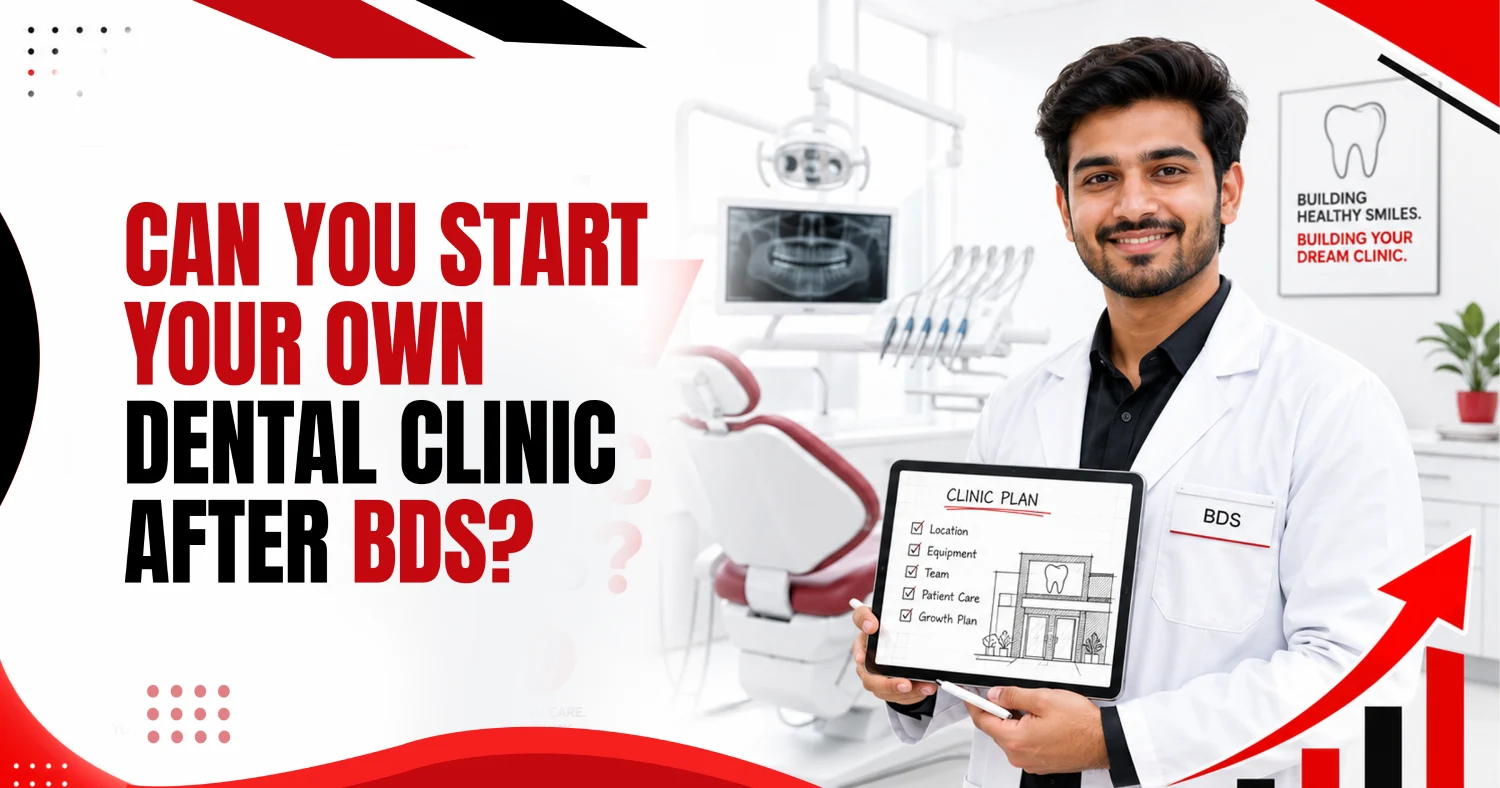
Stepping into the field of dentistry sounds good, and the curiosity pertaining to the future and career possibilities often hovers in the mind of aspirants. For many students, the dream isn’t just about becoming a dentist; it’s about building something of their own – a dental clinic where they can make a real difference in people’s lives. But at some point, most students wonder, “Can I actually start my own dental clinic right after completing my Bachelor of Dental Surgery (BDS)?” And the answer is ‘YES’.
There is a moment every dental intern remembers. The last case of the day is done, the department is emptying, and a senior asks the question casually. So, clinic or job?
It sounds like a small question. It is not. Behind it sit two numbers that most students never see written down side by side: what the degree cost, and what the first clinic will cost.
For many students, the second number is the frightening one, mostly because nobody talks about it plainly. Equipment dealers quote packages. Seniors quote rumours. Parents quote whatever a cousin spent in 2014.
The fees for BDS course are easier to research, though even there the spread is wide enough to confuse anyone. A government seat can cost less than a single year at a deemed university.
This guide puts both sets of figures in one place. It covers what a BDS graduate is legally allowed to do, what a college should be judged on before any money changes hands, what the course actually costs once hostel and instruments are added, what a clinic costs to build in 2026, and ten steps that make the first practice survive its first year.
Can a BDS Graduate Legally Open a Dental Clinic in India?
Yes. An MDS is not required to run a general dental practice. What is required is a completed one-year compulsory rotatory internship and registration with a State Dental Council, which issues the registration number that makes the practice lawful.
It is quite common to hear that a fresh graduate cannot do much without a postgraduate degree. The reality on the ground is somewhat different.
The practical position is a little softer than the legal one. Most graduates who do well spend a year or two working under someone else before they sign a lease, because chairside speed and a personal patient list are worth more on opening day than any piece of equipment.
What a registered BDS graduate can and cannot do
| A registered BDS graduate can | A registered BDS graduate cannot |
| Open and own a dental clinic in their own name | Advertise themselves as a specialist in any of the nine MDS branches |
| Diagnose, plan treatment and take radiographs | Perform procedures that fall outside recognised general dental practice |
| Perform fillings, root canal treatment, scaling, extractions and dentures | Practise before completing the internship and obtaining council registration |
| Place implants after a recognised fellowship or certificate course | Run an X-ray unit without an AERB licence obtained through the eLORA portal |
| Employ other dentists, hygienists and support staff | Operate without clinical establishment registration in states that require it |
| Apply for government-backed business finance as a professional | Dispose of clinical waste outside an authorised biomedical waste channel |
Sources: National Dental Commission registration rules; Clinical Establishments (Registration and Regulation) Act 2010; Atomic Energy Regulatory Board eLORA guidelines.
How Should a Student Choose the Best Dental College Before Any of This?
Everything above depends on one earlier decision. A graduate who has treated two hundred patients opens a clinic differently from one who has watched two hundred.
From a student point of view, the questions worth asking are the ones with numbers as answers. A college that gives a clear figure is usually confident about it. A college that answers with adjectives is often describing the brochure rather than the clinic.
Seven checks before choosing a dental college
| What to check | Why it matters | The question to ask |
| Regulatory listing | Only recognised colleges allow council registration later | Does the college and its current intake appear on the National Dental Commission list? |
| Daily patient count | Skill comes from repetition, not from infrastructure | How many patients does each department see in a day? |
| Chairs per final-year student | Decides how much a student personally treats | How many working chairs are available in the final year? |
| Attached hospital | Gives medical, surgical and emergency case handling | Is there a hospital on the same campus, and how many departments? |
| Affiliating university | Decides degree acceptance for NEET MDS and registration | Which university awards the degree? |
| Digital equipment access | Scanners and CBCT are standard in 2026 practice | In which year do students first operate the equipment themselves? |
| Written fee and stipend terms | Prevents surprises in years two to five | Can the approved fee notification and internship stipend be given in writing? |
Sources: National Dental Commission college listing requirements; Dental Council of India BDS Course Regulations and clinical quota norms.
What Are the Fees for BDS Course in India in 2026?
The honest answer is that no single figure exists. The gap between the cheapest and the costliest seat in the country runs to more than a hundred times.
The spread exists for a reason. Government seats are subsidised, private and deemed fees are approved each year by a state fee regulatory committee, and inside the same private college a government quota seat and a management quota seat can differ by several lakh a year. Two students sitting in the same lecture hall may therefore be paying very different amounts.
Which Costs Sit Outside the Fees for BDS Course?
Not everyone is aware that tuition is only part of the bill. The additions below are the ones families most often forget when they compare two colleges.
Costs that sit outside tuition
| Cost head | What to expect |
| Hostel and mess | Roughly Rs 40,000 to Rs 1,00,000 a year, depending on room type and city |
| Instrument kit and clinical materials | A one-time purchase in the early years, with top-ups through the clinical years |
| University examination and registration charges | Payable each academic year, separate from college tuition |
| Books, study material and dental models | Steady through the first three years |
| Internship year | A stipend may be paid, though the amount varies widely by state and by college |
| State dental council registration | A one-time charge after the internship, before practice can begin |
Sources: Published BDS fee and cost breakdowns, 2026; state dental council registration schedules.
One point is worth making plainly. When two colleges quote similar BDS course fees, the deciding factor should be the daily patient count, not the campus photographs. A cheaper seat at a college with an empty waiting room costs far more in the long run.
What Does It Cost to Set Up a Dental Clinic in India?
Less than most students fear, and more than most equipment dealers admit at the first meeting.
Dental clinic setup cost in India, 2026
| Clinic type | Approximate investment | What it includes |
| Basic single-chair clinic, tier-2 or tier-3 town | Rs 5 lakh to Rs 12 lakh | One chair, compressor, suction, autoclave, RVG sensor, basic interiors |
| Mid-range single or two-chair clinic, metro | Rs 15 lakh to Rs 25 lakh | Better chair, digital radiography, finished interiors, signage, staff |
| Advanced clinic with imaging and digital workflow | Rs 25 lakh to Rs 50 lakh | Adds OPG or CBCT, intraoral scanner, larger premises |
| Multi-chair specialty centre | Rs 50 lakh to Rs 1.5 crore | Three to five chairs, in-house laboratory, CAD/CAM, specialty positioning |
| Monthly running cost | Rs 40,000 to Rs 2,00,000 | Rent, salaries, consumables, waste disposal, software, marketing |
Sources: Dental clinic setup cost analyses published by Dentosky, Unicorn Denmart and Echelon Consulting, 2026.
One distinction saves a lot of trouble later. The setup figure is a one-time cost that can be staged over two or three years, while the monthly running cost starts on day one and does not wait for patients to arrive. A clinic that spends every rupee on equipment and keeps nothing back for six months of rent and salaries is the commonest way a good practice fails early.
What are the main equipment costs in 2026?
| Item | Approximate price | Note |
| Dental chair, Indian brand | Rs 2.5 lakh to Rs 5 lakh | The single largest first purchase; check local service support before brand |
| Dental chair, premium or imported | Rs 12 lakh to Rs 25 lakh | Rarely justified for a first clinic |
| RVG sensor with X-ray unit | Rs 1.4 lakh to Rs 2 lakh | Needs an AERB licence through eLORA before use |
| Silent oil-free compressor | From about Rs 55,000 | Worth buying new |
| Handpiece set | Rs 25,000 to Rs 40,000 per set | Quality here affects daily comfort and case time |
| Autoclave, Class B | Part of the basic package | Non-negotiable for infection control |
| Interiors for a single-chair clinic | Rs 3 lakh to Rs 6 lakh | Patients judge clinical skill partly on the room |
| Opening stock of materials | Around Rs 2 lakh | Composites, rotary files, consumables |
| OPG or CBCT | Rs 8 lakh to Rs 25 lakh | A later upgrade, not a first-year purchase |
Sources: Dental equipment price guides published by Dentosky, Unicorn Denmart and Best Dental Deals, 2026.
What Are the 10 Ways to Start Your Own Dental Clinic After BDS?
Ask any practitioner who survived the first two years, and the advice arrives in roughly this order.
1. Register with the State Dental Council first. The internship completion certificate and the council registration number are the legal basis for every step that follows, including the loan application and the clinical establishment licence.
2. Work as an associate for a year or two before spending anything. Speed, chairside confidence and a personal patient list are built in someone else clinic at no capital risk. Graduates who skip this stage are the ones who struggle most.
3. Choose the location on footfall, not on rent. A ground-floor unit with visible signage on a busy road beats a cheaper first-floor space on a quiet lane, and the difference shows within three months.
4. Start with one chair. A second chair adds a compressor, a suction line, an autoclave load and a salary. Add it when the first chair is genuinely full, not before.
5. Complete the licences in sequence, not in parallel. Clinical establishment registration, biomedical waste authorisation, the AERB licence through the eLORA portal, the municipal trade licence and, where applicable, GST registration and a fire NOC.
6. Buy the chair, compressor and sterilisation unit new, and defer the rest. Service support in your own city matters more than the brand name. A chair with no engineer nearby is a liability rather than an asset.
7. Fund the setup through a scheme built for it. MUDRA offers collateral-free credit up to Rs 10 lakh, PMEGP carries a government subsidy of 15 to 35 per cent of project cost, and CGTMSE-backed MSME loans remove the collateral requirement for larger projects.
8. Outsource laboratory work at the start. Between 60 and 70 per cent of Indian dental clinics outsource, and an in-house ceramic furnace or milling unit belongs to year four rather than year one.
9. Build the Google Business Profile before opening day. Around nine in ten patients search for a dentist nearby, so the listing, the photographs and the first reviews matter as much as the signboard.
10. Keep six months of running costs in reserve, and add one billable skill. A short fellowship in implantology, clear aligners or aesthetic dentistry turns the same chair into a higher-value appointment without another three years of study.
Licences and registrations a dental clinic needs
| Registration | Issued by | Why it is needed |
| State Dental Council registration | The State Dental Council | The legal basis for practising; the number must be displayed at the clinic |
| Clinical establishment registration | State health authority under the Clinical Establishments Act 2010, or the state own law where one exists | The core permission to operate; Delhi, Maharashtra and Karnataka follow their own statutes |
| AERB licence via the eLORA portal | Atomic Energy Regulatory Board | Mandatory for every dental X-ray unit, including intra-oral and hand-held; usually valid five years |
| Biomedical waste authorisation | State Pollution Control Board | Required alongside a tie-up with a common biomedical waste treatment facility |
| Trade or health trade licence | Municipal corporation | Permission to run a commercial clinical premises at that address |
| Fire NOC | Local fire department | Applies according to premises size and building type |
| GST registration and PAN or TAN | Income Tax Department and GST authorities | Applicable once turnover or staff payroll crosses the relevant threshold |
Sources: Atomic Energy Regulatory Board eLORA licensing guidelines; Clinical Establishments (Registration and Regulation) Act 2010; State Pollution Control Board biomedical waste rules.
Final Thought
Set the two figures beside each other and the picture settles. The fees for BDS course are the larger investment for most families, and the clinic that follows is usually the smaller one, especially outside the metros. A graduate who trained where the patients were can open a working single-chair practice for less than one year of tuition at a deemed university.
That is why the college decision carries so much weight. DJ College of Dental Sciences & Research has been teaching since 1999 at Modinagar in Ghaziabad district, runs nine clinical departments as separate clinics, keeps a multi-speciality hospital on the same campus and records over a hundred patients per department every day. Those numbers are what a student converts into speed, and speed is what makes the first clinic work.
Admissions for the 2026-27 BDS and MDS sessions at DJ College of Dental Sciences & Research are open to NEET qualified candidates. The approved fee structure, eligibility, counselling and scholarship details are available on the official website, djdentalcollege.com, or from the admissions office directly.
Frequently Asked Questions
Q1. Can a BDS graduate open a dental clinic without an MDS?
Yes. An MDS is not required for general dental practice. A graduate needs a completed one-year compulsory rotatory internship and registration with a State Dental Council. The registration number is what makes the practice lawful, and it must be displayed at the clinic.
Q2. What are the fees for BDS course in India in 2026?
Government dental colleges charge roughly Rs 15,000 to Rs 60,000 a year, which works out to about Rs 75,000 to Rs 3 lakh for the full five years. Private colleges range from Rs 2 lakh to Rs 10 lakh a year, and deemed universities charge more. Every private fee is approved annually by a state fee regulatory committee.
Q3. How much does it cost to open a dental clinic in India?
A basic single-chair clinic in a smaller town starts at about Rs 5 lakh to Rs 12 lakh. A mid-range metro clinic runs Rs 15 lakh to Rs 25 lakh, and a multi-chair specialty centre can reach Rs 1.5 crore. Monthly running costs sit between Rs 40,000 and Rs 2,00,000.
Q4. Which licences are needed to run a dental clinic in India?
State Dental Council registration, clinical establishment registration, an AERB licence through the eLORA portal for any X-ray unit, biomedical waste authorisation from the State Pollution Control Board, a municipal trade licence, and a fire NOC or GST registration where these apply.
Q5. Can a fresh BDS graduate get a loan to open a clinic?
Yes. MUDRA provides collateral-free credit of up to Rs 10 lakh for small healthcare businesses, PMEGP offers a government subsidy of 15 to 35 per cent of project cost for new service enterprises, and CGTMSE-backed MSME loans remove the collateral requirement on larger projects. Many lenders also ask for one to three years of clinical experience.
Related Posts