Why Should You Choose Oral Medicine and Radiology? Know the Future!
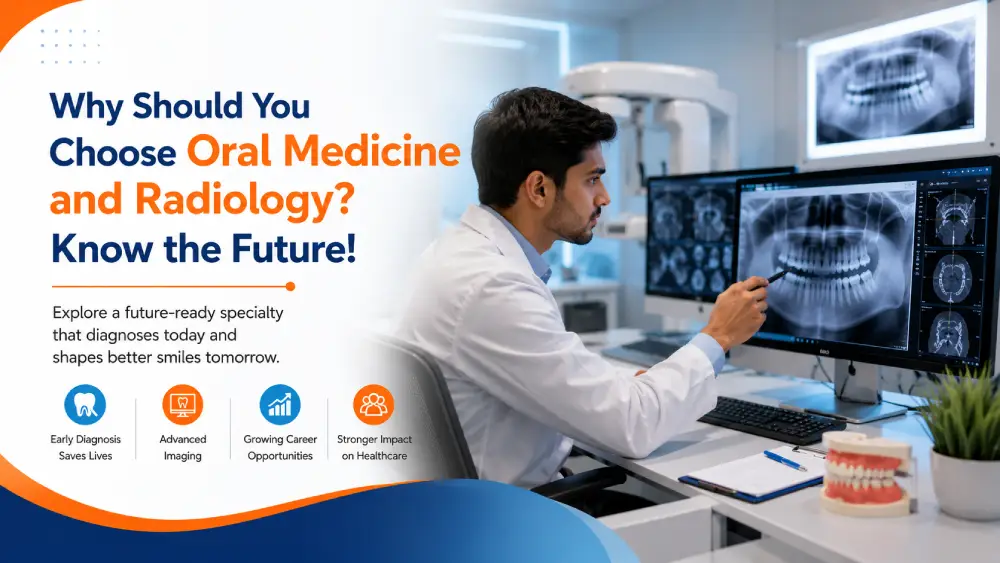
Stepping into the field of dentistry sounds good, and the curiosity pertaining to the future and career possibilities hovers in the mind of aspirants. One branch shapes almost every dental treatment, yet few students talk about it. That branch is oral medicine and radiology. It is the part of dentistry that finds out what is wrong before any treatment starts. A dentist may spot a white patch, a mouth ulcer that will not heal, or an odd shadow on an X-ray. The oral medicine and radiology expert studies these signs and names the problem early. In a country where oral cancer sits among the highest in the world, this early catch can save a life. Many students still ask one simple question. Is this branch worth it, and what does the road ahead look like? The short answer is a clear yes. The need for dental diagnosis keeps rising, imaging tools grow better each year, and skilled experts are wanted across hospitals, clinics and colleges. This blog breaks the subject down in plain words, backed by real numbers, so students and parents can choose well.
What is oral medicine and radiology in simple words?
Oral medicine and radiology is the dental speciality that finds and treats diseases of the mouth, jaws and face, and uses imaging like X-rays and scans to confirm them. In short, it is the detective work of dentistry.
The two sides that work as a team
The subject has two sides that support each other. Oral medicine looks at diseases of the soft tissue, such as ulcers, infections, oral cancer and jaw pain. Oral and maxillofacial radiology uses X-rays, OPG scans, CBCT and other images to see inside the teeth, bone and jaw. Put together, they help a dentist plan the right treatment.
| Aspect | Oral medicine | Oral and maxillofacial radiology |
| Main focus | Diseases of the mouth and soft tissue | Imaging of teeth, bone and jaw |
| Typical task | Diagnosis of ulcers, infections, oral cancer and jaw pain | Taking and reading X-rays, OPG and CBCT scans |
| Tools used | Clinical exam, biopsy, blood tests | Intraoral X-ray, panoramic machine, CBCT |
| Patient example | A patient with a mouth ulcer that will not heal | A patient needing a jaw scan before implant surgery |
Is oral medicine and radiology good as a career choice?
Yes. So, is oral medicine and radiology good for the long run? For a student who enjoys problem solving and medicine, it is one of the safer choices in dentistry.
General dentistry in India has grown crowded. The country now has over 3.5 lakh dentists registered with the Dental Council of India, and their numbers rise faster than the population. A plain BDS degree meets heavy competition. A speciality like this one helps a candidate stand apart, because few dentists can read complex scans or spot early oral cancer. That skill stays in demand.
What makes the future of oral medicine and radiology so bright?
The future of oral medicine and radiology looks strong, because dental imaging is one of the fastest growing parts of Indian healthcare. The demand for oral medicine and radiology experts keeps rising as scanners reach more towns and cities.
What the numbers show
The figures below come from public reports and research. They point one way, towards steady growth and real need.
| What the data shows | Figure | Source |
| Dentists registered with the DCI in India | Over 3.5 lakh | Deccan Herald, 2024 |
| India’s share of the world’s oral cancer cases | About one-third | NAMS report, 2025 |
| New oral cancer cases in India (2020) | Around 1,30,000 | NAMS report, 2025 |
| India dental imaging market (FY2024 to FY2032) | USD 169.72M to USD 363.81M | Marketsandata |
| India CBCT dental imaging market growth | About 16.7% each year | Data Bridge Research |
| MDS seats across approved dental colleges (2025-26) | 7,357 seats, 276 colleges | Shiksha / DCI |
The technology angle
Machines are spreading into more clinics, and someone must run and read them. Apollo Dental alone announced an investment of around INR 100 crore to open 50 new dental centres fitted with CBCT and digital X-ray units. Artificial intelligence now helps read scans, but it does not replace the expert. It works beside the specialist and makes the job faster and safer. Because India carries a heavy oral cancer load, and many cases are found late, the need for skilled diagnosis keeps growing.
Learn More About: How Artificial Intelligence is Changing Modern Dentistry
What career paths can you explore in oral medicine and radiology?
The career of oral medicine opens doors across clinics, hospitals, teaching and research. A specialist is not stuck at one desk. The choices are wide, and each one uses the same core skill of finding disease early.
Where can these experts work?
| Career path | Where they work | Main work |
| Oral medicine specialist | Dental clinics and hospitals | Diagnose oral diseases and jaw pain |
| Oral radiologist | Imaging centres, dental hospitals | Run and read X-rays, OPG and CBCT |
| Dental college faculty | Dental colleges | Teach students and guide research |
| Hospital consultant | Multi-speciality hospitals | Support cancer and surgery teams |
| Researcher | Universities and research units | Study new imaging and oral diseases |
| Forensic odontologist | Legal and forensic units | Use dental records to identify people |
| Own practice / consultant | Private clinic | Offer diagnosis and imaging services |
How much can they earn?
Pay grows with skill and years. The figures below are indicative only. They change with city, sector and experience, and are self-reported by job websites.
| Stage or role | Indicative pay per year | Note |
| Fresh MDS specialist | About INR 3 lakh to 10 lakh | Varies by city and clinic |
| Government dental officer | Around INR 4 lakh and above | Comes with job security |
| Experienced specialist / consultant | INR 10 lakh and above | Rises with reputation |
| Senior college faculty | Competitive academic pay | Plus research scope |
What are the eligibility and course details for oral medicine and radiology?
To become an oral medicine and radiology specialist, a student first finishes BDS, then completes a three-year MDS in this branch. Entry to the MDS is through the NEET MDS exam.
| Item | Detail |
| First degree | BDS (Bachelor of Dental Surgery), 5 years including internship |
| Entry test for MDS | NEET MDS score |
| Speciality course | MDS in Oral Medicine and Radiology, 3 years |
| Registration | State Dental Council registration after BDS |
| Recognised by | Dental Council of India (DCI) |
| Route at DJ College | BDS, then MDS in Oral Medicine & Radiology on the same campus |
What does the MDS course actually teach?
The oral medicine and radiology MDS mixes medicine, imaging and clinical practice. Over three years, students move from basic science to advanced scans and real patients.
| Focus area | What students learn |
| Oral medicine | Mouth ulcers, oral cancer, orofacial pain, salivary gland problems |
| Oral and maxillofacial radiology | X-ray methods, film and digital image reading |
| Advanced imaging | CBCT, CT, MRI and ultrasound of the face and jaw |
| Clinical therapeutics | Medicines for oral conditions and medically complex patients |
| Forensic odontology | Using dental knowledge for legal and identity work |
| Lab investigations | Blood and biochemical tests linked to oral diagnosis |
Why do students choose DJ College of Dental Sciences & Research?
Students choose DJ College of Dental Sciences & Research because it teaches oral medicine and radiology with strong clinical exposure, experienced faculty and a large campus, all in one place.
Set up in 1999 in Modinagar, Ghaziabad, the college sits close to Delhi NCR. It is approved by the Dental Council of India and holds NAAC accreditation as part of the DJ Group of Institutions. Its student community comes from over 17 countries, which gives the campus a wide, mixed feel.
| Feature | Detail |
| Years of experience | Over 25 years, since 1999 |
| Recognition | Approved by the Dental Council of India (DCI); NAAC accredited |
| Location | Modinagar, Ghaziabad, Uttar Pradesh, near Delhi NCR |
| Programmes | BDS and MDS with several specialisations, including Oral Medicine & Radiology |
| Faculty | Experienced and qualified teachers |
| Global presence | Students from 17+ countries |
| Patient exposure | Over 100 patients per department each day |
| Campus | Large modern campus, about 75 acres |
| Student support | Scholarships and career guidance |
The Department of Oral Medicine & Radiology is guided by senior faculty, which supports steady teaching, research and hands-on training.
Know More: Why Do BDS Graduates Prefer DJ College of Dental Sciences for Postgraduate Study?
How can students compare DJ College with other dental colleges in the region?
The Delhi NCR and Uttar Pradesh belt has several dental colleges, such as ITS Dental College, Institute of Dental Studies & Technologies (IDST), Inderprastha Dental College & Hospital, Santosh Dental College, Shree Bankey Bihari Dental College & Research Centre, Subharti Dental College and KD Dental College. A smart choice comes from comparing each college on the same checklist, rather than on name alone. The table below shows the points that matter, and what DJ College offers on each.
| What to check | Why it matters | DJ College offering |
| DCI recognition | Confirms a valid, legal degree | Approved by the DCI |
| Patient flow | More patients means better hands-on practice | High footfall across departments each day |
| Faculty experience | Good teachers shape good dentists | Experienced, qualified faculty |
| Imaging facilities | Modern scanners build real skill | Radiology and imaging support on campus |
| MDS specialisations | Wider choice for higher study | Includes Oral Medicine & Radiology |
| Campus and hostel | Comfort supports study | Large campus with hostel facilities |
| Global exposure | A mixed student base widens learning | Students from 17+ countries |
Should a student pick oral medicine and radiology?
For a student who likes medicine, puzzles and helping people early, oral medicine and radiology is a wise and future-ready choice. Demand is rising, the tools keep getting better, and India needs skilled diagnosticians to fight its heavy oral cancer burden. A degree from a recognised college such as DJ College of Dental Sciences & Research gives a strong start. The road asks for hard work, but it leads to a respected and steady career.
Frequently asked questions:
What is oral medicine and radiology?
Oral medicine and radiology is the dental speciality that diagnoses diseases of the mouth, jaws and face and uses imaging such as X-rays, OPG scans and CBCT to confirm them.
Is oral medicine and radiology good as a career?
Yes. It suits students who enjoy medicine and problem solving. General dentistry is crowded, so this speciality helps a dentist stand apart, and demand for skilled diagnosis keeps rising.
What is the future of oral medicine and radiology in India?
The future looks strong. India’s dental imaging market is growing fast, scanners are reaching smaller towns, and the country’s high oral cancer burden needs early, expert diagnosis.
How many years does it take to become a specialist?
A student needs 5 years for BDS, including internship, and then 3 years for the MDS in Oral Medicine and Radiology. So about 8 years in total after school.
What is the eligibility for MDS in Oral Medicine and Radiology?
A candidate must hold a BDS degree, have State Dental Council registration, and qualify the NEET MDS exam for admission.
What does an oral medicine and radiology specialist do?
The specialist diagnoses oral diseases, mouth ulcers, jaw pain and oral cancer, and takes and reads dental X-rays, OPG scans and CBCT images to guide treatment.
What jobs can students get after this course?
They can work as oral medicine specialists, oral radiologists, dental college faculty, hospital consultants, researchers or forensic odontologists, or run their own diagnosis practice.
What is the salary after MDS in Oral Medicine and Radiology?
Indicative starting pay ranges from about INR 3 lakh to 10 lakh per year, and rises with experience, city and sector. Figures vary and are self-reported by job sources.
Will AI replace dental radiologists?
No. Artificial intelligence helps read scans faster, but it works beside the specialist. A trained expert is still needed to confirm findings and plan care.
Does DJ College offer Oral Medicine and Radiology?
Yes. DJ College of Dental Sciences & Research offers MDS in Oral Medicine & Radiology among its dental specialisations, with clinical and imaging exposure on campus.
Where is DJ College of Dental Sciences & Research located?
The college is in Modinagar, Ghaziabad, Uttar Pradesh (PIN 201204), close to the Delhi NCR region.
Is NEET needed for admission?
Yes. NEET is required for BDS, and NEET MDS is required for the MDS speciality. Admission follows the counselling process.
Related Posts