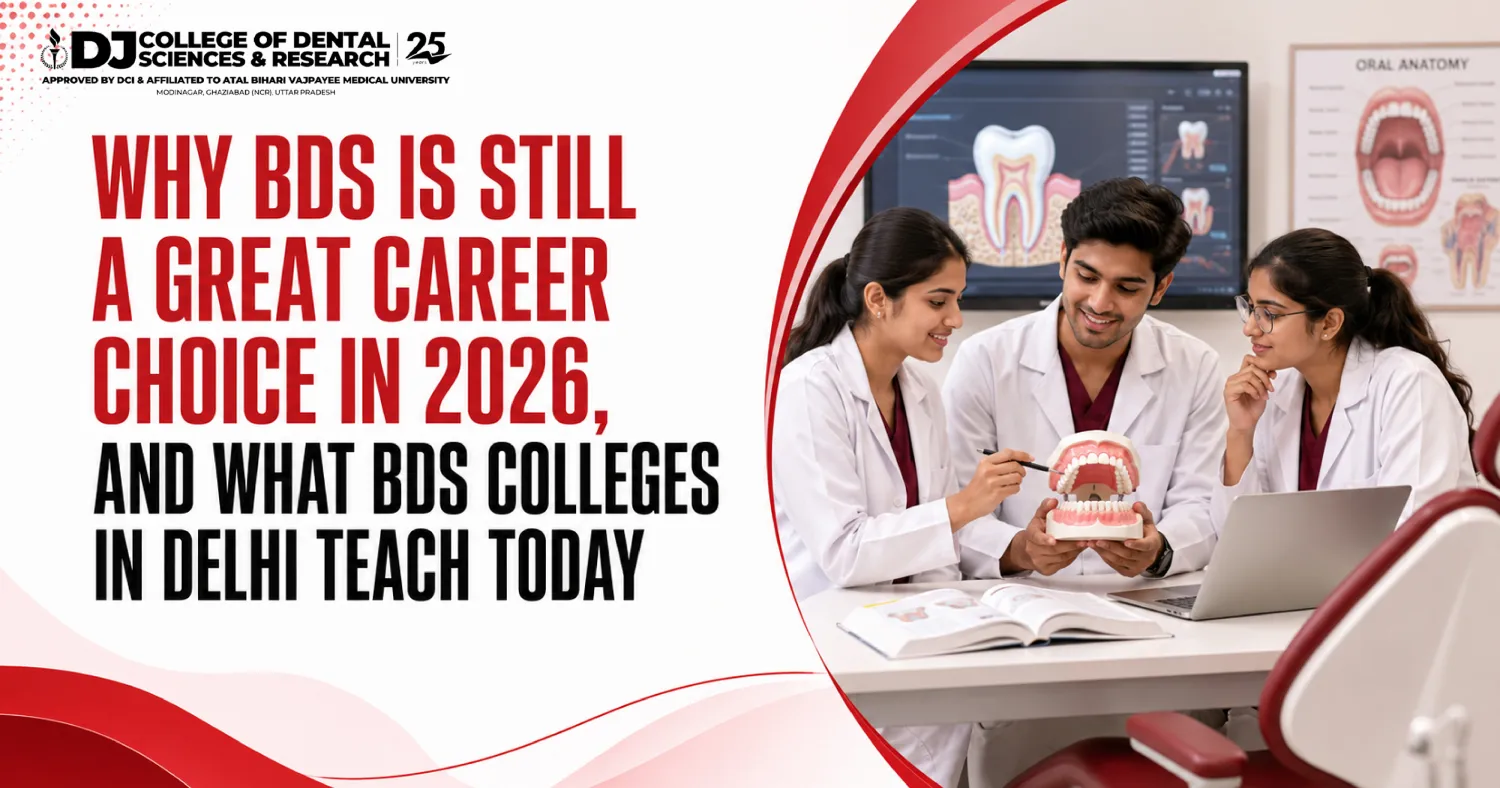
Every summer, a familiar scene plays out in thousands of Indian homes. The NEET result is out. The rank is decent, but not dazzling. A medical seat looks out of reach, and the family gathers around one phone screen typing the same question into Google: is BDS worth it now?
It is a fair question, and it deserves a fair answer rather than a sales pitch.
Close to 20 lakh students appeared for NEET UG 2026 and 11.21 lakh qualified, according to the National Testing Agency result notice dated 16 July 2026. Against that number, India offers roughly 27,900 BDS seats. The degree is not easy to get. Yet many families still hesitate, because they have heard from somewhere that dentistry has become crowded.
Here is what that worry leaves out. India has an enormous untreated oral disease load, and the people who need care most are the ones sitting farthest from a dentist. That gap is where a new graduate actually builds a career.
This guide walks through what BDS teaches, how it compares with MBBS, what the earnings look like, fifteen career paths that follow the degree, and what a student should check before picking from the many BDS colleges in Delhi and the wider National Capital Region.
What Is BDS, and Why Do Students Still Choose It?
BDS stands for Bachelor of Dental Surgery. It is the only undergraduate degree in India that allows a person to register as a dentist and treat patients legally. The course runs for four academic years and is followed by a one-year compulsory rotatory internship, which makes the full path five years.
Admission runs through NEET UG. Every dental college in the country, government or private, admits students only through that route.
One question that often comes up is whether dentistry counts as proper medicine. It does. A dental student studies anatomy, physiology, biochemistry, pathology, microbiology, pharmacology, general medicine and general surgery alongside the dental subjects. The difference lies in the area of focus, not the depth of the science.
BDS at a glance (2026-27 session)
| Point | Detail |
| Full name | Bachelor of Dental Surgery |
| Duration | 4 academic years plus 1 year of compulsory rotatory internship |
| Entrance examination | NEET UG, conducted by the National Testing Agency |
| Minimum qualification | 10+2 with Physics, Chemistry, Biology and English |
| Minimum age | 17 years completed on or before 31 December of the admission year |
| Regulator | National Dental Commission, which replaced the Dental Council of India on 19 March 2026 |
| Counselling | MCC handles All India Quota and deemed seats; state authorities handle state quota and private seats |
| Dental colleges in India | Roughly 319 to 329, depending on the year of the seat matrix |
| BDS seats in India | About 27,900, of which close to 74 per cent sit in private colleges |
| Postgraduate route | NEET MDS, leading to a three-year MDS in one of nine specialities |
Sources: National Testing Agency; National Dental Commission and Dental Council of India seat data; DJ College of Dental Sciences & Research BDS eligibility page.
What Is Actually Taught in a BDS Course?
The first two years are laboratory years. Students carve teeth out of wax, set artificial teeth on plaster models and practise cavity preparation on typodonts long before a live patient is involved. Clinical work starts in the third year and takes over almost completely in the fourth.
By the end of the internship, a student log book usually records a fixed quota of restorations, extractions, scalings, dentures and root canal treatments, every one of them completed under supervision.
Which Subjects Come in Which Year?
| Year | Main subjects | What happens in the clinic |
| First year | General Human Anatomy, General Human Physiology, Biochemistry, Dental Anatomy, Embryology and Oral Histology | Pre-clinical laboratory work only. Wax carving, tooth morphology and model work |
| Second year | General Pathology, Microbiology, Pharmacology, Dental Materials, Pre-clinical Prosthodontics, Pre-clinical Conservative Dentistry | Ward visits begin. Students observe chairside procedures and start typodont practice |
| Third year | General Medicine, General Surgery, Oral Pathology and Oral Microbiology, Oral Medicine and Radiology | Supervised chairside work begins. Case history taking, radiographs, simple restorations |
| Fourth year | Orthodontics, Paediatric and Preventive Dentistry, Periodontology, Prosthodontics, Conservative Dentistry and Endodontics, Oral and Maxillofacial Surgery, Public Health Dentistry | Full case handling across all nine departments with daily patient quotas |
| Internship (1 year) | No new theory. Rotation through every clinical department plus community postings | Independent case handling under supervision, camp duty and referral practice |
Sources: Dental Council of India BDS Course Regulations; DJ College of Dental Sciences & Research course and syllabus page.
What Do the Nine Clinical Departments Train a Student to Do?
A properly run dental college keeps all nine departments working as separate clinics, each with its own patient queue. That structure matters, because the number of cases a student handles inside each department decides how steady that student feels on day one of practice. This is one of the sharpest points of difference between BDS colleges in Delhi NCR, and it rarely appears in a brochure.
The 9 dental departments and the skills each one builds
| Department | What a student learns to do |
| Oral Medicine and Radiology | Diagnosis from case history, clinical examination and imaging. Reading IOPA, OPG and CBCT scans |
| Conservative Dentistry and Endodontics | Fillings, root canal treatment, post-endodontic restoration and aesthetic front-tooth work |
| Prosthodontics, Crown and Bridge and Implantology | Complete and partial dentures, crowns, bridges and implant-supported replacements |
| Periodontology and Oral Implantology | Scaling and root planing, gum disease management, flap surgery and implant maintenance |
| Oral Pathology and Microbiology | Biopsy handling and reporting, oral cancer screening and laboratory diagnosis |
| Orthodontics and Dentofacial Orthopaedics | Braces, aligners, space management and correction of jaw growth patterns |
| Paediatric and Preventive Dentistry | Treating children, fluoride and sealant programmes, habit correction and behaviour management |
| Oral and Maxillofacial Surgery | Extractions, impacted third molars, minor oral surgery, facial trauma and jaw procedures |
| Public Health Dentistry | Screening camps, epidemiological surveys, school programmes and oral health policy work |
Why Does BDS Still Have Strong Scope in India?
The World Health Organization estimates that oral diseases affect close to 3.7 billion people, and that untreated tooth decay in permanent teeth is the single most common health condition on earth. Its Global Oral Health Status Report placed the figure at 3.5 billion people, or about 45 per cent of the world population, and noted that cases have risen by a billion over three decades. India carries a heavy share of that load, and a large part of it never reaches a dental chair.
The demand and supply picture behind BDS scope
| Indicator | Latest figure | Source |
| People living with an oral disease worldwide | Close to 3.7 billion | WHO Oral Health fact sheet, 2025 |
| Share of the world population affected | About 45 per cent, or 3.5 billion people | WHO Global Oral Health Status Report, 2022 |
| People with untreated tooth decay | About 2.5 billion | WHO Global Oral Health Status Report, 2022 |
| Rise in oral disease cases over 30 years | About 1 billion additional cases | WHO, 2022 |
| Dentists registered in India | Over 3.5 lakh | Dental Council of India, as reported in 2024 |
| WHO benchmark dentist-to-population ratio | 1 dentist for every 7,500 people | World Health Organization |
| Urban India dentist-to-population ratio | About 1 for every 10,000 people | State dental council reporting, 2024 |
| Rural India dentist-to-population ratio | Between 1:50,000 and 1:2,50,000 | Indian dental workforce reporting, 2025 |
| Government dental colleges in India | About 56, holding roughly 4,100 BDS seats | National Dental Commission seat data, 2026 |
Sources: World Health Organization; Dental Council of India; Indian dental workforce studies. Full links appear in the sources list at the end of this article.
Where Is the Real Gap That a New Dentist Can Fill?
There is little doubt that the metros are crowded. A 2025 analysis by the Observer Research Foundation warned that India is producing dentists over three times faster than the population is growing, and that opening a clinic in a saturated urban market has become financially risky for a fresh graduate. That criticism is honest and worth reading before anyone signs an admission form.
The picture changes the moment one steps outside the metro ring. In rural districts the dentist-to-population ratio still sits somewhere between 1:50,000 and 1:2,50,000. Tier-two and tier-three towns across Uttar Pradesh, Haryana, Rajasthan and Bihar have populations large enough to support a serious clinic and almost no competition worth the name.
Ask any practitioner with fifteen years behind them, and they will tell you the same thing. The graduates who struggled were usually the ones who opened a general clinic in an already crowded neighbourhood with no added skill. The ones who did well either specialised, joined government or defence service, or set up early in a growing town and stayed there.
BDS vs MBBS: What Students Need to Know
Many parents and students still believe that BDS is simply a consolation prize for anyone who missed MBBS. The seat data tells a more interesting story. India has 1,36,939 MBBS seats across 823 medical colleges for the 2026-27 session, as per the National Medical Commission seat matrix, against roughly 27,900 BDS seats. Dentistry is the smaller and, in raw numbers, the more tightly held of the two systems.
BDS compared with MBBS, point by point
| Point of comparison | BDS | MBBS |
| Course length | 4 years plus 1 year internship | 4.5 years plus 1 year internship |
| Entrance examination | NEET UG | NEET UG |
| Undergraduate seats, 2026-27 | About 27,900 | 1,36,939 (excludes AIIMS and JIPMER) |
| Number of colleges | Roughly 319 to 329 dental colleges | 823 medical colleges |
| Postgraduate seats | 6,501 MDS seats through NEET MDS 2026 | About 67,000 PG seats, as stated by the NMC in 2025 |
| Rough PG to UG seat ratio | About 1 postgraduate seat for every 4 graduates | About 1 postgraduate seat for every 2 graduates |
| Nature of daily work | Planned, appointment-based, largely outpatient procedures | Wider range, including emergencies, night duty and inpatient care |
| Time to independent practice | A graduate can open a small clinic soon after internship | Independent practice usually follows postgraduate specialisation |
| Skill type | Manual precision and aesthetic judgement, close to a craft | Diagnostic breadth across systems of the body |
Sources: National Medical Commission MBBS seat matrix 2026-27; National Dental Commission and Dental Council of India seat data; NBEMS NEET MDS 2026 seat information.
The postgraduate bottleneck is the number that deserves attention. Only about one BDS graduate in four will find an MDS seat, so a student should plan a career that works with or without one. That is not a weakness of the degree. It simply means the plan matters.
How Do Modern BDS Degrees Prepare Students for 2026 Practice?
The dental chair of 2026 looks very different from the one most parents remember. Putty impression trays are giving way to intraoral scanners. Flat radiographs are being read alongside CBCT volumes. Crowns that once took two weeks and three appointments are milled chairside from a digital file. Software now flags early decay and bone loss on a radiograph before the human eye catches it, and lasers handle soft-tissue work that used to need sutures.
In practical terms, this changes what a good college has to teach. A graduate who finishes in 2026 without touching a scanner or opening a CBCT viewer will spend the first two years of practice catching up with juniors. It is worth noting that the colleges where this equipment gets used rather than displayed are almost always the ones with heavy daily patient numbers, because volume is what turns a machine into a habit.
From a student point of view, the shortlist among BDS colleges in Delhi NCR should therefore favour institutions that can answer three plain questions: how many patients walk into each department every day, how many chairs are free per final-year student, and in which year does a student first operate the digital equipment themselves.
What Are the 15 Career Opportunities After BDS?
From an employer point of view, a dental graduate is three things at once: a trained clinician, a small business operator and a science graduate. That combination travels much further than most students expect. After completing a BDS course from one of the best BDS colleges in Delhi NCR, you will have a bunch of exciting career opportunities.
Fifteen career paths open to a BDS graduate
| No. | Career path | What the work involves |
| 1 | Associate dentist in a private clinic | General chairside dentistry under an owner dentist, usually the first job after internship |
| 2 | Own dental practice | Setting up a clinic, building a patient base and running the business side |
| 3 | MDS specialist | Three-year postgraduate training in one of nine specialities, followed by specialist practice |
| 4 | Corporate dental chain dentist | Protocol-driven practice at organised chains, with a fixed salary and case flow |
| 5 | Government dental surgeon | Posting at a primary health centre, community health centre or district hospital |
| 6 | Dental officer in the Armed Forces | Short service commission entry into the Army, Navy or Air Force dental branch |
| 7 | Academic and teaching post | Tutor, lecturer and reader roles in a dental college, usually after MDS |
| 8 | Public health dentistry and NGO work | Screening surveys, school programmes and work under the National Oral Health Programme |
| 9 | Forensic odontology | Identification of persons from dental records, working with police and disaster response teams |
| 10 | Oral implantology practice | Implant placement and restoration after a fellowship or certificate programme |
| 11 | Dental industry and medical affairs | Clinical roles at implant, aligner and dental material companies |
| 12 | Clinical research associate | Trials on oral care products, restorative materials and treatment protocols |
| 13 | Hospital administration | Management roles after an MHA or an MBA in hospital management |
| 14 | Tele-dentistry and dental communication | Remote consultation, patient education, medical writing and dental publishing |
| 15 | Licensed practice abroad | Clearing INBDE for the United States, ORE or LDS for the United Kingdom, ADC for Australia or NDEB for Canada |
Earnings vary sharply by city, by employer and by whether a dentist owns the chair or rents it. The bands below are the ones most commonly reported in 2026, and they should be read as starting points rather than promises.
Know More : What to Do After BDS?
Reported earnings for dentists in India, 2026
| Stage or role | Reported earnings | Source |
| Fresh BDS graduate in a private clinic | Rs 20,000 to Rs 40,000 a month | Salary compilations for BDS graduates, 2026 |
| Average dentist across India | About Rs 4,00,000 a year | PayScale India, 2026 |
| General dentist, self-reported range | Rs 0.3 lakh to Rs 6.0 lakh a year, average Rs 2.6 lakh across 501 reports | AmbitionBox |
| Government dental surgeon at entry | About Rs 40,000 to Rs 50,000 a month | Reporting based on the 7th Central Pay Commission matrix |
| Dentist after MDS specialisation | Rs 80,000 to Rs 1,50,000 a month | Dentist salary compilations, 2026 |
| Established owner practice | Rises with patient flow, usually from the third year onward | Practice reporting, indicative only |
Sources: PayScale India 2026; AmbitionBox self-reported salary data; published Indian dentist salary compilations, 2026. Figures are indicative and vary by city, employer and case mix.
How Big Is the Money Side of Dentistry in 2026?
For the most part, students hear about dentistry only in terms of clinic income. The sector sitting around the clinic is a good deal larger, and it is the part that creates jobs in industry, research and management. All foreign currency figures below have been converted at Rs 95 to the United States dollar, the mid-market rate on 7 August 2026.
| Indicator | Figure as published | Converted to INR | Source |
| India dental services market, 2024 | USD 2.5 billion | About Rs 23,750 crore | Nexdigm India Dental Services report |
| India dental services market growth rate to 2030 | 8 per cent a year | Not applicable | Nexdigm |
| India dental tourism market by 2030 | USD 4.6 billion | About Rs 43,700 crore | Nexdigm |
| Global dental tourism market, 2026 | USD 15.3 billion | About Rs 1,45,350 crore | Persistence Market Research |
| Global dental tourism market by 2033 | USD 52.8 billion | About Rs 5,01,600 crore | Persistence Market Research |
| India dental tourism growth rate to 2036 | 18.0 per cent a year | Not applicable | Future Market Insights |
| United States national dental spending, 2024 | USD 189 billion | About Rs 17,95,500 crore | American Dental Association analysis, January 2026 |
The dental tourism number explains itself the moment the treatment costs are placed side by side. Patients from the United States, the United Kingdom, Canada and the Gulf fly to India because the same implant system, placed by an MDS-qualified surgeon, costs a fraction of the home price. That inbound flow is one reason Indian clinics keep upgrading their equipment, and it is one reason a young dentist with implant or aesthetic skills has room to grow.
Read More : How BDS Colleges in Delhi NCR Are Shaping Tomorrow’s Clinicians
Why patients travel to India for dental treatment
| Treatment | Typical cost in the United States | Converted to INR | Typical cost in India | Converted to INR |
| Single dental implant with crown | USD 3,000 to USD 6,000 | Rs 2.85 lakh to Rs 5.70 lakh | USD 400 to USD 800 | Rs 38,000 to Rs 76,000 |
| Overall saving reported by overseas patients | 60 to 80 per cent lower | Not applicable | Same clinical protocols and implant brands | Not applicable |
| Patients travelling abroad for dental care each year | 5 million to 7 million worldwide | Not applicable | India among the top destinations | Not applicable |
Sources: Persistence Market Research dental tourism report; published 2026 dental tourism cost comparisons; United States Centers for Disease Control guidance on dental care as the most common form of medical tourism. Conversions at Rs 95 per USD.
Why Is DJ Dental College the Right Place to Build Your Dental Career?
DJ College of Dental Sciences & Research sits at Ajit Mahal, Niwari Road, Modinagar, in Ghaziabad district, roughly an hour from east Delhi. It was founded in 1999 by Ajit Singh Jassar and was among the first five private dental colleges in Uttar Pradesh. The college is affiliated to Atal Bihari Vajpayee Medical University, Lucknow, and carries recognition from the Dental Council of India, whose regulatory functions now rest with the National Dental Commission.
What Makes DJ Dental Different from Other BDS Colleges in Delhi NCR?
The short version is patient volume and a hospital on the same campus. A dental student learns by repetition, and repetition needs people in the waiting room.
DJ College of Dental Sciences & Research at a glance
| Strength | Detail |
| Years in dental education | Over 25 years, founded in 1999 |
| Campus | 75-acre DJ Group of Institutions campus at Modinagar, Ghaziabad district, Uttar Pradesh |
| Programmes offered | BDS at undergraduate level and MDS across multiple specialisations |
| Clinical departments | Nine, each running as a separate clinic |
| Daily patient load | Over 100 patients per department every day |
| On-campus hospital | A 100-bed multi-speciality hospital with 13 departments, ICUs and operation theatres, open around the clock |
| Recognition and affiliation | Recognised by the Dental Council of India, now under the National Dental Commission; affiliated to Atal Bihari Vajpayee Medical University, Lucknow; NAAC accredited |
| International student presence | Students drawn from 17 or more countries |
| Professional membership | Member of the American Academy of Developmental Medicine and Dentistry |
| Research culture | Faculty with national and international publications, with student research encouraged from the undergraduate years |
| Student support | Merit and category scholarships, career support and an IDA student branch on campus |
How Should a Student Compare BDS Colleges in Delhi and the Wider NCR Belt?
Students searching for BDS colleges in Delhi almost always mean the whole National Capital Region. The National Capital Territory itself holds only a handful of dental colleges, and nearly all of them are government institutions with very few seats. The private options sit in the surrounding districts: Ghaziabad, Greater Noida, Meerut and Gurugram. This is worth knowing before a family narrows the search by postcode and misses half the field.
The dental college cluster around Delhi
| Institution | Location | State |
| DJ College of Dental Sciences & Research | Modinagar, Ghaziabad district | Uttar Pradesh |
| Inderprastha Dental College and Hospital | Sahibabad, Ghaziabad | Uttar Pradesh |
| Institute of Dental Studies and Technologies | Ghaziabad | Uttar Pradesh |
| I.T.S Dental College | Greater Noida | Uttar Pradesh |
| I.T.S Centre for Dental Studies and Research | Muradnagar, Ghaziabad | Uttar Pradesh |
| Sharda University, School of Dental Sciences | Greater Noida | Uttar Pradesh |
| Subharti Dental College and Hospital | Meerut | Uttar Pradesh |
| Kalka Dental College | Meerut | Uttar Pradesh |
| SGT University, Faculty of Dental Sciences | Gurugram | Haryana |
Sources: Institutional websites and National Dental Commission college listings. Intake numbers change every session and should be checked on the current seat matrix before applying.
Five questions separate a good shortlist from a long one:
1. Does the college and its current BDS intake appear on the National Dental Commission list for the 2026-27 session?
2. What is the average daily patient count per department, rather than the total campus footfall?
3. Which university grants the degree, and is that degree accepted for NEET MDS and for state council registration?
4. How many working chairs are available per final-year student?
5. What are the internship stipend, hostel position and scholarship rules, confirmed in writing?
Final Thought
Dentistry rewards the patient and the practical. Nobody becomes wealthy in the first two years, and anybody promising otherwise is selling something. What the degree does hand over is a licence, a skill that improves every single year, and a very wide set of doors: clinical practice, specialisation, government service, defence, teaching, research, public health, industry and licensed work abroad.
For a student who enjoys working with their hands, likes talking to people and wants a profession that machines can assist but not replace, BDS in 2026 still holds up well. The choice that matters more than the degree itself is the college. Among the BDS colleges in Delhi and the wider NCR region, DJ College of Dental Sciences & Research offers over 25 years of teaching, nine working departments, a 100-bed hospital on the same campus and a daily patient load that gives a student the one thing no brochure can promise on its own, which is practice.
Admissions for the 2026-27 BDS session at DJ College of Dental Sciences & Research are open to NEET UG qualified candidates. Eligibility, counselling and scholarship details are available on the official website, djdentalcollege.com, or by contacting the admissions office directly.
Follow Us: LinkedIn | You Tube
Frequently Asked Questions About BDS in 2026
Q1. Is BDS still a good career option in 2026?
Yes. India carries a very large untreated oral disease burden, and the World Health Organization reports that close to 3.7 billion people worldwide live with an oral disease. Demand is steady, and a graduate can start clinical work within a year of finishing the internship. The outcome depends heavily on skill, location and whether the graduate specialises.
Q2. What is the salary of a BDS graduate in India?
A fresh BDS graduate working in a private clinic usually earns between Rs 20,000 and Rs 40,000 a month. PayScale India puts the average dentist salary at about Rs 4,00,000 a year in 2026. Government dental surgeons start around Rs 40,000 to Rs 50,000 a month, and earnings rise sharply after MDS specialisation.
Q3. Is BDS easier than MBBS?
BDS is shorter, running four years plus a one-year internship against four and a half years plus internship for MBBS. It is not easier in content. Dental students study anatomy, physiology, pathology, pharmacology, general medicine and general surgery alongside dental subjects, then add manual laboratory work that MBBS students do not face.
Q4. How many BDS seats are there in India in 2026?
India has roughly 27,900 BDS seats spread across about 319 to 329 dental colleges, according to National Dental Commission and Dental Council of India seat data. Close to 74 per cent of those seats sit in private colleges, and only about 4,100 seats are in the 56 or so government dental colleges.
Q5. Can a BDS graduate practise dentistry abroad?
Yes, after clearing the licensing examination of the destination country. The common routes are INBDE for the United States, the Overseas Registration Examination or the Licence in Dental Surgery for the United Kingdom, the Australian Dental Council examination and the NDEB pathway for Canada. Each route has its own eligibility rules and timelines.
Q6. Which is the best BDS college in Delhi NCR?
No single college suits every student, so the sensible approach is to compare institutions on daily patient volume per department, chairs available per final-year student, affiliating university, National Dental Commission listing and internship terms. Long-established private options in the region include DJ College of Dental Sciences & Research in Ghaziabad district.
Q7. Is NEET compulsory for BDS admission?
Yes. NEET UG is the only accepted entrance route for BDS admission in India, in government, private and deemed dental colleges alike. A candidate must also have passed 10+2 with Physics, Chemistry, Biology and English, and must have completed 17 years of age on or before 31 December of the admission year.
Q8. What is the scope of BDS without an MDS degree?
It is wider than most students assume. Only about one BDS graduate in four secures an MDS seat. The rest work as associate dentists, open their own clinics, join corporate dental chains, sit for government and defence dental posts, take fellowships in implantology or aesthetics, or move into dental industry, research and hospital administration roles.
Q9. How much does a BDS course cost in India?
Fees vary widely between government, private and deemed institutions, and they are revised each session by state fee regulatory committees. Students should ask each college for the approved fee notification for the current year in writing, along with hostel charges, examination fees and the scholarship categories available to them.
Q10. What is the difference between the DCI and the National Dental Commission?
The Dental Council of India regulated dental education and practice under the Dentists Act, 1948. It was dissolved on 19 March 2026 and replaced by the National Dental Commission under the National Dental Commission Act, 2023. Recognitions granted earlier continue during the transition, so existing college approvals remain valid.
Related Posts