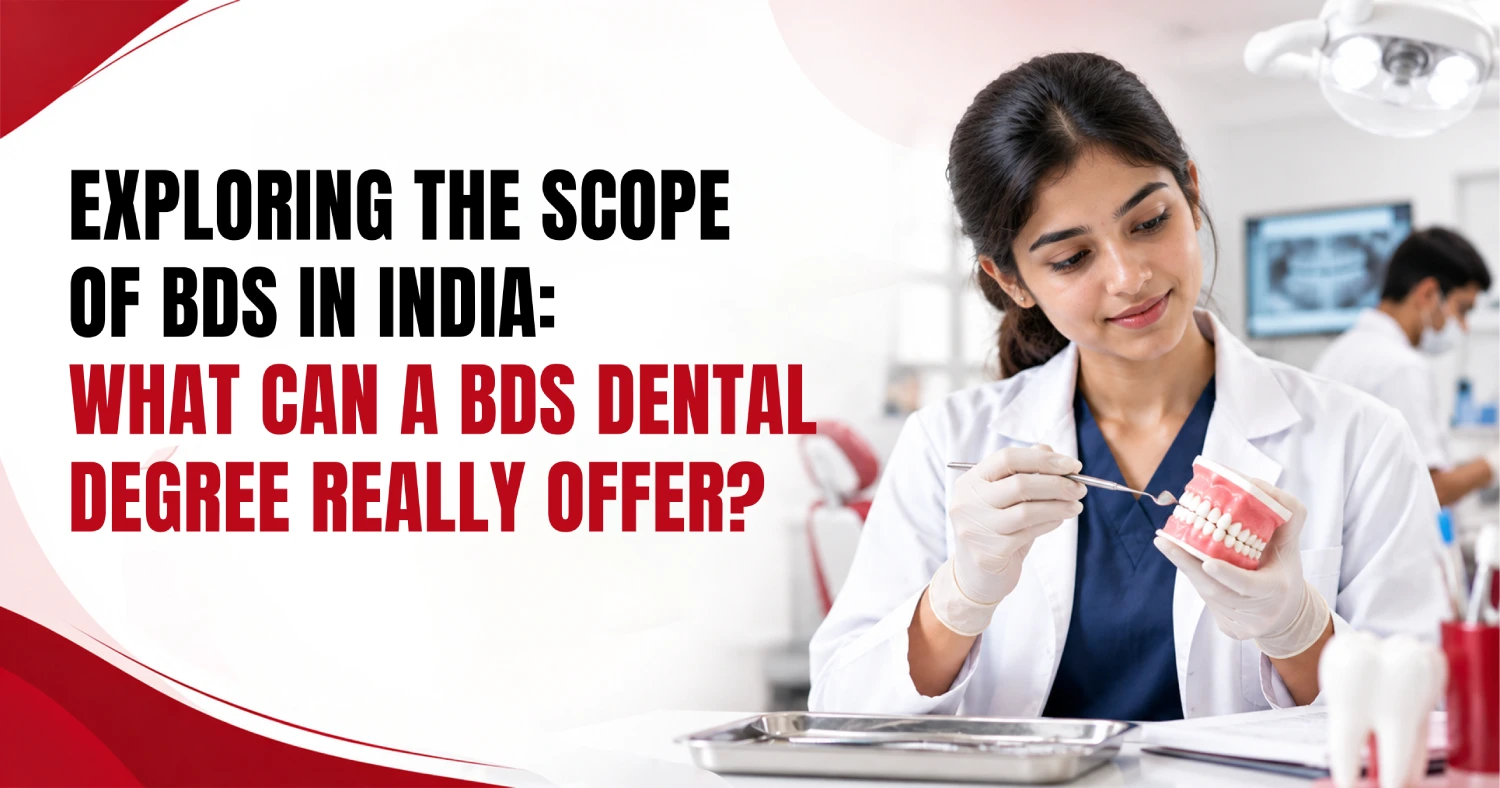
| A BDS dental degree is a five-year professional qualification, four years of study plus one year of compulsory rotating internship, that licenses a graduate to practise dentistry in India. Its scope covers private practice, hospital jobs, government posts, MDS specialisation, teaching, research, corporate dental chains and overseas licensing routes. |
Why Do So Many Students Still Pick Dentistry?
Stepping into the field of dentistry sounds good, and the curiosity pertaining to the future and career possibilities hovers in the mind of every aspirant. Parents ask one question first. After five years and a fair amount of fees, what does a dentist actually do for a living?
It is a fair question. The honest answer surprises most families.
India carries the heaviest oral disease burden on the planet. Global Burden of Disease figures quoted in the WHO Global Oral Health Status Report put India at roughly 632 million cases of the five leading oral diseases, the highest caseload of any country. Six hundred and thirty-two million mouths. Somebody has to treat them.
A worry still floats around parent WhatsApp groups. People say dentistry has become saturated. A closer look at the industry shows that the picture is patchy, not saturated. The dentists sit in the cities. The patients sit everywhere.
For many students, the value of a BDS dental degree lies in what comes after it, not in the certificate itself.
This blog walks through the full career scope of BDS in India, with real numbers, salary ranges, higher study routes and the questions worth asking before a seat is booked.
What Is the BDS Course, and Who Can Apply for It?
BDS stands for Bachelor of Dental Surgery. It is the only recognised undergraduate route to becoming a licensed dentist in India.
• Four years of academic study, followed by one year of compulsory rotating internship.
• Regulated by the Dental Council of India and the National Dental Commission.
• Admission runs through NEET UG, followed by state and all-India counselling.
• On completion, the graduate registers with a State Dental Council and can practise.
What Are the Eligibility Rules for a BDS Dental Seat?
• Pass in 10+2 with Physics, Chemistry and Biology or Biotechnology.
• At least 50 per cent aggregate in those three subjects for general category candidates.
• Minimum age of 17 years as on 31 December of the admission year.
• A qualifying NEET UG score, since no dental college can admit without it.
BDS Course Snapshot at a Glance
| Detail | Information |
| Full form | Bachelor of Dental Surgery |
| Duration | 4 years of study plus 1 year of rotating internship |
| Level | Undergraduate professional degree |
| Entrance exam | NEET UG |
| Eligibility | 10+2 with Physics, Chemistry, Biology or Biotechnology, minimum 50 per cent |
| Regulator | Dental Council of India / National Dental Commission |
| Total seats in India | 27,966 across 319 colleges (2025-26) |
| Outcome | Licence to practise dentistry after State Dental Council registration |
| Next study option | MDS, fellowships, diplomas, public health and management courses |
Source: National Dental Commission seat data for 2025-26, compiled by AspirantsOnly; Dental Council of India BDS Course Regulations.
How Big Is the Dental Field in India Right Now?
Numbers settle arguments faster than opinions. Here is what the data says.
• India has 3,76,721 dentists registered with the Dental Council of India.
• The overall dentist to population ratio sits near 1 : 3,846.
• The WHO benchmark for developing countries is 1 : 7,500.
• About 85 per cent of Indian dentists work in cities.
• In poorly served rural pockets the ratio still runs as wide as 1 : 20,000.
It would not be wrong to say that India does not have too many dentists. India has them in the wrong places.
Dental Seats and Colleges in India, 2025 to 2026
| Type of College | Colleges | BDS Seats | Share of Seats | Typical Annual Tuition |
| Government | 56 | 4,096 | 14.6% | Rs 10,000 to Rs 80,000 |
| Private | 229 | 20,580 | 73.6% | Varies by state and college |
| Deemed University | 34 | 3,290 | 11.8% | Highest of the three |
| All India Total | 319 | 27,966 | 100% | Not applicable |
Source: National Dental Commission data 2025-26, compiled and analysed by AspirantsOnly. India also offers 7,357 MDS seats across 276 colleges, as per the Dental Council of India.
Oral Disease Burden, India Against the World
| Measure | Figure | Why It Matters to a Dental Student |
| India cases of top five oral diseases | About 632 million | The largest national caseload in the world |
| People worldwide with a main oral condition | About 3.69 billion | Nearly 46 per cent of the global population |
| Untreated caries in permanent teeth (global) | About 2.24 billion cases | Fillings and root canals stay in constant demand |
| Severe gum disease (global) | About 1.07 billion cases | Periodontal work is a growing branch |
| Tooth loss, complete (global) | About 353 million cases | Dentures, crowns and implants keep prosthodontics busy |
Source: Global Burden of Disease Study 2021, published in The Lancet, 2025; WHO Global Oral Health Status Report 2022 (India caseload from GBD 2019).
What Career Paths Can a BDS Dental Graduate Explore?
This is where things become interesting. Dental career opportunities branch out far earlier than most students realise.
• Private practice, alone or as a partner in a clinic.
• Junior dentist or associate in a corporate dental chain.
• Government service through state health departments, ESIC, railways and municipal bodies.
• Armed Forces, through the Army Dental Corps and allied recruitment routes.
• Teaching in dental colleges after completing MDS.
• Public health dentistry, survey work and health policy roles.
• Research posts and clinical trial coordination.
• Dental product companies, in clinical support, training and sales.
• Hospital administration and healthcare management after a management course.
• Overseas practice after clearing the licensing exam of that country.
Ask any experienced professional in the field, and they will tell you the same thing. The degree opens the door. The skill decides the room.
Main Career Routes After a Dental Degree
| Career Route | What the Work Involves | Usual Entry Point |
| Private clinic practice | Fillings, extractions, root canals, cleaning, crowns | Straight after internship |
| Corporate dental chain | Fixed hours, shared patient flow, in-house training | Straight after internship |
| Government dental officer | Public hospitals, health centres, community programmes | Through state or central recruitment |
| Army Dental Corps | Service dentistry for personnel and families | Short service commission entry |
| MDS specialist | Braces, implants, surgery, child dentistry and more | After clearing NEET MDS |
| Dental college teaching | Lectures, clinical supervision, research guidance | After MDS |
| Public health dentistry | Camps, surveys, school programmes, policy work | After BDS or MDS |
| Overseas practice | Clinical work in the UK, USA, Australia, Canada, Gulf | After the local licensing exam |
Source: Dental Council of India career pathways; recruitment notifications of ESIC, Indian Railways and the Army Dental Corps.
How Much Does a BDS Graduate Actually Earn in India?
Honest answer first. The first two years are lean for almost everyone. Income climbs sharply once the hands get steady and patients start returning.
• A fresher usually starts between Rs 20,000 and Rs 40,000 a month.
• With three to five years behind them, that moves to Rs 50,000 to Rs 70,000.
• Experienced dentists and clinic owners cross Rs 1,00,000 a month.
• Government posts pay less at the top end but bring allowances and job security.
• Private practice income depends on location, footfall and word of mouth.
From an employer’s point of view, the pay gap between two graduates of the same batch usually comes down to one thing: how many cases each of them completed during college.
BDS Salary Range in India by Experience
| Experience Level | Monthly Income (INR) | Annual Range (INR) | What Usually Changes |
| Fresher (0 to 2 years) | Rs 20,000 to Rs 40,000 | About Rs 3 to 5 lakh | Junior roles, learning speed |
| Early career (1 to 3 years) | Rs 40,000 to Rs 60,000 | About Rs 5 to 7 lakh | Independent case handling |
| Mid level (3 to 5 years) | Rs 50,000 to Rs 70,000 | About Rs 6 to 8.5 lakh | Repeat patients, referrals |
| Experienced (5 years and above) | Rs 1,00,000 and above | Rs 12 lakh and above | Own clinic or senior post |
| After MDS specialisation | Higher than general practice | Varies by branch and city | Specialist case fees |
Source: BDS Salary in India 2026 report, PhysicsWallah (pw.live), based on market salary data. Figures are indicative and change with city, clinic and skill.
What Can a BDS Dental Graduate Earn Abroad?
Overseas earnings look large on paper. The catch is that every country demands its own licensing exam first, and living costs there run much higher.
• United Kingdom: the Overseas Registration Examination, run by the General Dental Council.
• United States: the Integrated National Board Dental Examination, followed by an advanced standing programme.
• Australia: the Australian Dental Council examination series.
• Canada: the National Dental Examining Board route.
• Gulf countries: DHA, MOH or HAAD licensing tests.
Is MDS the Only Way Forward After BDS?
No, though it is the most common next step. Many parents and students still believe that a BDS without MDS leads nowhere. The reality on the ground is somewhat different.
• Plenty of general dentists build busy clinics without any specialisation.
• Short fellowships in implantology, aesthetics and laser dentistry add skills in months, not years.
• Public health, hospital management and health informatics courses open non-clinical doors.
• MDS still pays off best for those who want teaching posts or surgical work.
MDS Specialisations Available After BDS
| MDS Specialisation | What the Specialist Does |
| Oral Medicine and Radiology | Diagnosis, CBCT imaging, oral lesions |
| Conservative Dentistry and Endodontics | Root canals, restorations, tooth-coloured work |
| Prosthodontics, Crown and Bridge, Implantology | Dentures, crowns, bridges, dental implants |
| Periodontology and Oral Implantology | Gum treatment, flap surgery, implant placement |
| Oral Pathology and Microbiology | Biopsy reporting, laboratory diagnosis |
| Orthodontics and Dentofacial Orthopaedics | Braces, aligners, jaw correction |
| Paediatric and Preventive Dentistry | Child patients, fluoride care, habit correction |
| Oral and Maxillofacial Surgery | Extractions, trauma, corrective dental surgery |
| Public Health Dentistry | Community programmes, surveys, health policy |
Source: Dental Council of India MDS regulations; department listings at DJ College of Dental Sciences and Research. India has 7,357 MDS seats across 276 colleges.
Dental Market Size, Foreign Currency Converted to INR
| Market Segment | Year | Value in USD | Same Value in INR (at Rs 94.5 per USD) |
| Global dental services market | 2025 | 518.6 billion | About Rs 49.0 lakh crore |
| Global dental services market (forecast) | 2033 | 785.7 billion | About Rs 74.2 lakh crore |
| India dental services market | 2025 | 4,300 million | About Rs 40,635 crore |
| India dental services market (forecast) | 2031 | 8,550 million | About Rs 80,798 crore |
| India dental tourism (forecast) | 2030 | 4.6 billion | About Rs 43,470 crore |
Source: Grand View Research (global dental services market); Ken Research (India dental services market and treatment episodes); Nexdigm (India dental tourism forecast). Converted at the XE mid-market rate of about Rs 94.5 per USD, September 2026.
How Should a Student Choose Among BDS Colleges in India?
Rankings on random websites settle nothing. Five checks settle a great deal.
• Daily patient count in the attached hospital, department by department.
• Number of dental chairs, and how many students share each chair.
• Whether the college runs MDS courses, since postgraduates raise the level of clinical teaching.
• Faculty qualifications and how long the senior teachers have stayed.
• Scholarship routes, hostel quality and total cost over five years.
A BDS dental seat is a five-year commitment. It is worth noting that the best dentist in any town is usually the one who treated the largest number of patients while still a student.
Checklist Before Booking a BDS Seat
| What to Check | Why It Matters | Good Sign |
| Daily OPD numbers | Decides how many cases a student completes | Published, verifiable patient data |
| Dental chairs per student | Decides waiting time at the chair | A high chair count for the batch size |
| MDS departments on campus | Postgraduates guide undergraduates daily | All nine specialisations running |
| DCI recognition | Decides whether the degree is valid | Current DCI or NDC recognition |
| Internship structure | Decides how ready a graduate feels | Rotation through every department |
| Total five-year cost | Decides family financial strain | Clear fee sheet plus scholarship options |
Source: Dental Council of India BDS Course Regulations; admission guidance published by dental colleges and the National Dental Commission.
How Does DJ College of Dental Sciences and Research Fit Into This Picture?
DJ College of Dental Sciences and Research sits in Modinagar, Ghaziabad, inside the Delhi NCR belt. It has been running dental education since 1999.
• Recognised by the Dental Council of India, with 100 BDS seats.
• Nine full departments, all offering MDS, with 45 postgraduate seats.
• A 75-acre campus with an attached teaching hospital and 300 dental chairs.
• Over 3,000 alumni and students drawn from 17 countries.
• Scholarship routes through NSP, Samaj Kalyan, AICTE and internal merit grants.
The clearest proof of clinical volume is the OPD register, and the college publishes it.
Is a BDS Degree Still Worth It in India?
• India holds the largest oral disease caseload in the world, so the work exists.
• Dentists cluster in cities, which leaves wide gaps in smaller towns and villages.
• Income starts modest and climbs steeply with skill, patients and reputation.
• MDS, fellowships and overseas licensing keep the ladder going upward.
• The college a student picks decides how many cases they finish before graduation.
There is little doubt that the career scope of BDS is wider today than the WhatsApp rumours suggest. Dental surgery has moved well past fillings and extractions into implants, aligners, aesthetics and digital workflows.
For students comparing BDS colleges in India, the sensible test is simple. Count the chairs, count the patients, then decide. A BDS dental degree earned in a busy hospital carries far greater weight than the same degree earned in an empty one.
Frequently Asked Questions (FAQs)
Q1. What is the full form of BDS and how long is the course?
BDS stands for Bachelor of Dental Surgery. The course runs for four years of academic study, followed by one year of compulsory rotating internship, which makes it a five-year commitment in total.
Q2. What is the eligibility for BDS admission in India?
A candidate must pass 10+2 with Physics, Chemistry and Biology or Biotechnology, score at least 50 per cent in these subjects taken together for the general category, be at least 17 years old, and qualify NEET UG.
Q3. Is NEET compulsory for a BDS dental seat?
Yes. No dental college in India, whether government, private or deemed, can admit a student to BDS without a valid NEET UG score. Counselling follows the exam.
Q4. Is there still scope for BDS in India?
Yes. India records the largest oral disease caseload in the world, at roughly 632 million cases of the top five oral diseases. About 85 per cent of dentists work in cities, so demand outside metros remains unmet.
Q5. What is the average salary after BDS in India?
Freshers usually earn between Rs 20,000 and Rs 40,000 a month. With three to five years of practice, that rises to Rs 50,000 to Rs 70,000. Experienced dentists and clinic owners commonly cross Rs 1,00,000 a month.
Q6. Can a BDS graduate work abroad?
Yes, after clearing the licensing exam of that country. Common routes include the ORE for the United Kingdom, the INBDE for the United States, the ADC series for Australia, the NDEB route for Canada, and DHA, MOH or HAAD tests for the Gulf.
Q7. What government jobs are open after BDS?
Dental officer posts in state health departments, ESIC hospitals, Indian Railways, municipal bodies and central government hospitals, along with the Army Dental Corps through short service commission entry.
Q8. Is MDS necessary after BDS?
No. Many general dentists build successful clinics without it. MDS matters most for those who want to teach in dental colleges, perform surgical work or practise as a recognised specialist.
Q9. How many BDS seats are there in India?
India has 27,966 BDS seats across 319 approved dental colleges for 2025-26. Of these, 4,096 sit in 56 government colleges, 20,580 in 229 private colleges and 3,290 in 34 deemed universities.
Q10. Which specialisations are available in MDS?
Nine recognised branches: Oral Medicine and Radiology, Conservative Dentistry and Endodontics, Prosthodontics with Crown and Bridge, Periodontology, Oral Pathology and Microbiology, Orthodontics, Paediatric Dentistry, Oral and Maxillofacial Surgery, and Public Health Dentistry.
Q11. What should students check before picking among BDS colleges in India?
Daily OPD patient numbers, dental chairs per student, whether all nine MDS departments run on campus, faculty qualifications, DCI recognition, internship structure and the total five-year cost including hostel.
Q12. Does DJ College of Dental Sciences and Research offer BDS?
Yes. DJ College of Dental Sciences and Research in Modinagar, Ghaziabad, is recognised by the Dental Council of India and offers 100 BDS seats, along with 45 MDS seats across nine departments on a 75-acre campus.
Q13. Can a dentist do well without owning a clinic?
Yes. Associate roles in corporate dental chains, government dental officer posts, teaching jobs after MDS, public health work, research roles and positions with dental product companies all offer steady income without clinic ownership.
Related Posts