Why Is Orthodontics Becoming a Preferred Career Choice After BDS?
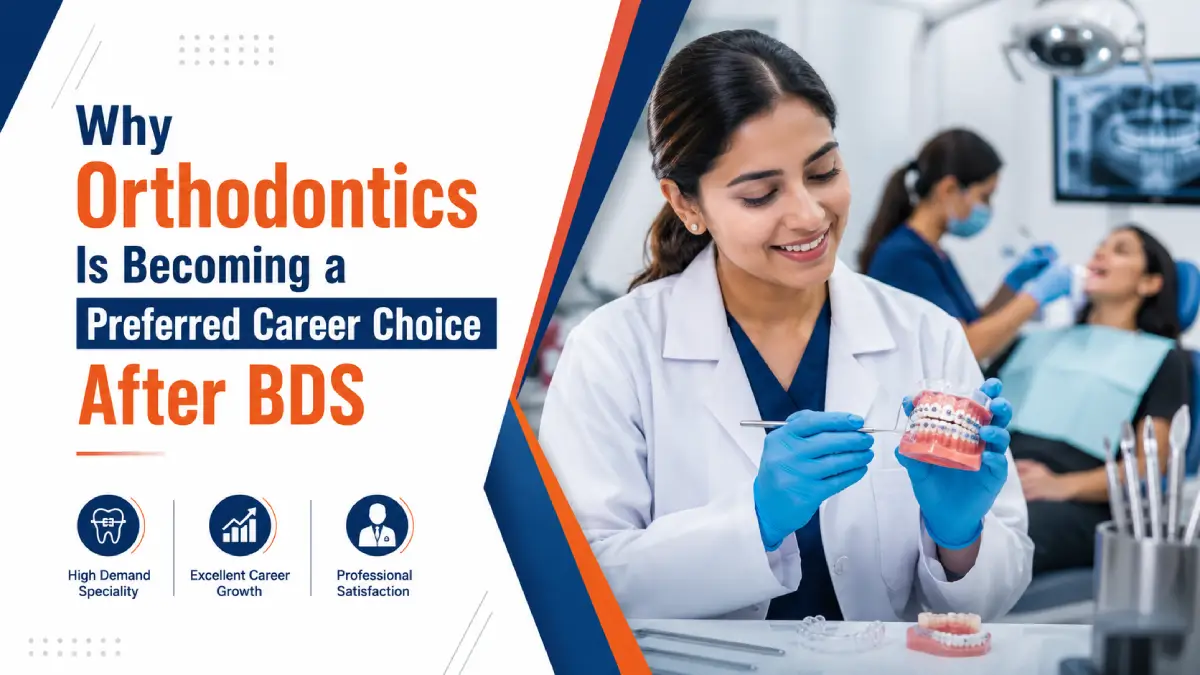
Stepping into the field of orthodontics sounds good, and the curiosity pertaining to the future and career possibilities hovers in the mind of aspirants. Every year, thousands of dental graduates in India finish their BDS and then pause at the same question. Which path will bring respect, steady income, and long-term growth? A large number of them now point to one answer. Orthodontics.
There is a general notion that South India is quite ahead in dental education, with a wide network of reputed colleges. Yet North India, and the Delhi NCR belt in particular, has caught up at a fast pace. Students also weigh the cost of study, and the BDS course fees in private college often shape where they enrol. Orthodontics, the branch that straightens teeth and corrects jaw alignment, has moved from a lesser-known specialisation to one of the most wanted careers after BDS. This blog explains why, in plain words, so that students and parents can plan the next step with full confidence.
What Is Orthodontics, and Why Does It Matter?
Orthodontics is the branch of dentistry that corrects the position of teeth and jaws. An orthodontist fixes crooked teeth, gaps, crowding, and bite problems using braces, aligners, and other appliances. The work improves both the look and the function of the mouth. Straight teeth are also easier to clean, so they support better oral health.
At the postgraduate level, the orthodontics course is called MDS in Orthodontics and Dentofacial Orthopaedics. It runs for three years after BDS. During this period, students build skills in diagnosis, treatment planning, and patient care.
Why Are BDS Graduates Turning to Orthodontics?
Several reasons sit behind this shift. The wish for straight teeth has grown in cities and small towns alike. Adults now want treatment, not only teenagers. Clear aligners have made braces socially easy to accept. All of this brings a steady flow of patients for a skilled orthodontist.
| Reason | What it means for a graduate |
| Rising demand | A steady stream of patients in clinics and hospitals |
| Aesthetic focus | People pay for a better smile, so the work is valued |
| Clear aligners | New technology has widened the patient base |
| Professional respect | Specialists earn standing among peers and patients |
| Private practice | An orthodontist can run an independent clinic |
Know More: Clear Aligners or Traditional Braces: What Should Future Dentists Know?
What Do the Numbers Say About Demand?
India shows a clear pattern. The clear aligner market alone was valued at about USD 96 million in 2022, and it is expected to reach about USD 967 million by 2030. That is a yearly growth rate of over 34 percent. One reason is simple. Studies place the rate of malocclusion, which means poorly aligned teeth, at about 35 percent among Indian children aged 8 to 15. A patient base of this size keeps orthodontics busy for years ahead.
| Data point | Figure | Source |
| Clear aligner market (2022) | About USD 96 million | Grand View Research |
| Clear aligner market (2030, projected) | About USD 967 million | Grand View Research |
| Market growth rate (CAGR) | About 34% per year | Grand View Research |
| Malocclusion in children (8 to 15 yrs) | About 35% | NCBI study (via Grand View) |
Braces or Clear Aligners: What Is Changing?
Both options straighten crooked teeth. The choice shapes patient comfort and cost, and it explains why demand keeps rising.
| Feature | Traditional braces | Clear aligners |
| Look | Visible metal | Almost invisible |
| Comfort | Fixed, some irritation | Removable and smooth |
| Cost | Lower | Higher |
| Best for | Complex cases | Mild to moderate cases |
| Cleaning | Extra effort needed | Easy to remove and clean |
The move towards aligners has pulled many adults into treatment, which adds to the workload of an orthodontist.
Know More: The Future of Dentistry in India: Why BDS Remains a Smart Career Choice in 2026
What Career Paths You Can Explore After an Orthodontics Course
An orthodontics course opens up several doors. The right choice depends on interest, location, and long-term goals.
| Career path | Where you work | Main focus |
| Private practice | Own or partner clinic | Braces, aligners, retainers |
| Hospital orthodontist | Multi-speciality hospital | Complex cases and team care |
| Academics | Dental colleges | Teaching and research |
| Corporate dental chains | Clinic networks | High patient volume |
| Aligner companies | Dental technology firms | Treatment planning and product roles |
| Practice abroad | Clinics overseas | After local licensing exams |
How Much Can an Orthodontist Earn in India?
Income is a fair question for any student. Pay depends on city, experience, and workplace. Entry-level orthodontists start on the lower side. With experience and a steady patient base, earnings rise well.
| Experience level | Approximate yearly income |
| Entry level (0 to 2 years) | ₹4 lakh to ₹6 lakh |
| Mid level (3 to 6 years) | ₹7 lakh to ₹12 lakh |
| Senior (7+ years) | ₹12 lakh to ₹18 lakh or above |
Know More: How BDS Colleges in Delhi Shape Modern Dental Technology?
What Are the BDS Course Fees in Private College Options?
Cost sits at the centre of every big education decision. Before a student reaches orthodontics, the BDS journey comes first. The BDS course fees in private college vary by state, by seat quota, and by the college itself. Government colleges cost the least. Private colleges charge higher, because they offer modern labs, more patient exposure, and better facilities. The table below compares the BDS course fees in private college with government college fees.
| College type | Approximate yearly fee | Notes |
| Government | ₹15,000 to ₹2 lakh | Lowest cost, high competition |
| Private | ₹3 lakh to ₹10 lakh | Modern facilities, more seats |
| Deemed or elite private | ₹8 lakh to ₹22 lakh or above | Premium fee, strong brand |
On average, the BDS course fees in private college in India run from about ₹3 lakh to ₹10 lakh each year. The full five-year cost can cross ₹25 lakh in some places. This is why many families study the BDS course fees in private college with care before they choose a place to study.
What About MDS Orthodontics Fees?
After BDS, an MDS in Orthodontics adds three more years. Private colleges usually charge about ₹5 lakh to ₹15 lakh each year for this specialisation, and premium branches can go higher. Even after accounting for the BDS course fees in private college, the long-term return remains strong, because a skilled orthodontist earns steadily across a long career. When students compare the BDS course fees in private college against future income, orthodontics looks like a sound choice.
Know More: What Sets the Best Private Dental Colleges in UP Apart?
How Does DJ College of Dental Sciences & Research Support Orthodontics Aspirants?
Fathoming the consequence of rising demand, private universities have expanded their infrastructure and facilities to attract students from different regions to study orthodontics and explore the possibilities. DJ College of Dental Sciences & Research, in Modinagar near Delhi NCR, sits among the older private dental colleges in Uttar Pradesh. It was established in 1999 and holds recognition from the Dental Council of India.
The college offers BDS and MDS, and its MDS list covers Orthodontics and Dentofacial Orthopaedics along with eight other specialities. Students gain patient exposure across departments each day, which builds real clinical skill. For an aspirant who wants a strong start in an orthodontics college, this kind of hands-on setting matters.
| DJ College at a glance | Detail |
| Established | 1999 (over 25 years of dental education) |
| Recognition | Dental Council of India (DCI); NAAC and UGC noted |
| Affiliation | Atal Bihari Vajpayee Medical University, Lucknow |
| Location | Modinagar, Ghaziabad, Uttar Pradesh (Delhi NCR) |
| Programmes | BDS and MDS across nine specialities |
| Campus | Large multi-speciality campus, about 75 acres |
| Patient exposure | High patient inflow across departments each day |
| Global presence | Students from 17 countries |
| Facilities | CBCT, CAD/CAM, simulation labs, digital academic support |
Before choosing a place to study, students should check recognition, faculty, patient exposure, lab facilities, and the fee structure. These points, taken together, shape both learning and future placement.
Know More: What to Do After a BDS in UP? A Complete Guide to Career Possibilities
What Should Students Take Away?
Orthodontics has earned its place as a preferred career after BDS. The demand is strong, the income grows over time, and the work brings steady satisfaction. Students who plan early, and who weigh the BDS course fees in private college against future returns, put themselves in a good spot. With the right orthodontics college and steady effort, a bright dental career stays well within reach.
Frequently Asked Questions
Why is orthodontics a good career after BDS?
Orthodontics offers steady demand, a strong income over time, and the option of private practice. More adults and teenagers now want straight teeth, so a skilled orthodontist rarely runs short of patients.
How many years is an orthodontics course after BDS?
An MDS in Orthodontics and Dentofacial Orthopaedics runs for three years after BDS. Students learn diagnosis, treatment planning, and hands-on care with real patients during this time.
Is orthodontics in high demand in India?
Yes. The clear aligner market in India was valued at about USD 96 million in 2022 and is expected to reach about USD 967 million by 2030. This rise points to a wide and growing patient base.
How much does an orthodontist earn in India?
Pay depends on city and experience. Entry-level orthodontists earn about ₹4 lakh to ₹6 lakh each year, while senior specialists can earn ₹18 lakh or above.
What are the BDS course fees in private college in India?
The BDS course fees in private college in India run from about ₹3 lakh to ₹10 lakh each year on average. The full five-year cost can cross ₹25 lakh, and premium colleges charge more.
What is the difference between braces and clear aligners?
Braces are fixed metal appliances and cost less, and they suit complex cases. Clear aligners are almost invisible and removable, and they suit mild to moderate cases. Both straighten teeth over time.
Can a BDS graduate open an orthodontics clinic?
A general BDS graduate can offer basic dental care, but orthodontic treatment needs an MDS in Orthodontics. After the MDS, a graduate can run an independent orthodontics clinic.
Which entrance exam is needed for MDS in Orthodontics?
Admission to MDS in Orthodontics is through NEET MDS. Candidates must hold a BDS degree from a DCI-recognised college and finish the one-year internship.
Does DJ College of Dental Sciences & Research offer orthodontics?
Yes. DJ College of Dental Sciences & Research offers MDS in Orthodontics and Dentofacial Orthopaedics, along with eight other MDS specialities, and it holds recognition from the Dental Council of India.
Is a career after BDS orthodontics better than general dentistry?
A career after BDS orthodontics usually brings higher income and standing than general practice, because it is a specialised skill. General dentistry, however, needs a shorter study path and lower cost.
What should students check before choosing an orthodontics college?
Students should check the BDS course fees in private college, faculty experience, patient exposure, lab facilities, and DCI recognition. These points shape both learning and future placement.
Is orthodontics harder than other dental specialisations?
Orthodontics needs patience, precision, and long treatment planning. It is not harder as such, but it rewards students who enjoy detailed, steady work with visible results.
Related Posts