Clear Aligners or Traditional Braces: What Should Future Dentists Know?
Every dental student meets the same question in the clinic. A young patient with crooked teeth walks in and asks, “Should I pick clear aligners or normal braces?” The answer shapes their smile for years. It also shapes the kind of dentist a student becomes. Orthodontics is one of the most in-demand parts of dentistry in India, and both tools sit at the centre of it.
So which one wins? The short answer is that neither is a clear winner for every case. Clear aligners suit mild to moderate problems and people who want a discreet look. Traditional braces handle complex cases with firm control. A good dentist knows when to use each. That skill starts with strong study at one of the best dental colleges in India, where students see real patients and learn on modern tools.
This guide explains how clear aligners and braces treatment work, what they cost, how long they take, and why future dentists must learn both. It also shows the career scope that an orthodontics course can open.
What Are Clear Aligners and Traditional Braces?
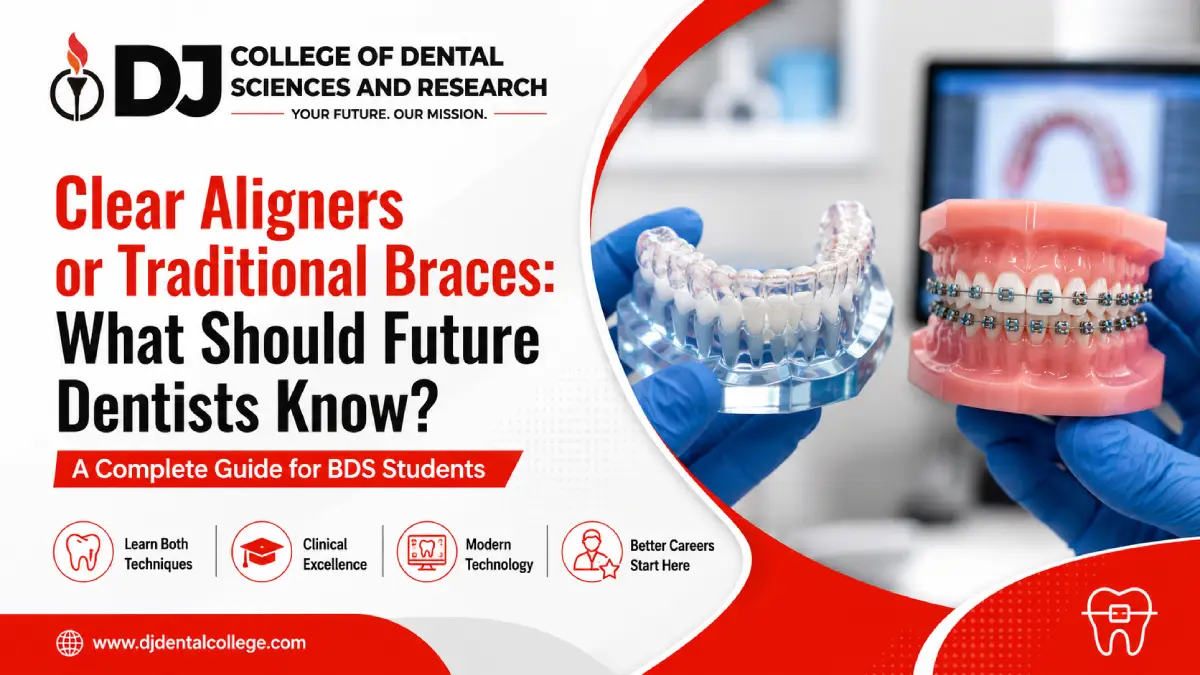
Clear aligners are thin, see-through trays made from medical-grade plastic. They fit over the teeth and move them bit by bit. A patient wears a new set every week or two. They can take the trays out to eat, brush, and drink water.
Traditional braces use metal or ceramic brackets glued to each tooth. A thin wire runs through the brackets and gently guides the teeth into place. Braces stay fixed until the treatment ends. An orthodontist adjusts the wire during regular visits.
Both methods do the same job. They correct crowding, gaps, and bite problems. The difference lies in how they look, how they feel, and which cases they suit best.
Know More: The Future of Dentistry in India: Why BDS Remains a Smart Career Choice in 2026
How Do Clear Aligners and Traditional Braces Differ?
The main differences come down to looks, comfort, hygiene, and control. The table below sets them side by side.
| Feature | Clear Aligners | Traditional Braces |
| Look | Nearly invisible | Visible metal or ceramic |
| Removable | Yes, for meals and cleaning | No, fixed until the end |
| Comfort | Smooth, less rubbing | Wires may irritate cheeks |
| Cleaning teeth | Easy, the trays come off | Harder around the brackets |
| Food limits | None, trays are removed | Sticky and hard foods avoided |
| Best for | Mild to moderate cases | Simple to complex cases |
| Clinic visits | Fewer, with remote checks | Regular, for adjustments |
Which Option Costs More in India?
In most cases, clear aligners are the pricier choice. They often cost about 20 to 50 percent above simple metal braces. The reason is the 3D scanning, custom trays, and digital planning behind each set. The table below shows common price bands in India. Actual fees change with the city, the clinic, and how hard the case is.
| Treatment type | Common price range in India |
| Metal braces | Rs 20,000 to Rs 80,000 |
| Ceramic braces | Rs 40,000 to Rs 1,00,000 |
| Self-ligating braces | Rs 45,000 to Rs 90,000 |
| Lingual braces | Rs 75,000 to Rs 1,50,000 |
| Clear aligners | Rs 40,000 to Rs 3,50,000 |
Know More: How BDS Colleges in Delhi Shape Modern Dental Technology?
How Long Does Each Treatment Take?
Treatment time depends on the case, not only the tool. Simple problems finish faster with either method. Clear aligners usually take 6 to 24 months, and mild cases can finish in about 6 months. Braces treatment runs from 6 months to 3 years, based on how far the teeth must move. Complex bites need longer with any method.
| Point | Clear Aligners | Traditional Braces |
| Usual time | 6 to 24 months | 6 months to 3 years |
| Mild cases | About 6 months | About 6 to 12 months |
| Complex cases | Harder, may need extras | Handles them well |
| Patient effort | Wear 20 to 22 hours a day | Fixed, no wear routine |
Know More: What is Preventive Dentistry? Knowing Common Dental Problems That Can Be Prevented
Why Should Future Dentists Learn Both Methods?
A dentist who knows only one method limits their patients. Some cases suit aligners. Others need the firm control of braces. Learning both makes a student ready for any chair.
Clear aligners also bring in new skills. Students learn 3D scanning, digital planning, and software that maps tooth movement. These skills match where dentistry is heading. At the same time, braces teach the core science of force, wires, and biomechanics. Both together build a complete orthodontist.
This is why hands-on training matters so much. The best dental colleges in India give students real patients, modern labs, and expert guidance. That mix turns theory into skill.
What Does the Data Say About Clear Aligners in India?
The clear aligner market in India is growing fast. Awareness is rising, and many adults now choose a discreet fix. The numbers show why future dentists should take note. The table below brings together key figures from research groups and health bodies.
| Data point | Figure |
| Global clear aligner market (2025) | About USD 8.29 billion |
| Global market forecast (2033) | About USD 56.81 billion |
| India clear aligner market by 2030 | About USD 967 million |
| India market growth rate | Around 34 percent a year |
| Malocclusion in Indian children (8 to 15 years) | About 35.4 percent |
| DCI-approved dental colleges in India | Around 329 |
| BDS seats in India | About 27,600 |
The best dental colleges in India now train students in aligner skills early, which lifts their job scope.
Know More: What Sets the Best Private Dental Colleges in UP Apart?
What Career Paths Can You Explore After an Orthodontics Course?
An orthodontics course opens many doors. It leads to clinical work, teaching, research, and even the fast-growing aligner industry.
Stepping into the field of orthodontics sounds good, and the curiosity about the future and career possibilities hovers in the mind of aspirants. The scope is wide. These are the common paths.
| Career path | What you do |
| Clinical orthodontist | Treat patients with braces and aligners |
| Aligner brand consultant | Plan cases for aligner companies |
| Dental faculty | Teach and guide new students |
| Researcher | Study new tools and materials |
| Clinic owner | Run a private orthodontic practice |
| Hospital specialist | Handle complex jaw and bite cases |
The best dental colleges in India prepare students for each of these roles. Pay grows with skill and specialisation, and aligner-trained orthodontists often earn premium fees.
Know More: What to Do After a BDS in UP? A Complete Guide to Career Possibilities
Why Choose DJ College of Dental Sciences and Research?
For students who want to master both clear aligners and braces, the college they pick matters. DJ College of Dental Sciences and Research, founded in 1999, stands among the best dental colleges in India for hands-on dental education. Its Orthodontics and Dentofacial Orthopaedics department gives students deep clinical exposure. This is what sets the college apart.
A Legacy Built Over 25 Years
DJ College has shaped dental careers for over two decades and holds strong standing in North India.
• Over 25 years of experience in dental education
• Among the top dental colleges in Uttar Pradesh and Delhi NCR
• Recognised by the Dental Council of India (DCI)
• One of the first five private dental colleges in Uttar Pradesh
A Campus Built for Real Practice
A large campus gives students space to learn and to treat patients, paired with modern tools.
• A 75-acre modern campus
• 100+ patients in each department every day
• CAD-CAM lab, skill lab, and digital academic support
• Attached multi-speciality teaching hospital
Courses, Faculty and Research
Strong faculty and a research culture help students grow beyond the textbook.
• BDS and MDS programmes with many specialisations
• Experienced and qualified faculty
• Active research and publication work, including orthodontic studies on mini-implants
• MDS in Orthodontics and Dentofacial Orthopaedics with six seats
Support for Every Student
The college backs students with financial help, global exposure, and all-round growth.
• Students from 17+ countries
• Scholarships and career support
• A focus on holistic, all-round development
• In-house hostels, sports, and a Wi-Fi-enabled campus
This makes DJ College a strong pick as a best private dental college in India for orthodontics study.
Know More: Why Do BDS Graduates Prefer DJ College of Dental Sciences for Postgraduate Study?
What Is the Future Scope of Orthodontics in India?
The future of orthodontics in India looks bright. Digital tools, AI planning, and clear aligners are changing how teeth are straightened. More people now want a good smile, and aligner brands are growing in small towns, not only big cities. This means steady demand for skilled orthodontists. Students who train at the best dental colleges in India will lead this shift, since dental education in India now adds digital training that keeps students ready for the market.
Final Thoughts
Clear aligners and traditional braces both have a place in modern dentistry. Aligners offer a discreet, easy fix for mild cases. Braces give firm control for hard ones. A skilled dentist knows when to use each, and that skill comes from good training.
For students who dream of a career in orthodontics, the choice of college shapes everything. Learning at one of the best dental colleges in India builds the clinical skill, the digital know-how, and the confidence to treat any smile. DJ College of Dental Sciences and Research offers all of this, which makes it a strong home for future orthodontists and a leading best private dental college in India for dental education.
Frequently Asked Questions
What is the difference between clear aligners and braces?
Clear aligners are removable see-through trays that shift teeth slowly. Braces are fixed brackets and wires glued to the teeth. Aligners look discreet, while braces give more control for hard cases.
Are clear aligners better than braces?
Neither is better for every case. Aligners suit mild to moderate problems and people who want a hidden look. Braces work better for complex bites and severe crowding.
Which costs more in India, clear aligners or braces?
Clear aligners usually cost above metal braces. They often run about 20 to 50 percent higher because of 3D scanning and custom trays. Final fees depend on the case, the brand, and the clinic.
How long does clear aligner treatment take?
Most aligner cases take 6 to 24 months. Mild problems can finish in about 6 months. The time depends on how far the teeth must move.
Can clear aligners fix all dental problems?
No. Aligners handle mild to moderate cases well. Severe bite or jaw problems often need braces or extra tools. An orthodontist decides the best option after a proper check.
Do future dentists need to learn both methods?
Yes. Patients come with different needs. A dentist who knows both aligners and braces can treat more cases and give safer, better care.
What is an orthodontics course?
An orthodontics course teaches how to correct crooked teeth and bite problems. In India it is a three-year MDS taken after the BDS degree. Students learn braces, aligners, and jaw correction.
Is orthodontics a good career in India?
Yes. Demand for straight teeth is rising and the aligner market is growing fast. Skilled orthodontists have strong scope in clinics, teaching, research, and the aligner industry.
Which college is good for orthodontics study in India?
Look for strong clinical exposure, modern labs, and expert faculty. DJ College of Dental Sciences and Research ranks among the best dental colleges in India for orthodontics, with a dedicated department and MDS seats.
Are clear aligners painful?
Aligners are not free of feeling, but they cause less rubbing than braces. Patients may feel mild tightness when they switch to a new tray. This usually fades in a day or two.
Do braces work faster than aligners?
Not always. Speed depends on the case, not only the tool. For some complex problems, braces move teeth with more control and may finish sooner.
What skills do students learn in an orthodontics course?
Students learn 3D scanning, digital treatment planning, wire and bracket work, and the science of tooth movement. These skills prepare them for both aligner and braces treatment.
Related Posts