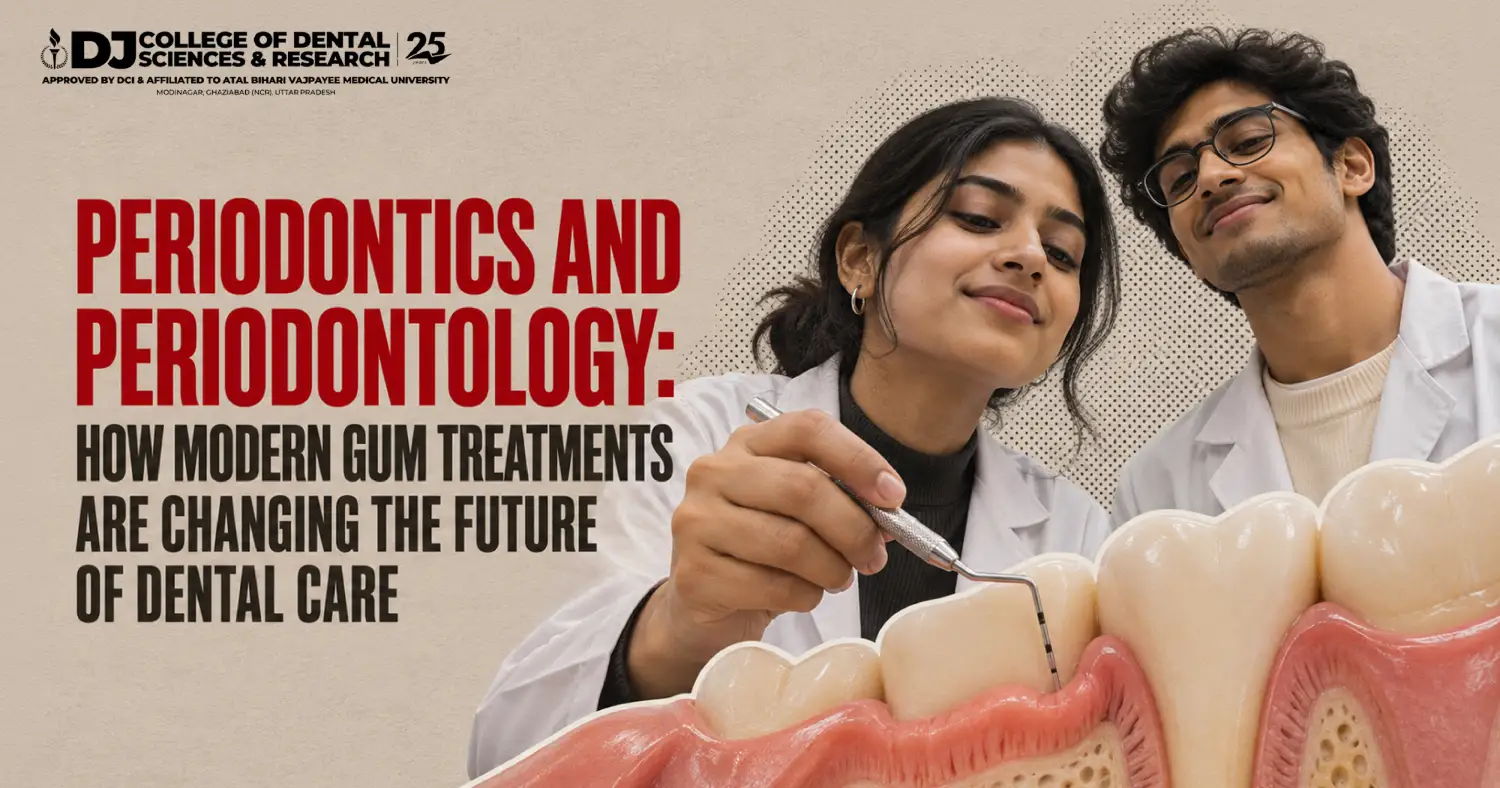
Periodontics and periodontology deal with the gums and the bone that hold the teeth in place. Periodontology is the science, and periodontics is the treatment. Gum disease affects about 51% of Indian adults, and severe forms affect about 19% of adults worldwide. Treatment now follows four clear steps: risk control, deep cleaning, surgery where needed and lifelong maintenance. Newer aids include lasers, platelet-rich fibrin, bone grafts and implants. Treating gum disease also helps people with diabetes control blood sugar.
Introduction:
A little blood in the sink after brushing rarely worries anyone. It is quite common to hear people say, “It is only the gums.” That small sign is often the first chapter of a long story that ends with a lost tooth.
The specialty that reads this story early is periodontics and periodontology. For years, gum care meant a yearly cleaning and little else. The situation has changed considerably. Dentists now stage the disease, rebuild lost bone in selected cases and link gum health with diabetes care. This blog explains the field in question-and-answer form, for patients, students and parents.
What is dental periodontics, and how does it differ from periodontology?
The answer to “what is dental periodontics” lies in one word: support. Teeth stand in bone and are sealed by gum. Periodontics looks after that support.
Table 1: Periodontology and periodontics
| Point | Periodontology | Periodontics |
| Meaning | The study of the gums, ligament and bone around teeth | The clinical practice that treats their diseases |
| Main question | Why does gum disease start and spread? | How can this patient be treated? |
| Where it happens | Classroom, laboratory and research | Dental chair and operating room |
| Who does it | Researchers and teachers | Periodontists and dentists |
Source: Standard definitions used in dental education.
In daily use, periodontics and periodontology mean the same specialty, and Indian colleges call the department Periodontology.
How common is gum disease in India and the world?
Table 2: Burden of periodontal disease
| Measure | Figure |
| Adults worldwide with severe periodontal disease | About 19%, over 1 billion cases |
| Indian adults with any periodontal disease | 51% |
| Indian adults with gingivitis | 46.6% |
| Indian adults with mild to moderate periodontitis | 26.2% |
| Indian adults with severe periodontitis | 19% |
| Indians aged 65 and above with severe periodontitis | 32.7% |
Source: World Health Organization estimates as quoted by FDI World Dental Federation; Janakiram and others, Journal of Oral Biology and Craniofacial Research, 2020 (30 studies, 92,219 adults).
Half of Indian adults carry some form of the disease. Most of them feel no pain, which is why it goes unnoticed.
Read More: Top Dental Colleges in India: Why Clinical Exposure Matters Far Beyond Rankings
What is the difference between gingivitis and periodontitis?
Table 3: Two stages of gum disease
| Point | Gingivitis | Periodontitis |
| What is affected | Gums only | Gums, ligament and bone |
| Common signs | Redness, swelling, bleeding on brushing | Deep pockets, receding gums, loose teeth |
| Can it be reversed? | Yes, with cleaning and good brushing | It can be controlled; lost bone does not grow back by itself |
| Main risk factors | Plaque left on teeth | Plaque, tobacco and diabetes |
Source: World Health Organization oral health information; European Federation of Periodontology.
How is periodontal disease treatment planned today?
Periodontal disease treatment now follows a published guideline. In 2020 the European Federation of Periodontology released its S3-level guideline, built on 15 systematic reviews. It sets four steps, and each patient moves up only as far as needed.
What are the four steps of care in periodontics and periodontology?
Table 4: The four-step plan for periodontitis
| Step | What the dentist does | What the patient does |
| Step 1 | Controls risk factors and removes plaque and tartar above the gum line | Brushes and cleans between teeth daily; stops tobacco; controls diabetes |
| Step 2 | Cleans the root surfaces below the gum line (scaling and root planing) | Keeps up home care and returns for review |
| Step 3 | Performs gum surgery or regenerative surgery on sites that have not healed | Follows care instructions after surgery |
| Step 4 | Reviews and cleans every few months for life | Attends maintenance visits |
Source: European Federation of Periodontology S3-level clinical practice guideline, 2020.
The guideline makes one point plain. Surgery is not advised for a patient who does not clean well at home.
Which modern gum disease treatment methods are in use?
Gum disease treatment has added several tools to the old scaler. The evidence for each is not equal, and an honest account should say so.
Table 5: Newer treatments and what research says
| Treatment | What it does | What studies show |
| Lasers with deep cleaning | Laser light cleans the pocket lining | A 2026 meta-analysis found only a small extra gain of about 0.32 mm in attachment, not statistically proven |
| Platelet-rich fibrin (PRF) | A clot from the patient’s own blood is placed in the bone defect | Improved pocket depth and attachment when added to bone grafts |
| Bone grafts and membranes | Fill the defect and guide new bone | Standard option for suitable defects in Step 3 |
| Soft tissue grafts | Cover exposed roots and thicken thin gums | Used for recession and appearance |
| Dental implants | Replace lost teeth with a titanium root | Need healthy gums first and regular maintenance |
Source: Lasers in Medical Science meta-analysis, 2026; meta-analysis of bioactive materials in intrabony defects (PMC5994283); EFP guideline.
Advanced periodontal therapy is an addition to cleaning, never a replacement for it.
Why does periodontal health care matter for the rest of the body?
Periodontal health care is no longer seen as a mouth-only matter. The clearest link is with diabetes.
Table 6: Effect of gum treatment on blood sugar in people with diabetes
| Time after gum treatment | Fall in HbA1c |
| 3 to 4 months | 0.43 percentage points |
| 6 months | 0.30 percentage points |
| 12 months | 0.50 percentage points |
Source: Cochrane review, 2022 (35 trials, 3,249 participants). HbA1c shows average blood sugar over about three months.
This is where things become interesting. A dental cleaning produced a change that doctors usually expect from adding a medicine.
How large is the market for periodontal treatment?
Table 7: Global periodontal disease treatment market
| Year | Value in US dollars | Value in INR |
| 2025 | USD 2.71 billion | ₹25,512 crore |
| 2026 | USD 2.86 billion | ₹26,924 crore |
| 2031 (forecast) | USD 3.86 billion | ₹36,338 crore |
Source: MarketsandMarkets; converted at the Reserve Bank of India rate of 6 November 2026 ($1 = ₹94.1402).
Who is a periodontist in India, and how does one become one?
• A periodontist in India is a dentist with an MDS in Periodontology.
• The route is BDS, a one-year internship, NEET MDS and a three-year MDS.
• Periodontology treatment skills taught in MDS include flap surgery, regenerative surgery, gum grafts and implant placement.
• Graduates work as specialists in clinics and hospitals, teach in dental colleges or run implant practices.
Periodontics and periodontology at DJ College of Dental Sciences & Research, Modinagar
Table 8: Department of Periodontology & Oral Implantology at DJ College
| Point | Detail |
| MDS seats | 6, recognised by the Dental Council of India |
| Course duration | 3 years |
| MDS tuition (2026) | ₹5,00,000 a year |
| Clinic | Subsidised OPD running six days a week |
| Procedures taught | Flap surgery, gum grafting, bone regeneration, sinus lift, implants, laser dentistry, PRF |
| Research | Case studies and field projects are required of postgraduates |
Source: DJ College department page; 2026 fee filing as reported by Medical Dialogues.
• DJ College stands in Modinagar, Ghaziabad district, within Delhi NCR, and has taught dentistry since 1999.
• 100+ patients visit each department every day on a 75-acre campus.
• Students come from 17+ countries.
What can a person do at home to keep the gums healthy?
• Brush twice a day with fluoride toothpaste.
• Clean between the teeth once a day.
• Stop tobacco in every form.
• Keep diabetes under control.
• See a dentist if the gums bleed for over a week.
Read More: Is Oral Pathology a Good Career in 2027? A Straight Answer for BDS Graduates
Conclusion
Periodontics and periodontology have moved from simple cleaning to planned, step-by-step care. Half of Indian adults have some gum disease, and most do not know it. The treatment that works best is still the plainest one: clean roots, clean habits and regular review. Lasers, grafts and PRF help in the right case.
For patients, the message is to act on bleeding gums early. For BDS graduates, the specialty offers surgical skill, implant work and a growing link with general medicine. The Department of Periodontology & Oral Implantology at DJ College of Dental Sciences & Research, Modinagar, trains MDS students in all of these.
This article is for education only. It is not medical advice. A dentist should examine any gum problem in person.
Frequently Asked Questions (FAQs)
What is the difference between periodontics and periodontology?
Periodontology is the study of the gums and the bone that hold the teeth. Periodontics is the clinical practice that treats their diseases. Most people use the two words for the same specialty.
What is dental periodontics in simple words?
It is the branch of dentistry that prevents and treats gum disease, saves loose teeth and places dental implants.
How common is gum disease in India?
A pooled analysis of 92,219 Indian adults found periodontal disease in 51%. Severe periodontitis affected 19%.
What are the early signs of gum disease?
Bleeding while brushing, red or swollen gums, bad breath that stays, gums pulling back from the teeth and teeth that feel loose.
Can gum disease be cured?
Gingivitis, the early stage, can be reversed with cleaning and good brushing. Periodontitis can be controlled and kept stable, but lost bone does not fully return without regenerative treatment.
Is laser gum treatment better than normal cleaning?
Studies show only a small extra benefit when lasers are added to deep cleaning. Scaling and root planing remains the main treatment.
Does treating gum disease help people with diabetes?
Yes. A Cochrane review of 35 trials found that gum treatment lowered HbA1c by about 0.43 percentage points after three to four months.
Who is a periodontist?
A periodontist is a dentist who has completed BDS and a three-year MDS in Periodontology. A periodontist in India must register with a state dental council.
How does a dentist become a periodontist in India?
By completing BDS and a one-year internship, qualifying NEET MDS and finishing a three-year MDS in Periodontology at a recognised college.
Does DJ College of Dental Sciences & Research offer MDS in Periodontology?
Yes. The Department of Periodontology & Oral Implantology at DJ College, Modinagar, has 6 MDS seats recognised by the Dental Council of India.
Related Posts