Yes, for the right student. Oral pathology suits BDS graduates who prefer diagnosis, lab work and research to chair-side treatment. India logged 2,05,878 new lip and oral cavity cancer cases in the latest IARC estimate, and each case needs a biopsy report. So, is oral pathology a good career in 2027? It is, though pay starts modest and grows with experience.
The internship year is almost over. Friends are busy talking about orthodontics and endodontics. Somewhere in that noise, one quiet question keeps coming back. Is oral pathology a good career, or is it the branch people pick only when nothing else is left?
It is quite common to hear the second version in hostel corridors. Many parents and students still believe that a dentist without a drill in hand is not a “real” dentist. The reality on the ground is somewhat different.
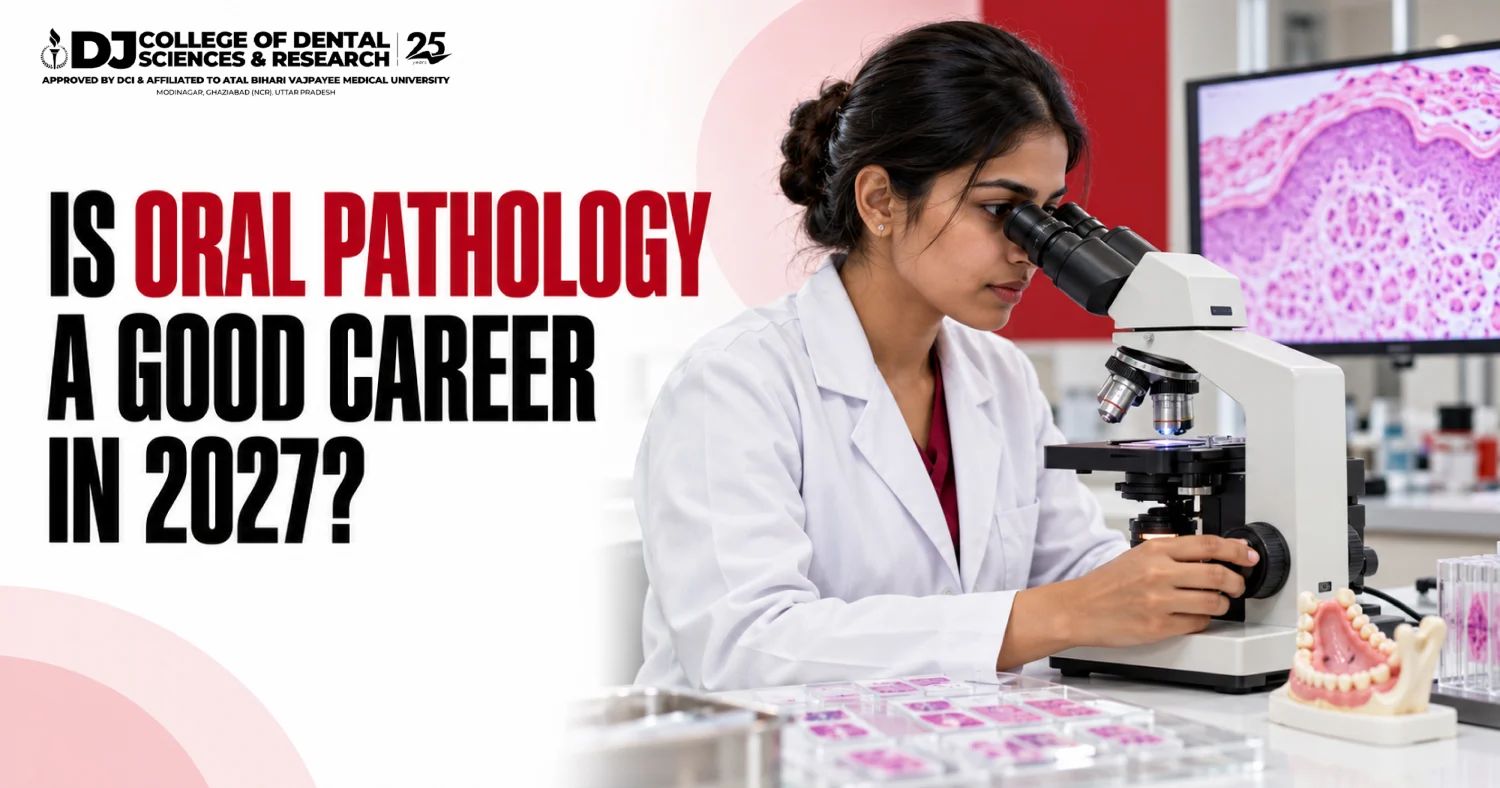
Every oral cancer case in India starts with one small piece of tissue and one person at a microscope who has to get the answer right. A surgeon cannot plan, and a family cannot decide, until that report arrives. That person is the oral pathologist.
So what does the job look like in 2027? How much does it pay? Who should choose it? This blog from DJ College of Dental Sciences & Research, Modinagar, answers each question with numbers, not guesses.
What Is Oral Pathology, and What Does Oral and Maxillofacial Pathology Do?
Oral pathology is the branch of dentistry that studies diseases of the mouth, jaws, face and salivary glands. In simple words, the oral and maxillofacial pathology specialty finds out what a disease is, and why it happened, before anyone treats it.
• Histopathology & biopsy: it studies tissue under a microscope.
• Cytology: it checks cells taken from mouth scrapings and fluids.
• Microbiology and haematology: it tests microbes and blood linked to mouth diseases.
• Oral oncology: it confirms cancer and pre-cancer so that treatment can start early.
What Does a Maxillofacial Pathologist Do on a Normal Working Day?
• Receives biopsy samples from surgeons and dentists.
• Processes the tissue, cuts thin sections and stains the slides.
• Reads the slides and writes the diagnosis report.
• Talks through difficult cases with surgeons and oncologists.
• Teaches BDS students and guides research.
Not everyone is aware that this specialist rarely meets the patient, yet decides the direction of the whole treatment.
Who Is the Father of Oral Pathology?
Dr Kurt Hermann Thoma, a Harvard professor, is widely called the father of oral and maxillofacial pathology. In India, that title goes to Dr H. M. Dholakia. Dental colleges mark 25 February as National Oral Pathologist Day in his memory.
Why Does India Need Oral Pathologists in 2027?
One question that often comes up is whether real work exists for this specialist. The numbers settle it.
| What the data shows | Figure | Source |
| New lip and oral cavity cancer cases in India (2024 estimate) | 2,05,878 | IARC GLOBOCAN |
| Deaths from lip and oral cavity cancer in India | 86,307 | IARC GLOBOCAN |
| Share of all new cancer cases in India | 13.2% | IARC GLOBOCAN |
| Rank among cancers in India | 2nd overall, 1st in men | IARC GLOBOCAN |
| Oral cancer screenings recorded under NP-NCD (till 31 October 2025) | 31.88 crore | MoHFW, Govt of India |
| MDS seats on offer across India (NEET MDS 2025) | About 6,228 in 259 colleges | Amar Ujala |
• India reports the highest number of mouth cancer cases in the world.
• Wider screening finds many suspicious patches, and each one needs a biopsy and a trained eye.
What Career Paths Can Students Explore After MDS in Oral Pathology?
Stepping into this field sounds good, and the curiosity about the future hovers in the mind of every aspirant. The oral and maxillofacial pathology specialty opens wider doors than most people realise.
| Career path | Where the work happens |
| Teaching faculty | Dental colleges, from Lecturer up to Professor and Head |
| Consultant oral pathologist | Diagnostic laboratories and hospitals |
| Head and neck oncopathology | Cancer hospitals and oral cancer centres |
| Research scientist | Research institutes and PhD programmes |
| Forensic odontology | Forensic laboratories and legal cases |
| Own diagnostic practice | Private oral pathology laboratory |
It is worth noting that NABL accepts an MDS in oral pathology as an authorised signatory for biopsy and cytology reports of the mouth and jaw region, as the Journal of Oral and Maxillofacial Pathology records. Students still comparing branches can read the guide on the best MDS specialisations in India.
Is Oral Pathology a Good Career for Students Who Prefer Diagnosis to Drilling?
For many students, the answer is yes. The branch suits those who:
• enjoy microscopes, patterns and puzzles
• like reading and research
• prefer steady lab hours to long clinic days
• want to teach the next batch of dentists
It may not suit a student who dreams of a busy private clinic from day one.
Is Oral Pathology a Good Career When It Comes to Salary?
In practical terms, pay starts modest and grows with experience.
• Fresh MDS graduates in India usually earn about Rs 3 to 5.5 lakh a year.
• The average MDS salary sits around Rs 3 to 8 lakh a year, as per Glassdoor and AmbitionBox figures quoted by GetMyUni.
• Pay rises with teaching rank, lab consultancy and fellowships in oncopathology.
What Are the Honest Downsides of This Branch?
• Teaching posts in dental colleges are limited.
• General pathologists compete for the same laboratory work.
• Early salaries stay below those of clinical branches.
Ask any experienced professional in the field, and the reply stays the same: this branch rewards patience.
What Is the Hardest Field in Dentistry, and Where Does Oral Pathology Stand?
Most dentists name oral and maxillofacial surgery as the hardest field because of long operations and emergency duty. Oral pathology is hard in a different way. It asks for heavy reading, a sharp eye and the nerve to sign a cancer report. The hands rest, but the mind does not.
How Does a BDS Graduate Become an Oral Pathologist?
| Step | Requirement |
| Degree | BDS from a recognised dental college |
| Internship | One-year compulsory rotatory internship |
| Registration | State Dental Council registration |
| Entrance test | NEET MDS, held by NBEMS. The 2026 test took place on 2 May 2026. NBEMS has not yet announced the 2027 date. |
| Course | MDS in Oral Pathology & Microbiology, three years, full time |
| Subjects | Histopathology, cytology, haematology, immunohistochemistry, oral microbiology and research methods |
Students can check the full MDS eligibility and admission process and the course and fee structure on the college website.
Why Do Students Pick DJ College of Dental Sciences & Research for Oral Pathology?
Students who ask is oral pathology a good career often forget that the college decides half the answer. DJ College of Dental Sciences & Research in Modinagar, Ghaziabad, has taught dentistry in Delhi NCR since 1999. Its Oral Pathology & Microbiology department offers:
• Three wings: Clinical Oral Pathology, the Oral Pathology Laboratory and a Research Wing.
• Oral Cancer Detection Centre and a Tobacco Intervention Clinic on campus.
• 3,000+ archived cases and an e-library with 170+ journals.
• Automatic tissue processors and microtomes, with training in immunohistochemistry and microbial culture.
• Every MDS resident produces a publishable research paper within three years.
• 100+ patients in each department daily, on a 75-acre campus.
• Students from 17+ countries, with scholarships and career support.
• Recognised by the Dental Council of India (DCI), now succeeded by the National Dental Commission (NDC).
Conclusion: Should a BDS Graduate Choose Oral Pathology in 2027?
So, is oral pathology a good career in 2027? For the right student, yes. India carries the world’s largest count of oral cancer cases, screening keeps widening, and every diagnosis still depends on a specialist at the microscope.
The pay starts slow and the branch asks for patience. In return, it gives steady hours, respect among clinicians and work that saves lives without a single drill. Students who feel drawn to it can speak to the admissions team at DJ College of Dental Sciences & Research, Modinagar, and see the labs for themselves.
Frequently Asked Questions
Is oral pathology a good career in India in 2027?
Yes. India reports the highest number of oral cancer cases in the world, so trained diagnosticians stay in demand. The branch suits students who enjoy lab work, teaching and research. Early pay is modest.
What does oral and maxillofacial pathology do?
It identifies diseases of the mouth, jaws, face and salivary glands. Specialists study biopsy tissue, cells, blood and microbes, then give the diagnosis that guides treatment.
What does a maxillofacial pathologist do?
A maxillofacial pathologist reads biopsy slides under a microscope, writes diagnostic reports, advises surgeons and oncologists, teaches dental students and carries out research.
Who is the father of oral pathology?
Dr Kurt Hermann Thoma is widely called the father of oral and maxillofacial pathology. In India, Dr H. M. Dholakia is known as the father of Indian oral pathology.
What is the hardest field in dentistry?
Most dentists name oral and maxillofacial surgery because of long operations and emergency duty. Oral pathology is demanding in another way, through heavy reading and high-stakes reports.
What is the eligibility and duration of MDS in Oral Pathology?
A candidate needs a recognised BDS degree, a one-year rotatory internship, State Dental Council registration and a qualifying NEET MDS score. The course runs for three years, full time.
What is the salary after MDS in Oral Pathology in India?
Fresh MDS graduates in India usually earn about Rs 3 to 5.5 lakh a year. The average sits around Rs 3 to 8 lakh and rises with experience, teaching rank and lab consultancy.
What jobs can an oral pathologist get?
Teaching posts in dental colleges, consultant roles in diagnostic labs, head and neck oncopathology in cancer hospitals, research, forensic odontology and private lab practice.
Does an oral pathologist treat patients?
Mostly no. The oral pathologist works in the laboratory and gives the diagnosis. Surgeons, oncologists and dentists then treat the patient on the basis of that report.
Does DJ College of Dental Sciences & Research offer MDS in Oral Pathology?
Yes. The college in Modinagar, Ghaziabad, Delhi NCR, offers a three-year MDS in Oral Pathology & Microbiology with its own Oral Cancer Detection Centre and research wing.
Related Posts