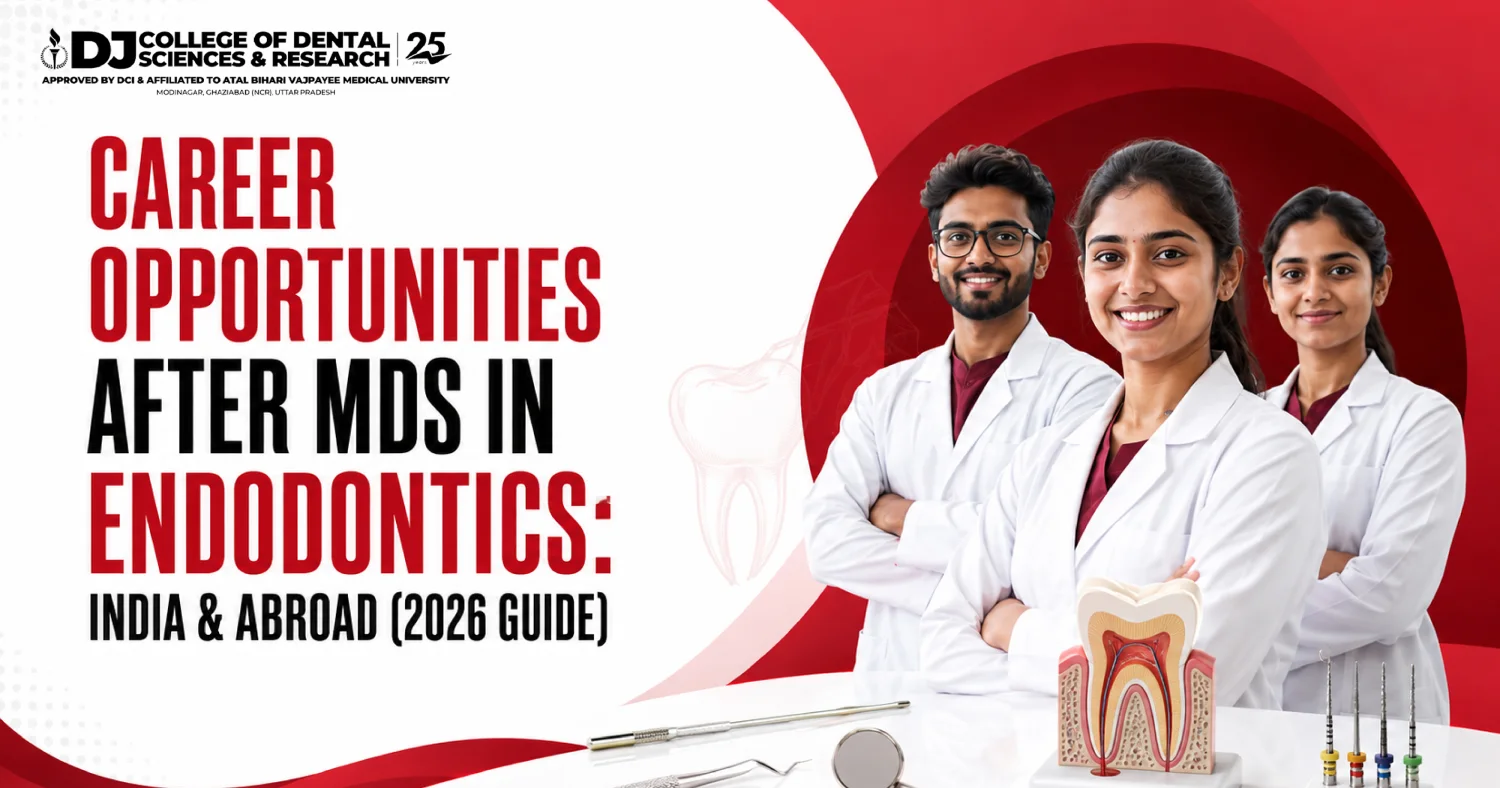
There are many students who spent their years in a BDS classroom wondering about one big question, “What happens after MDS in Endodontics?” Root canal work is one of the busiest branches of dentistry and every BDS graduate wonders if the postgraduate degree is worth the effort, the fees and the three years of clinical grind.
It is worth noting that the answer depends on where a student studies and how the college builds their clinical hands which is why the choice of dental colleges in Uttar Pradesh matters as much as the choice of specialisation.
This guide looks at real job roles, salary figures from India and abroad, licensing exams for practising overseas and how a college such as DJ College of Dental Sciences & Research, Uttar Pradesh prepares a student for all of it.
What Is MDS in Endodontics and Why Does It Matter?
MDS in Endodontics is a three year postgraduate dental course which is used for training a dentist to treat the pulp and root canal system of a tooth. This is exactly the part that causes the sharpest pain when it is infected. A BDS graduate who clears NEET MDS and joins this specialisation moves from general dentistry into focused, high precision root canal work which often uses a dental microscope and rotary instruments.
Ask any experienced professional in the field and they will confidently say the same thing. Root canal treatment is one of the most repeated procedures in any dental clinic which keeps demand for trained endodontists fairly steady from all across the cities and small towns alike.
Why Are Students Choosing Dental Colleges in Uttar Pradesh for MDS Endodontics?
Uttar Pradesh and the Delhi NCR belt now organize some of the busiest dental education hubs in North India. A large patient base with a mix of urban and rural cases and a growing number of DCI-recognised seats make dental colleges in Uttar Pradesh a practical choice for MDS aspirants who want strong clinical exposure without moving too far away from home.
DJ College of Dental Sciences & Research is one such institute that has been part of the dental education for more than 25 years and spreads across a 75 acres campus. The college is recognised by the Dental Council of India and runs BDS and MDS programmes across nine departments which also includes Conservative Dentistry & Endodontics, Oral & Maxillofacial Surgery, Periodontology, Prosthodontics, Orthodontics, Paediatric Dentistry, Oral Pathology, Oral Medicine & Radiology and Public Health Dentistry. Reports from the college notes that there are more than 100 patients per department daily which gives an MDS Endodontics student a fairly wide range of root canal cases to work with before graduation. Students from 17 or more countries have studied on the campus which adds a mixed, international clinic environment that is not common in every private dental college in this region.
What Career Paths Open Up After MDS in Endodontics?
Not everyone is aware that an MDS Endodontics degree opens more than one road. A graduate is not limited to a private clinic. Government hospitals, dental colleges, corporate dental chains, research bodies and even product companies all hire specialists from this branch.
The common paths taken by graduates in India
| Career Path | The Role that Involves | Typical Annual Salary in India (INR) |
| Clinical Endodontist (private practice) | Root canal treatment, retreatment, microscope assisted cases | ₹4 – 15 lakh, rising with case load |
| Hospital / multi speciality dental chain | Salaried consultant role at chains such as Clove Dental, Apollo, or Fortis dental units | ₹4 – 12 lakh |
| Academic lecturer / professor | Teaching BDS and MDS students, guiding thesis work | ₹8 – 9 lakh, higher with seniority |
| Government dentist | Postings in district hospitals and public health centres | ₹3 – 8 lakh, plus government benefits |
| Dental research / product advisory | Working with dental material or equipment companies | ₹4 – 10 lakh |
Source: figures compiled from Glassdoor and Ambitionbox data, as reported by GetMyUni and Collegedunia.
Read More : Why Choose MDS in Conservative Dentistry and Endodontics?
How Much Do MDS Endodontics Graduates Earn as Experience Grows?
Salary in this field grows steadily rather than in a sudden jump so a fresh MDS graduate should not expect a top bracket pay package in year one.
Earning potential moves with years in practice
| Experience Level | Years in Practice | Approx. Annual Salary (INR) |
| Early career | 0 – 4 years | ₹3 – 8 lakh |
| Mid career | 5 – 10 years | ₹8 – 15 lakh |
| Senior / established practice or academic post | 16+ years | ₹25 – 30 lakh and above |
Source: Glassdoor and Ambitionbox salary data, as reported by GetMyUni.
Can an MDS Endodontics Graduate from Uttar Pradesh Practise Abroad?
Yes, definitely, but not without clearing a licensing exam first. Most countries do not accept an Indian BDS or MDS degree as direct proof of competence, so a graduate needs to sit in a local qualifying exam and complete a short bridging or advanced standing programme before registering to practise.
Graduate needs for each major destination
| Country | Licensing Exam / Path | Additional Step |
| United States | NBDE / INBDE, then state licensure | 2 year Advanced Standing Programme at a CODA approved dental school |
| United Kingdom | Overseas Registration Exam (ORE), written and practical | GDC registration after passing; IELTS required |
| Canada | NDEB equivalency process and licensing exam | Credential assessment before sitting the exam |
| Australia | Australian Dental Council (ADC) exam, written and practical | Some bridging study before the practical component |
| New Zealand | Dental Council of New Zealand assessment (NZDREX where applicable) | Case by case document assessment first |
| UAE | DHA, DOH or MOH licensing exam | Regarded as one of the quicker licensing routes for Indian dentists |
What Do Endodontists Earn Abroad, Compared to India?
Money is usually the second question after figuring out the exams you need. Pay abroad looks large in foreign currency but it helps to see the same number converted to rupees before deciding if the extra years of licensing exams are worth it.
| Country | Approx. Annual Salary (Local Currency) | Approx. Annual Salary in INR* |
| United States | USD 165,000 – 202,000 (general dentist to endodontist range) | ₹1.57 – 1.92 crore |
| Australia | AUD 110,000 (general dentist, base pay) | ₹68 lakh (approx.) |
| Canada (Ontario) | CAD 135,000 (gross, before tax) | ₹93 lakh (approx.) |
| India | INR 4 – 15 lakh (clinical practice, varies with experience) | ₹4 – 15 lakh |
Source: PayScale, Salary.com and CountryTaxCalc.com data, as cited at the bottom of this article.
How Does DJ College of Dental Sciences & Research Compare with Other Dental Colleges in Uttar Pradesh?
A closer look at the wider region shows several private dental colleges competing for the same pool of MDS aspirants across Ghaziabad, Greater Noida, Meerut and Gurgaon. Fee structure, seat matrix and current recognition status change every admission cycle, so always confirm these details on the official website of each college and on the Dental Council of India portal before applying.
| College | City / State | Known For |
| DJ College of Dental Sciences & Research | Uttar Pradesh | 25+ years in dental education, 75 acre campus, 9 departments, students from 17+ countries |
| Inderprastha Dental College and Hospital | Ghaziabad, UP | BDS and MDS programmes with an attached hospital |
| Institute of Dental Studies & Technologies | Ghaziabad, UP | Long running dental institute in western UP |
| ITS Dental College | Greater Noida, UP | Part of a larger multi disciplinary education group |
| Sharda University (Dental College) | Greater Noida, UP | University run dental programme with broader campus facilities |
| Subharti Dental College | Meerut, UP | Attached to Swami Vivekanand Subharti University |
| Kalka Dental College | Meerut, UP | Established private dental college in western UP |
| SGT University (Dental College) | Gurgaon, Haryana | University run programmes just outside the UP border |
What Is the Eligibility and Admission Snapshot for MDS Endodontics?
Students should always first check the basic eligibility, entrance exam and counselling requirements before applying for MDS Endodontics. The admission route is fairly structured with NEET MDS being the main entrance requirement.
| Requirement | Detail |
| Qualifying degree | BDS from a DCI recognised college with completed internship |
| Entrance exam | NEET MDS, mandatory for every seat, including management quota |
| Counselling | Conducted through MCC (All India quota) or the respective state authority |
| Course duration | 3 years, full time, on-campus clinical training |
| Total MDS seats in India (2025-26) | 7,357 seats across 276 DCI-approved dental colleges |
Source: Dental Council of India (DCI) data, as reported by Shiksha.com.
What Makes DJ College of Dental Sciences & Research a Practical Choice?
For students comparing multiple dental colleges in Uttar Pradesh, a few points such as patient volume for practice, faculty experience, campus facilities and support once the course ends, seems to matter the most.
● Recognised by the Dental Council of India (DCI).
● 75 acre campus with digital academic support and dental labs.
● More than 100 patients per department daily, which builds real clinical hours.
● Nine departments, including Conservative Dentistry & Endodontics and Oral & Maxillofacial Surgery, all fall under one roof.
● An established research and publication track record among faculty.
● Scholarships and career support for eligible students.
● A genuinely mixed campus with students across 17 or more countries.
Conclusion
It would not be wrong to say that MDS in Endodontics remains one of the steadier postgraduate choices for dentistry in both India and abroad. The Indian route offers quicker entry into practice, while the overseas route asks for patience, licensing exams and a fair amount of money but it can pay off over a career. What ties both paths together is the training years spent in college. That is why the choice among dental colleges in Uttar Pradesh and the clinical exposure a student gets there often decides how confident they feel walking into their first root canal case as a specialist.
Frequently Asked Questions
1. What can I do after MDS in Endodontics?
A graduate can start a private root canal practice, join a hospital or dental chain, teach at a dental college, work in government service, or even move into dental research.
2. What is the starting salary after MDS Endodontics in India?
Most fresh graduates earn between ₹3 lakh and ₹8 lakh a year, depending on the city and the type of practice.
3. Can an MDS Endodontics graduate from India work in the USA?
Yes, after clearing the NBDE or INBDE exam and completing a 2 year Advanced Standing Programme at a CODA approved dental school then followed by state licensure.
4. Is NEET MDS compulsory for admission to MDS Endodontics?
Yes. NEET MDS is mandatory for every seat that includes management quota seats, as per Dental Council of India rules.
5. How many MDS seats are available in India?
The Dental Council of India lists 7,357 MDS seats across 276 approved dental colleges for the 2025 to 26 session.
6. Which countries are easier for Indian dentists to get licensed in?
UAE licensing routes, such as DHA, DOH or MOH are generally considered quicker compared to the USA, UK, Canada or Australia.
7. What is the course duration of MDS Endodontics?
MDS in Endodontics is a full time, 3 year postgraduate programme.
8. Does DJ College of Dental Sciences & Research offer MDS Endodontics?
DJ College of Dental Sciences & Research runs MDS programmes across nine departments, including Conservative Dentistry & Endodontics. Contact the admissions cell through the official website for the current seat matrix.
9. Is dental education in Uttar Pradesh a good option for MDS?
Several dental colleges in Uttar Pradesh offer DCI-recognised MDS seats with a strong daily patient load which matters for practical training in a clinical branch such as Endodontics.
10. Do foreign dental degrees count for practice in India?
Only if the awarding university and degree are recognised by the Dental Council of India. Many foreign dental degrees are not automatically recognised, so this should be checked before enrolling abroad.
Related Posts