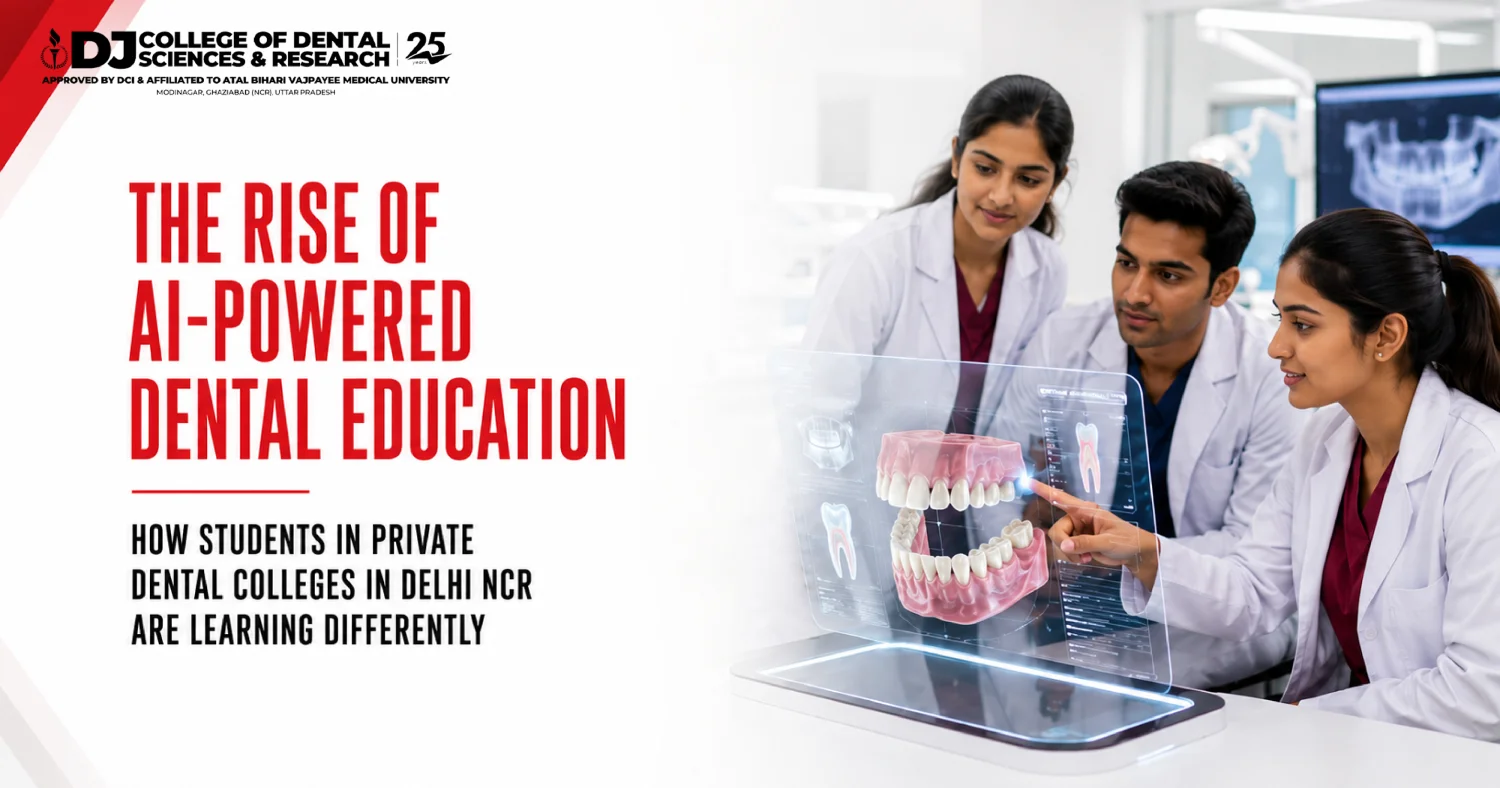
A first year dental student in 1999 learned to prepare a cavity on a plastic tooth clamped into a metal head. A first year student in 2026 may do the first hundred attempts on a screen, holding a stylus that pushes back when the drill meets enamel.
Here is the short answer.
AI powered dental education means using software and simulators to teach, practise and assess dental skills. Software reads radiographs and flags suspected decay. Haptic simulators copy the feel of cutting a tooth and score the result the moment the student finishes. Scanners and design software replace putty impressions and plaster models.
None of this replaces treating real patients. It changes what happens before that.
For families comparing private dental colleges in Delhi NCR, this raises a fair question. Does the college teach with these tools, or only talk about them? A brochure photograph of a scanner proves very little.
This guide sets out the tools in use, what published research actually shows, the limits nobody advertises, and the careers that follow.
What is AI-powered dental education, and what has changed?
Dentistry has always been taught in three parts. Theory in a lecture hall. Practice on a model. Then real patients under supervision. The middle part is where the change has landed.
The situation has changed considerably over the last few years. A plastic tooth gives no feedback and no score. A haptic simulator does both, instantly, and it never runs out of teeth.
How dental training has shifted
| Task | The older method | The current method | What the student gains |
| Cavity preparation practice | Plastic teeth in a phantom head | Haptic simulator with force feedback | Unlimited attempts and an instant score |
| Assessment of preparations | A teacher inspects each one by eye | Software measures depth, angle and shape | The same standard for everyone, no subjectivity |
| Reading radiographs | Naked eye on a viewing box | Detection software marks suspected areas | A second opinion while still learning |
| Impressions and models | Putty trays and plaster casts | Intraoral scanner and a digital file | Fewer remakes and faster turnaround |
| Crown and bridge design | Hand wax-up in the laboratory | CAD design and milling or printing | Design skills that laboratories now expect |
| Treatment planning | Flat X-rays and clinical judgement | CBCT with 3D reconstruction and planning software | Better view of anatomy before cutting |
| Study material | Library books and photocopied notes | Digital libraries and learning platforms | Access outside college hours |
Source: published reviews of digital dentistry and simulation in dental curricula, 2021 to 2026.
There is a practical reason this matters more in India than in smaller countries. India runs 329 dental colleges and admits about 27,618 students to BDS every year. Teacher time is the scarce resource, not student enthusiasm. A simulator that scores a cavity preparation in seconds gives feedback that a department of ten teachers could never give to a batch of a hundred, five days a week.
Which AI tools do dental students actually use?
| Tool | What it does | Where it fits in the course |
| Haptic virtual reality simulator | Copies the feel of cutting enamel and dentine, then scores the work | Preclinical years, before patient contact |
| Caries detection software | Marks suspected decay on radiographs for the student to confirm | Oral Medicine and Radiology, Conservative Dentistry |
| CBCT with 3D reconstruction | Builds a three dimensional view of bone, roots and nerve canals | Oral Surgery, Endodontics, Implantology |
| Intraoral scanner | Captures a digital impression without trays or putty | Prosthodontics, Orthodontics |
| CAD design and milling or 3D printing | Designs and produces crowns, bridges and aligners | Prosthodontics, Orthodontics |
| Cephalometric analysis software | Places landmarks and measures jaw relations automatically | Orthodontics and Dentofacial Orthopaedics |
| Shade matching software | Matches restoration colour to the natural tooth | Prosthodontics, Conservative Dentistry |
| Practice and record management systems | Keeps case records, images and appointments in one place | Clinical years and internship |
Source: dental technology reviews and clinical software categories reported in the AI in dentistry market literature, 2025 to 2026.
What does a haptic simulator actually feel like?
Students describe it as stranger than expected. The stylus pushes back when the virtual bur meets enamel, then gives way as it reaches softer dentine. The screen shows a magnified tooth. A foot control starts and stops the drill. When the attempt ends, the software compares the cut against an ideal preparation and returns a percentage. For many students, the first score is a shock. The second attempt is usually far better, which is the pattern the research has recorded too.
What does the research actually prove about simulator training?
This is where things become interesting, because the honest answer is narrower than the marketing. Several systematic reviews have looked at haptic simulators. They agree on the gains. They also agree on the ceiling.
What systematic reviews found on haptic simulators
| Study | Scale | Main finding | Source |
| Patil and others, systematic review | 9 high quality studies, 826 undergraduate dental students worldwide | Simodont improved psychomotor and movement skills, gave objective computer assessment and reduced cost | BMC Oral Health, 2023 |
| Bandiaky and others, systematic review | 23 studies published between 2010 and 2022, across ten countries | Haptic simulators improve preclinical students’ motor skills across several specialities | Journal of Dental Education, 2024 |
| Koolivand and others, systematic review | 14 studies | Improves psychomotor skills, practical skills, knowledge and self confidence | BMC Medical Education, 2024 |
| Preclinical cavity preparation review | 5 studies, 20 to 88 students each | Effective for early skill building, but evidence does not show superiority over conventional methods | Dentistry Journal, 2026 |
| Umbrella review | Multiple systematic reviews pooled | Clear gains in preclinical skill and confidence, though certainty is limited by weak study design | Umbrella review, 2026 |
| Randomised study on paediatric procedures | 173 third year dental students | Largest jump came between the first and second attempt, then gains flattened | Randomised controlled study, 2026 |
Ask any experienced professional in the field, and they will tell you the same thing in plainer words. A screen teaches the hand. Only a patient teaches the head.
Reading this evidence properly matters. The reviews do not say simulators are better. They say simulators help, quickly, and then the curve flattens. In practical terms, a college that puts every student through a run of supervised sessions collects most of the available benefit. A college that buys one machine and photographs it for the prospectus collects none.
What are the benefits of AI-powered dental education?
The gains fall on three different groups, and they are not the same gains.
Benefits of AI powered dental education, by group
| Who gains | Benefit | Why it matters |
| Students | Unlimited practice attempts at no extra material cost | Skill comes from repetition, and plastic teeth run out |
| Students | Instant, numerical feedback on each attempt | Errors are corrected the same day, not at the next review |
| Students | Fair assessment by software rather than by eye | The same standard applies to every student in the batch |
| Students | Early practice on rare or difficult cases | Some cases never walk into a college hospital during five years |
| Patients | Fewer mistakes made on real people | Students arrive at the chair having already made their errors on a screen |
| Patients | Faster restorations from scanning and milling | Fewer visits and fewer temporary crowns |
| Colleges | Objective data on how each student is progressing | Weak students are identified early rather than at examination time |
| Colleges | Teaching capacity beyond teacher availability | Simulators run when the department does not |
The gain that counts for most is the one patients never see. A student who has already made a hundred mistakes on a screen makes fewer of them on a person. From a student’s perspective, it also removes some of the fear that comes with the first real cavity.
What do Indian dental students actually think about AI?
Surveys across Indian dental colleges give a fairly consistent picture. Students are enthusiastic. Their knowledge is thinner than their enthusiasm.
Indian survey findings on AI in dentistry
| Finding | Figure | Sample | Source |
| Believed AI would bring major advances in dentistry | 94 per cent | 1,256 dental students across 15 Indian states | Journal of Oral Biology and Craniofacial Research, 2025 |
| Agreed AI can be used for definitive diagnosis | 89 per cent | Same sample | Same study, 2025 |
| Supported AI for radiographic diagnosis of caries and periodontal disease | Over 90 per cent | Same sample | Same study, 2025 |
| Disagreed that AI could replace dentists | 59 per cent | Same sample | Same study, 2025 |
| Aware of the ethical questions around AI in dentistry | Only 26 per cent, with 44 per cent unaware | Same sample | Same study, 2025 |
| Familiar with AI but unaware of its dental applications | 80.9 per cent familiar, only 39.2 per cent aware of dental uses | 214 Indian dental students and professionals | Cross-sectional survey of Indian dental professionals, 2024 |
| Wanted dedicated AI training inside the dental curriculum | 58.9 per cent | Same sample | Same survey, 2024 |
| Named high cost as the main barrier | 67.3 per cent | Same sample | Same survey, 2024 |
Looking at the broader picture, the pattern is consistent. Enthusiasm runs well ahead of understanding. Students want AI in the syllabus, and many of them cannot yet name what it does inside their own subject. Not everyone is aware that the same surveys record a wide gap between confidence and knowledge, which is precisely the gap a good college should be closing.
What are the limits and the risks?
Many parents and students still believe that new equipment automatically means better teaching. The reality on the ground is somewhat different.
Honest limits of AI in dental education
| Limit or risk | What it means in practice |
| Simulators do not beat conventional training | Published evidence supports them as an addition, not a substitute |
| Gains flatten quickly | In one randomised study the biggest improvement came after a single extra attempt |
| Cost | Two thirds of surveyed Indian dentists named cost as the main barrier, and a single haptic unit serves few students at a time |
| Software is not always transparent | Nearly half of surveyed professionals raised the difficulty of knowing why software flagged something |
| Patient data and privacy | Radiographs and records used to train software carry consent duties |
| Over-reliance | A student who trusts a flag without checking it learns less, not more |
| Teacher training | Equipment without a trained department becomes a demonstration piece |
| Ethics teaching lags behind | Only around a quarter of Indian dental students report awareness of the ethical questions |
What should a student do about all this? Learn to check the software rather than trust it. A detection tool that marks a shadow is offering an opinion, not a diagnosis. The student who can explain why that mark is right or wrong will always be more useful than the student who simply accepts it. That habit is the real skill worth carrying out of college.
How should students compare private dental colleges in Delhi NCR on technology?
One question that often comes up is how to tell a working department from a display cabinet. Four questions settle most of it, and they are best asked on a working weekday rather than on an open day.
| What to check | The question to ask | Why the answer matters |
| Access, not ownership | How many students share one simulator or scanner in a week? | One unit for two hundred students is a demonstration, not training |
| Which year it starts | In which year do students first use these tools themselves? | Skills built early carry into the clinical years |
| Who teaches it | How many faculty are trained on the software the college owns? | Equipment without trained teachers goes unused |
| Patient volume | How many patients does each department treat daily? | Digital tools only help if real cases pass through them |
| Speciality range | How many MDS departments run on campus? | More departments give an undergraduate wider clinical range |
| Records and consent | How are patient images stored and consented? | Shows whether the college teaches ethics as well as software |
It is worth noting where these colleges actually sit. Delhi itself has very few dental colleges. Most of the seats serving the capital region are in Ghaziabad, Greater Noida, Gurugram and Meerut.
What career opportunities does this open up?
Stepping into the field of dentistry sounds good, and the curiosity pertaining to the future and career possibilities hovers in the mind of aspirants. India already has 376,721 registered dentists. A distinct skill, rather than the degree alone, is what separates one graduate from the next.
Career routes that digital and AI skills open
| Career route | What the work involves | What it usually needs |
| Digital dentistry practice | Scanning, CAD design and same day restorations in a clinic | BDS plus training on scanner and design software |
| Orthodontics with aligner planning | Digital treatment planning and aligner sequencing | MDS in Orthodontics plus aligner certification |
| Implantology with guided surgery | CBCT planning and surgical guide design | MDS plus implantology training |
| Prosthodontics and CAD/CAM | Crown, bridge and full mouth design and milling | MDS in Prosthodontics |
| Oral radiology and imaging | Reading CBCT and working alongside detection software | MDS in Oral Medicine and Radiology |
| Clinical roles with dental technology companies | Training dentists on scanners, software and milling units | BDS or MDS plus product training |
| Dental informatics and research | Building or testing detection models on clinical data | MDS or PhD, with data skills |
| Teledentistry and screening programmes | Remote triage and public health screening at scale | BDS, with public health training preferred |
| Teaching in a dental college | Clinical teaching in a department running digital workflows | MDS, with research output preferred |
Building the skill follows a simple order. Finish BDS. Learn one digital workflow properly rather than three badly. Take a certification on the software the chosen speciality actually uses. Then log cases, because employers count procedures, not certificates. Students comparing private dental colleges in Delhi NCR should ask how many of a college’s own postgraduates use these workflows in daily practice.
The money behind these roles is not small, though the figures depend heavily on what each research house counts.
| Segment measured | Figure | INR equivalent | Source |
| AI in dental imaging, 2025 | USD 1.28 billion | About INR 11,140 crore | Knowledge Sourcing Intelligence, 2025 |
| AI in dental imaging, 2030 forecast | USD 3.01 billion at 18.6 per cent a year | About INR 26,190 crore | Knowledge Sourcing Intelligence, 2025 |
| Dental diagnostic AI software, 2025 | USD 393.46 million | About INR 3,423 crore | 360iResearch, 2025 |
| Dental diagnostic AI software, 2030 forecast | USD 1,244.20 million at 25.54 per cent a year | About INR 10,825 crore | 360iResearch, 2025 |
| AI in dentistry overall, 2025 | USD 516.46 million | About INR 4,493 crore | InsightAce Analytic, 2026 |
| AI in dentistry overall, 2035 forecast | USD 3,916.69 million at 22.50 per cent a year | About INR 34,075 crore | InsightAce Analytic, 2026 |
| People affected by dental disease worldwide, 2025 | 3.7 billion | Not applicable | Cited in AI dental imaging market research, 2025 |
Read More : Laser Dentistry in 2026
What does the future of dental education look like in India?
Two changes arrived together. One is technology. The other is regulation.
The Dental Council of India was dissolved on 19 March 2026 and replaced by the National Dental Commission. The Dentists Act of 1948 was repealed on the same day. Three autonomous boards now handle education, assessment and ethics, and a common licensing examination for dental graduates is being framed. Recognitions granted earlier continue during the transition.
Put the two together and the direction is clear. Assessment is becoming more standardised, and standardised assessment favours students who trained with objective feedback rather than by opinion alone. That is the practical case for AI powered dental education in India, and it is a stronger case than any brochure line.
Why do searches for private dental colleges in Delhi NCR keep surfacing DJ Dental College?
The answer is patient volume. A dental student learns by treating people, and the number of cases a department sees each day decides how much practice each student gets. Software helps a student prepare. Patients are what turn preparation into competence. When a family lines up the best private dental colleges in Delhi NCR, daily case numbers deserve more attention than the equipment list.
There is little doubt that equipment lists will keep growing at every college in the region. What will not change is the worth of a busy department. Among private dental colleges in Delhi NCR, the ones worth shortlisting are those where a student can point to a specific machine, a specific department, and the specific year in which they first used it themselves.
DJ College of Dental Sciences and Research at a glance
| Point | Detail |
| Years in dental education | Over 25 years, founded in 1999, among the first five private dental colleges in Uttar Pradesh |
| Location | Ajit Mahal, Niwari Road, Modinagar, Ghaziabad district, Uttar Pradesh, inside the Delhi NCR belt |
| Approval and affiliation | Approved under the Dental Council of India, whose functions passed to the National Dental Commission in March 2026. Affiliated to Atal Bihari Vajpayee Medical University, Lucknow. NAAC accredited |
| Programmes | BDS and MDS, with multiple MDS specialisations across nine departments |
| Departments | Oral Medicine and Radiology, Conservative Dentistry and Endodontics, Prosthodontics, Periodontology, Oral Pathology and Microbiology, Orthodontics, Paediatric and Preventive Dentistry, Oral and Maxillofacial Surgery, Public Health Dentistry |
| Daily patient load | Reported at over 100 patients per department each day |
| Campus and hospital | 75 acre campus shared across the DJ Group, with a 100 bed hospital providing round the clock specialty care |
| Faculty | Experienced and qualified teaching staff across all nine departments |
| Laboratories and academic support | Advanced laboratories with digital academic support |
| Research | An active research and publication culture |
| International student mix | Students drawn from 17 countries |
| Student support | Scholarships and career support, with an all round approach to student development |
Conclusion:
AI has changed how dental skills are practised and assessed. It has not changed what makes a good dentist. Published research is consistent on that point, and every review says the same thing in the same careful language.
For a student comparing private dental colleges in Delhi NCR, the useful test is simple. Ask how many students share each machine, in which year they first touch it, how many faculty are trained on it, and how many patients walk through each department daily. A college that answers all four without hesitation is teaching with the technology. A college that answers none is advertising with it.
One could argue that the technology is the easy part. A college can buy it in a single quarter. Building departments busy enough to make all that practice count takes far longer.
Students and parents can explore the BDS and MDS programmes, departments, eligibility and admission details on the DJ College website, or speak to the admissions team directly.
Follow Us: LinkedIn | You Tube
FAQs:
Q1. What is AI-powered dental education?
It means using artificial intelligence and digital tools to teach, practise and assess dental skills. Common examples are haptic simulators that copy the feel of cutting a tooth, software that flags suspected decay on radiographs, intraoral scanners, CAD design software and 3D printing.
Q2. Does AI replace traditional dental training?
No. Every systematic review published so far reaches the same conclusion. Haptic simulators and AI tools work best as an addition to conventional phantom head training and clinical postings, not as a substitute for them. Real patients remain the core of dental education.
Q3. What are the main benefits of AI-powered dental education?
Unlimited practice attempts, instant numerical feedback, fair assessment by software rather than by eye, early practice on rare cases, and fewer errors made on real patients. Colleges also get objective data showing which students need extra help.
Q4. Is there proof that haptic simulators improve dental skills?
Yes, with limits. A 2023 review of nine studies covering 826 students found improvements in psychomotor and movement skills. A 2024 review of 23 studies across ten countries reached the same conclusion. A 2026 review noted the gains do not show superiority over conventional methods, so simulators should complement them.
Q5. What do Indian dental students think about AI in dentistry?
In a survey of 1,256 students across 15 Indian states, 94 per cent believed AI would bring major advances and over 90 per cent supported its use for radiographic diagnosis. However, 59 per cent disagreed that AI could replace dentists, and only 26 per cent were aware of the ethical questions involved.
Q6. What are the risks of using AI in dental training?
Cost is the barrier most often named by Indian dentists. Other risks include software that cannot explain its own reasoning, patient data and consent duties, students trusting a software flag without checking it, and equipment sitting unused because faculty are not trained on it.
Q7. Which AI skills should a dental student learn first?
Start with the ones used daily in clinical practice. Reading CBCT scans, working with an intraoral scanner, basic CAD design for crowns and bridges, and understanding how detection software reaches its conclusions so that its output can be checked rather than accepted.
Q8. Which are the best private dental colleges in Delhi NCR?
Delhi itself has very few dental colleges, so most seats serving the capital region sit in Ghaziabad, Greater Noida, Gurugram and Meerut. Students comparing private dental colleges in Delhi NCR usually look at DJ College of Dental Sciences and Research, Inderprastha, IDST, ITS, Sharda, Subharti, Kalka and SGT.
Q9. What careers open up after learning digital and AI dentistry?
Digital dentistry practice, orthodontics with aligner planning, implantology with guided surgery, prosthodontics with CAD/CAM, oral radiology, clinical roles with dental technology companies, dental informatics research, teledentistry and teaching.
Q10. Who regulates dental education in India now?
The National Dental Commission, in force from 19 March 2026. The National Dental Commission Act 2023 repealed the Dentists Act 1948, and the Dental Council of India was dissolved on the same date. Recognitions granted earlier continue during the transition.
Related Posts