What Should Students Know Before They Start?
Students who search for dental colleges in Delhi private groups are often surprised by the answers. Delhi city itself has only government and central university dental colleges so every private dental college that people casually call “Delhi” actually sits in the wider Delhi NCR belt, in Ghaziabad, Greater Noida, Faridabad or Gurugram. This article explains that gap, lists honest BDS fee bands with sources and covers the six shifts that will change dentistry between now and 2036.
Why Are Students Asking About Dentistry Again?
Many students who still wonder whether a dental degree still pays off should be aware that the parents in Kolkata or Kanpur type one phrase into Google after the NEET result and the same phrase returns every single year “dental colleges in Delhi private”. The volume climbs from June to September and behind each of those searches sits a Class 12 student with a NEET score, a fixed family budget and a very real worry about the next ten years.
This is where things become interesting because the list of private colleges inside Delhi city is not short. It is empty as Delhi runs government and central university dental colleges only. Meanwhile, dentistry itself is changing far faster than most college brochures suggest. Scanners are replacing putty impressions, software is reading X-rays and Crowns are being milled and fitted in a single sitting.
So the real question is not only where to study but whether the college a student picks will still be teaching the right skills in 2036. This article answers both parts in plain simple language.
Why Does the Search for Private Dental Colleges Inside Delhi Come Up Empty?
Delhi is one of only six states and union territories in India where every dental college is government run and others are Assam, Chandigarh, Goa, Manipur and Tripura. The capital holds three government dental colleges with roughly 162 BDS seats between them and one of the lowest per college averages in the country.
So the students who want a private seat should look outward and not inward. Ghaziabad, Greater Noida, Faridabad and Gurugram carry almost the entire private share of the region. It would not be wrong to say that Delhi in this search really means Delhi NCR. Once a student accepts that, the shortlist becomes far easier to build.
What Actually Exists in Delhi City vs Delhi NCR (2026)
| Location | Government colleges | Private colleges | What this means for a student |
| Delhi city | Yes (MAIDS, ESIC, Jamia Millia Islamia) | None | Very high NEET cut-offs, very few seats, nominal fees |
| Ghaziabad district | No | Yes | Largest private cluster in the belt, including Modinagar |
| Greater Noida | No | Yes | Several established private colleges, UP counselling |
| Faridabad / Gurugram | No | Yes | Haryana counselling applies, separate state quota |
| Meerut | No | Yes | Within commuting distance of the NCR belt |
Sources: National Dental Commission seat data via AspirantsOnly (2026); ShivaLearning Delhi Dental Counselling guide (2026).
How Should a Student Choose the Best Dental College?
Ask any experienced dentist and they will tell you the same thing. Patient numbers decide how much a student actually learns, not the marble floors. A dental student learns by practising, and doing needs a steady queue of real patients walking through the door.
How Should You Compare Dental Colleges in Delhi Private Trusts Run?
Five checks separate a strong college from a weak one. Each of them can be verified before a single rupee is paid.
● Daily patient load per department and not just the total hospital OPD figure
● National Dental Commission recognition status and the name of the affiliating university
● Number of dental chairs measured against the number of students in each batch
● MDS branches running on campus because postgraduate departments raise undergraduate teaching quality
● Whether digital equipment is actually used by undergraduates or only displayed on open day
Many parents still believe rank tables alone decide quality, since not everyone is aware that seat count, chair count and daily patient flow tell a far better story. Among dental colleges in Delhi private bodies manage, these three numbers vary widely from one campus to the next.
BDS Seat Distribution in India by College Type (2026)
| College type | Colleges | BDS seats | Share of all BDS seats |
| Private | 229 | 20,580 | 73.6 per cent |
| Government | 56 | 4,096 | 14.6 per cent |
| Deemed university | 34 | 3,290 | 11.8 per cent |
| All India total | 319 | 27,966 | 100 per cent |
Source: National Dental Commission seat data, compiled by AspirantsOnly (2026). Careers360, citing DCI records, reports a comparable national figure of 28,016 BDS seats across 329 colleges.
Government vs Private Dental Colleges, Side by Side
| Factor | Government dental college | Private dental college |
| Annual fee | Nominal, often under ₹50,000 | Substantially higher, see Table 4 |
| NEET cut-off | Very high, generally 550 marks and above for general category | More accessible, often achievable in later counselling rounds |
| Patient volume | Very high, tertiary referral load | Varies by campus, must be checked individually |
| Equipment | Depends on government funding cycles | Often newer, but confirm student access |
| Seat availability | About 1 in 7 BDS seats nationally | About 3 in 4 BDS seats nationally |
Sources: Propelled BDS Colleges in Delhi guide (2026); National Dental Commission seat data via AspirantsOnly (2026); Careers360 NEET BDS cut-off notes (2026).
What Does a BDS Degree Actually Cost in 2026?
BDS fees in India follow the college type and not the city name as government seats stay very cheap. Private and deemed seats cost far more and the gap between them is wide. Published estimates differ from one portal to another so the figures below should be read as bands, not quotes.
The point that deserves the most attention are the private fees which get reapproved every year by the state fee regulatory committee. The only reliable number is the one printed on a college’s own approved fee notification for that intake year. Any figure found on a listing site is an estimate, however confident it looks.
BDS Fee Bands by College Type, Delhi NCR and India (2026)
| College type | Annual tuition (approx.) | Full five-year cost (approx.) | Source |
| Government (Delhi) | Under ₹20,000 | Under ₹1 lakh | Propelld (2026) |
| Government (MAIDS band) | ₹17,000 to ₹47,000 | ₹85,000 to ₹2.35 lakh | PrepMed (2025) |
| Private (Delhi NCR) | ₹3 lakh to ₹8 lakh | ₹15 lakh to ₹40 lakh | Propelld (2026) |
| Private (all India) | ₹4 lakh to ₹14 lakh | ₹25 lakh to ₹75 lakh with hostel | CaderaEdu (2026) |
| Deemed university | Higher than private band | Varies widely by university | Propelld (2026) |
Since private colleges hold about 73.6 per cent of all BDS seats in India, the private fee band is the one most students will actually pay. Planning for it early makes the counselling weeks far less stressful.
Which Trends Will Shape Dentistry Over the Next Decade?
Dentistry is moving from hand skills alone to hand skills plus digital skills. A closer look at the industry shows six shifts that will matter most to anyone graduating between now and 2036.
Digital Workflows Are Replacing Putty and Plaster
Intraoral scanners, CAD/CAM milling units and 3D printers now handle work that once needed a week and two patient visits. The global digital dentistry market is projected to grow from about USD 5.47 billion in 2026 to USD 11.13 billion by 2034 and Dental CAD/CAM alone accounts for a large slice of that.
Software Is Learning to Read Dental X-rays
A 2025 umbrella review published in PLOS One pooled fourteen systematic reviews and found that artificial intelligence detected dental caries with a pooled sensitivity of 0.85 and a specificity of 0.90. A 2024 meta-analysis in the Japanese Dental Science Review went further in the three studies that compared them head to head and the AI models consistently showed higher average sensitivity than dentists although that does not mean software will replace dentists. Reviewers are clear that a positive AI finding still needs a clinician to confirm it. What it does mean is that the dentist who can read and question what the software reports will hold an advantage over the one who cannot.
Teledentistry Is Reaching Patients Who Never Visited a Clinic
The global teledentistry market is expected to rise from about USD 2.9 billion in 2026 to USD 5.81 billion by 2030. This matters a great deal in India because WHO estimates that oral diseases affect roughly 3.5 billion people worldwide and India carries the single largest national caseload at about 632 million cases. Remote screening reaches patients that clinics never see.
What Do These Trends Mean for Dental Colleges in Delhi Private Groups Run?
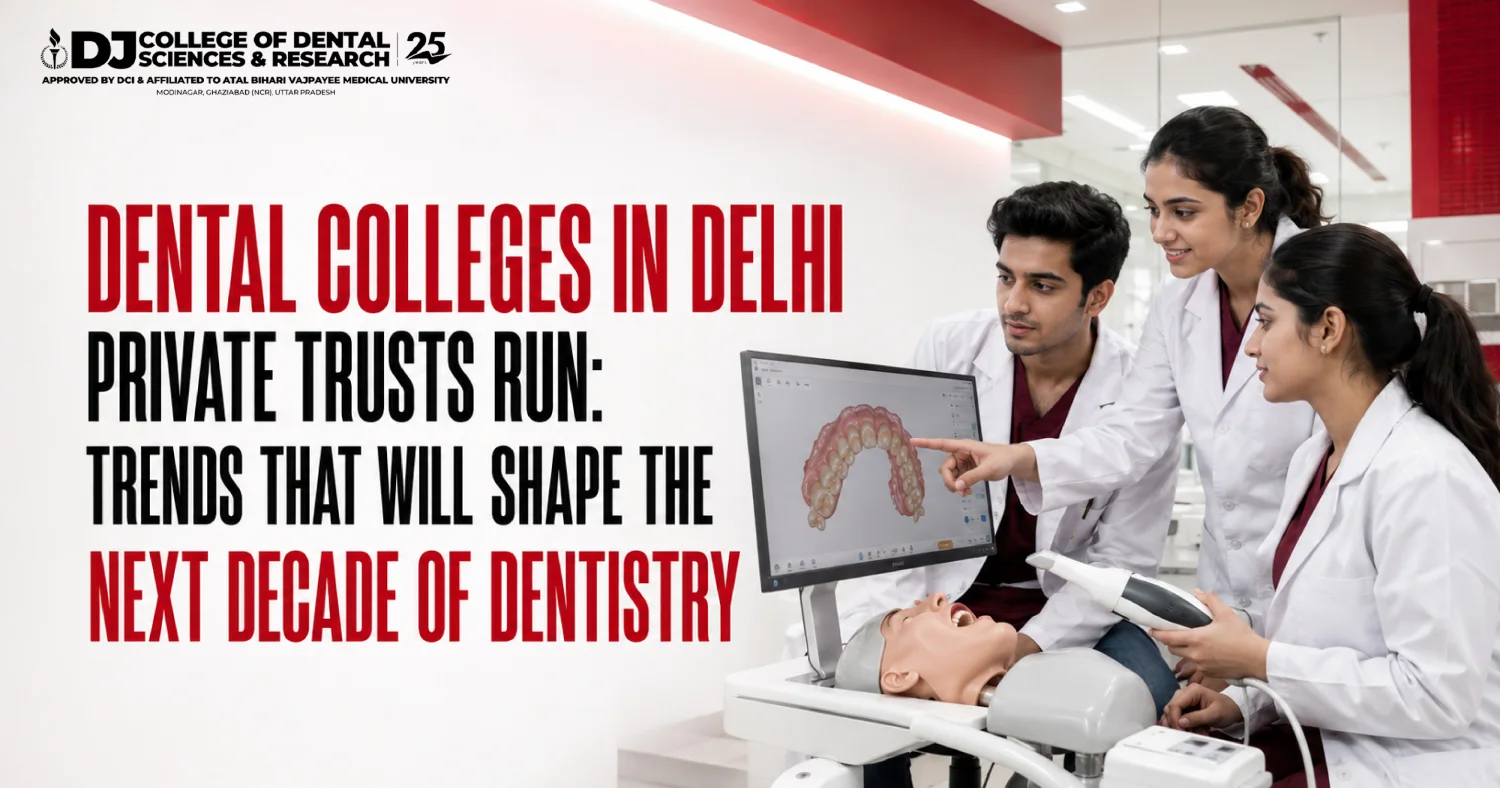
They change what a graduate must know on day one of practice. A student who has used a CAD/CAM unit, handled a digital scanner and questioned an AI-flagged radiograph starts ahead but the student who has only seen photographs of that equipment starts behind. This single difference is worth asking about during every campus visit.
Read More : Laser Dentistry in 2026
Dentistry Technology Markets, Converted to Indian Rupees
| Segment | Year | Value (USD) | Value (INR at ₹95.2/USD) | Source |
| Digital dentistry | 2026 | 5.47 billion | ₹52,074 crore | Fortune Business Insights |
| Digital dentistry | 2034 | 11.13 billion | ₹1.06 lakh crore | Fortune Business Insights |
| Dental CAD/CAM | 2026 | 2.89 billion | ₹27,513 crore | Straits Research |
| Dental CAD/CAM | 2034 | 5.45 billion | ₹51,884 crore | Straits Research |
| AI in dentistry | 2025 | 516.46 million | ₹4,917 crore | InsightAce Analytic |
| AI in dentistry | 2035 | 3,916.69 million | ₹37,287 crore | InsightAce Analytic |
| Teledentistry | 2026 | 2.9 billion | ₹27,608 crore | Research and Markets |
| Teledentistry | 2030 | 5.81 billion | ₹55,311 crore | Research and Markets |
| Dental services (global) | 2026 | 523.98 billion | ₹49.88 lakh crore | Precedence Research |
Conversion applied at 1 USD = ₹95.2, the mid-market rate on 10 August 2026. Exchange rates move, so treat the rupee column as indicative.
How Accurately Does AI Detect Dental Caries?
| Study | Sensitivity | Specificity | Source and year |
| Umbrella review of 14 systematic reviews | 0.85 | 0.90 | PLOS One (2025) |
| Meta-analysis, bitewing radiographs | 0.87 | 0.89 | Japanese Dental Science Review (2024) |
| Meta-analysis, dentin caries only | 0.84 | Not reported | Japanese Dental Science Review (2024) |
| Meta-analysis, enamel caries only | 0.71 | Not reported | Japanese Dental Science Review (2024) |
| Binary caries diagnosis, 13 studies | 0.86 | 0.91 | BMC Oral Health (2026) |
Note: enamel caries detection remains notably weaker than dentin caries detection. Reviewers advise that AI findings be confirmed by a dentist before treatment.
Six Trends and What Each One Means for a Dental Student
| Trend | What is changing | What a student should do about it |
| Digital impressions | Intraoral scanners replace putty trays | Ask which year students first use the scanner |
| CAD/CAM and 3D printing | Same-day crowns and printed surgical guides | Check whether the campus has a working CAD-CAM lab |
| AI-assisted diagnosis | Software flags caries and bone loss on radiographs | Learn to read radiographs well enough to question the software |
| Teledentistry | Screening and follow-up move partly online | Build clear communication skills, not just clinical ones |
| Preventive and minimally invasive care | Fewer extractions, earlier intervention | Take public health dentistry postings seriously |
| Graduate oversupply | India adds close to 28,000 BDS graduates a year | Plan for MDS, a niche skill, or a clear practice model early |
Sources: WHO Global Oral Health Status Report (2022); Observer Research Foundation analysis of dental workforce supply (2025); Fortune Business Insights; Research and Markets.
Where Does DJ College of Dental Sciences and Research Stand?
DJ College of Dental Sciences and Research sits in Modinagar, in Ghaziabad district, inside the Delhi NCR belt. It was founded in 1999 and is among the first five private dental colleges in Uttar Pradesh. The college runs BDS, MDS across nine departments and two allied programmes in dental hygiene and dental mechanics.
From a student’s perspective there are three points which connect directly to the trends above. The college reports 100+ patients per department each day, which answers the patient load question. Its published facilities include a CAD-CAM lab and a skill lab, which answers the digital equipment question. Students arrive from 17+ countries, which broadens the case mix a trainee will see.
DJ College of Dental Sciences and Research at a Glance
| Detail | Position | Why it matters to an applicant |
| Location | Modinagar, Ghaziabad district, UP | Inside the Delhi NCR belt, not Delhi city |
| Founded | 1999 | 25+ years of running dental programmes |
| Programmes | BDS, MDS, plus two allied courses | Postgraduate departments support UG teaching |
| MDS seats | 45 across nine departments | Six seats each in six branches, three each in three |
| Campus | 75 acre shared DJ Group campus | Attached teaching hospital on site |
| Daily patients | 100+ per department | Direct clinical practice for undergraduates |
| Digital facilities | CAD-CAM lab, skill lab | Matches the digital workflow trend |
| Student mix | 17+ countries represented | Wider variety of cases and case discussion |
Source: djdentalcollege.com, verified 10 August 2026, and the institutional USP sheet supplied by the college.
Conclusion
The next decade will reward dentists who can work skilfully with their hands and confidently with software. For students comparing dental colleges in Delhi private trusts run, the honest starting point is geography. The private options sit across Delhi NCR and not inside Delhi city, pretending otherwise only wastes counselling time and the checks stay simple. Patient load per department. Chair count per batch. National Dental Commission status. Real undergraduate access to digital equipment. Ask for each of those in writing before paying any fee. A brochure can promise the future of dentistry. Only the daily patient register and the equipment log can prove it.
Frequently Asked Questions
Are there any private dental colleges inside Delhi city?
No. Delhi runs government and central university dental colleges only, including Maulana Azad Institute of Dental Sciences, ESIC Dental College and the Faculty of Dentistry at Jamia Millia Islamia. Students searching for dental colleges in Delhi private trusts run will find every private option in the surrounding Delhi NCR districts such as Ghaziabad, Greater Noida, Faridabad and Gurugram.
How many BDS seats does India have in 2026?
India has roughly 27,966 BDS seats across 319 dental colleges, according to National Dental Commission data. Private colleges hold 20,580 of those seats, government colleges hold 4,096 and deemed universities hold 3,290. Careers360, citing DCI records, reports a slightly higher figure of 28,016 seats across 329 colleges.
What is the fee range for a private BDS degree near Delhi?
Published estimates place annual private BDS fees across the Delhi NCR belt at roughly ₹3 lakh to ₹8 lakh, with a full five-year cost between ₹15 lakh and ₹40 lakh. Deemed universities charge more. Since state committees re-approve private fees every year, always check the college’s own approved fee notification for the intake year.
Will artificial intelligence replace dentists?
No. Current evidence supports AI as a detection aid, not a replacement. A 2025 umbrella review in PLOS One reported pooled sensitivity of 0.85 and specificity of 0.90 for caries detection. Enamel caries detection is weaker still, at 0.71 sensitivity. Every positive finding needs a dentist to confirm it and to carry out the treatment.
Is BDS still a good career choice for the next decade?
Demand supports it. WHO estimates that oral diseases affect around 3.5 billion people worldwide, and India carries the largest national caseload at about 632 million cases. However, India also adds close to 28,000 BDS graduates each year. Specialisation, digital skills and a clear practice plan now decide who does well.
Related Posts