Why does a dental college feel so different from every other campus?
One question that often comes up in counselling season is a simple one. What does a student actually do all day inside a dental college? Parents picture lecture halls. Students picture white coats and a stethoscope that never arrives. The reality on the ground is somewhat different, and far busier.
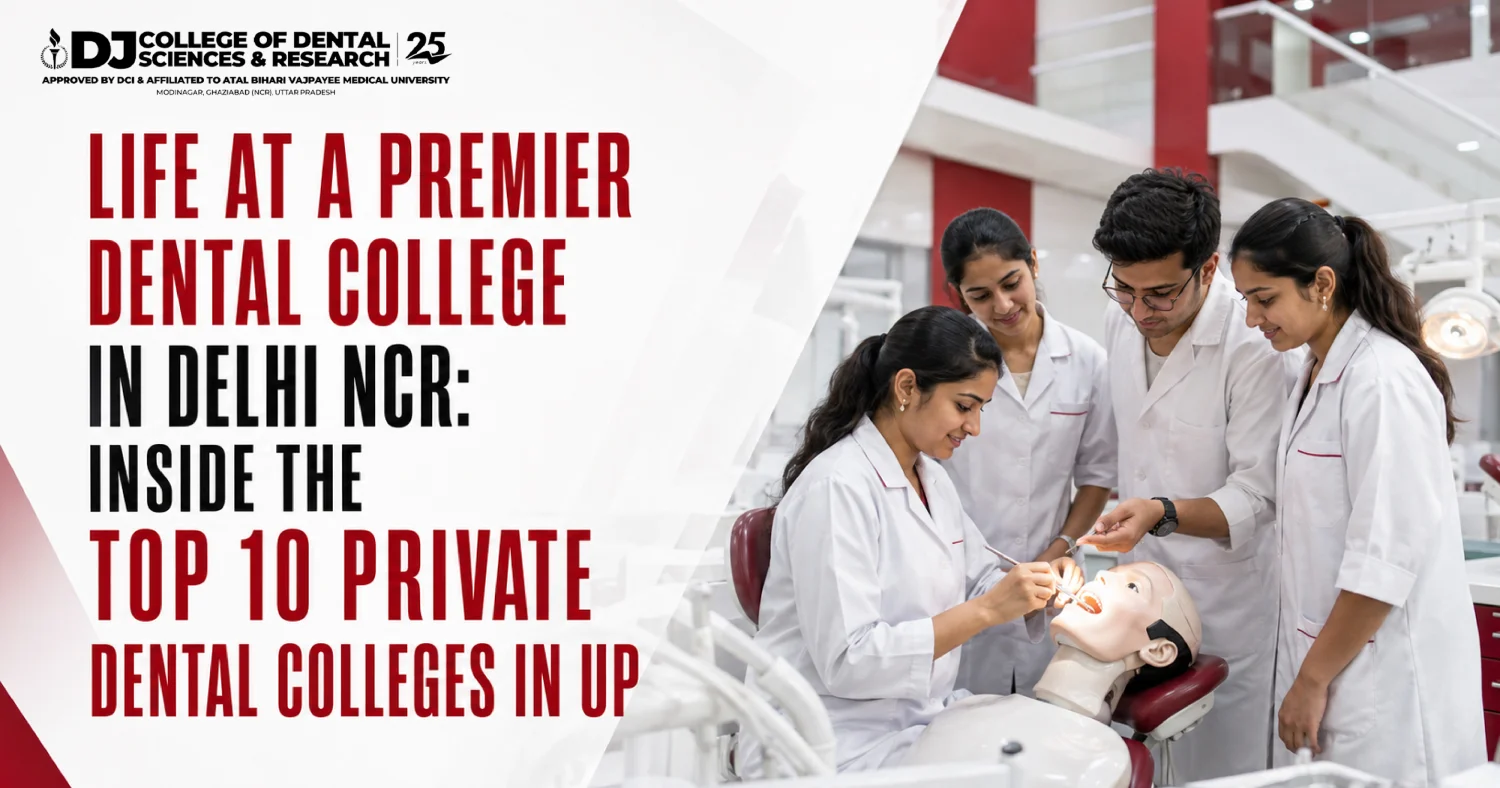
A dental campus in Delhi NCR wakes up early. By nine in the morning the out-patient departments are open, the registration counter is filling, and a third-year student is already standing beside a chair, watching a senior work on a molar. By the fourth year that same student is holding the handpiece. Not everyone is aware that dentistry is one of the few courses in India where a student treats a living patient long before the degree arrives.
For many students and their families, the search begins with a list. They type the top 10 private dental colleges in UP into a phone at midnight and scroll through names. Yet a list says very little about the five years that follow. This blog walks through those five years with numbers, comparisons and named sources, and shows where DJ College of Dental Sciences and Research fits into the picture.
What do dental programmes in India look like today?
India runs two dental degrees. BDS, the Bachelor of Dental Surgery, is the only route to becoming a registered dentist. MDS, the Master of Dental Surgery, is the specialist degree that follows. Both are filled through NEET, and both are regulated by the National Dental Commission, which took over from the Dental Council of India in March 2026.
The gap between the two is where the pressure sits. India offers close to 28,000 BDS seats but only about 7,357 MDS seats. It would not be wrong to say that a dental student begins competing for postgraduate study from the second year onward.
BDS and MDS side by side
| Point of difference | BDS | MDS |
| Level | Undergraduate degree | Postgraduate degree |
| Duration | 4 years of study plus 1 year of compulsory rotating internship | 3 years in one chosen branch |
| Entrance test | NEET UG | NEET MDS |
| Eligibility | Class 12 with Physics, Chemistry and Biology, minimum 50 per cent for the general category | BDS degree, completed internship and dental council registration |
| Seats in India | About 27,966 | About 7,357 |
| Outcome | Registered dentist able to run general practice | Specialist in one branch such as orthodontics or oral surgery |
Source: National Dental Commission seat data as compiled by AspirantsOnly, 2026; NEET UG eligibility rules, National Testing Agency.
Where the dental seats actually sit
| Category | Colleges | BDS seats | MDS seats | Share of BDS seats |
| India, all colleges | 319 | 27,966 | 7,357 | 100 per cent |
| India, private colleges | 229 | 20,580 | 5,267 | 73.6 per cent |
| India, government colleges | 56 | 4,096 | 977 | 14.6 per cent |
| India, deemed universities | 34 | 3,290 | 1,113 | 11.8 per cent |
| Uttar Pradesh, all colleges | 27 | About 2,513 | About 815 | 9 per cent of India |
| Uttar Pradesh, private colleges | 22 | 2,200 | 689 | 87.5 per cent of UP |
Source: AspirantsOnly, BDS Seats in India 2026 and MDS Seats in India; CareerMudhra, Dental Colleges in Uttar Pradesh, 2026. Seat counts change with each approval cycle, so the current DGME seat matrix should be checked before counselling.
What do the top 10 private dental colleges in UP teach in BDS and MDS?
The teaching plan looks similar on paper across these colleges, because the National Dental Commission sets the syllabus. The difference shows up in the departments. A college with nine working departments and a busy hospital gives a student far more cases than a college with a thin patient register. DJ College of Dental Sciences and Research runs all nine.
The nine clinical departments and what a student learns in each
| Department | What the student learns to do |
| Oral Medicine and Radiology | Reads X-rays and scans, diagnoses ulcers, lesions and early oral cancer |
| Conservative Dentistry and Endodontics | Fillings, tooth restoration and root canal treatment |
| Prosthodontics, Crown and Bridge and Implantology | Dentures, crowns, bridges and dental implants |
| Periodontology and Oral Implantology | Gum treatment, scaling, flap surgery and implant care |
| Oral Pathology and Microbiology | Laboratory study of oral disease, biopsy reading and slide work |
| Orthodontics and Dentofacial Orthopaedics | Braces, aligners and correction of jaw growth |
| Paediatric and Preventive Dentistry | Treatment of children, fluoride care and habit correction |
| Oral and Maxillofacial Surgery | Extractions, minor surgery, jaw fractures and facial procedures |
| Public Health Dentistry | Screening camps, community surveys and school programmes |
What are the course highlights a student should know before joining?
The five years are not evenly paced. The first two years feel like a science degree. The third year turns the corner. The fourth year and the internship look like a working hospital job. Students who understand this early plan their study hours far better.
Table 4. Year by year inside a BDS course
| Year | Main subjects and focus | Where the day is spent |
| First | General anatomy, physiology, biochemistry and dental anatomy | Lecture halls, dissection hall and carving labs |
| Second | Pharmacology, pathology, microbiology and dental materials | Laboratories and phantom head practice benches |
| Third | General medicine, general surgery, oral pathology and community dentistry | Hospital wards and first patient case histories |
| Fourth | All nine clinical departments, chair-side procedures and quotas | Out-patient departments from morning to evening |
| Fifth | Compulsory rotating internship across every department | Full working days treating patients under supervision |
Source: BDS Course Regulations, Dental Council of India, now administered by the National Dental Commission; DJ College of Dental Sciences and Research course pages.
What does a dentist really do for a patient, and why does it matter?
Filling a cavity is only a small part of the job. The mouth is where diabetes, vitamin deficiency, tobacco damage and even some cancers show their first sign. A closer look at the data shows how large the problem has become. Oral disease is now the most widespread health condition on earth, and India carries the heaviest single share of it.
That is the reason a dental student spends so many hours at a chair. Every patient who walks into a college hospital is both a person who needs care and a case that builds a young clinician.
The oral health burden and the dentist workforce
| Indicator | Figure | Source |
| People living with an oral disease worldwide | Nearly 3.7 billion | WHO oral health fact sheet, Global Burden of Disease 2021 |
| People with untreated tooth decay worldwide | About 2.5 billion | WHO Global Oral Health Status Report, 2022 |
| Oral disease cases against all five main non-communicable diseases combined | About 1 billion higher | FDI World Dental Federation |
| Oral disease caseload in India, top five causes | About 632 million, the highest of any country | Oral Diseases journal review of the WHO report, 2024 |
| Complete tooth loss, age 60 and above | About 23 per cent globally | WHO oral health fact sheet |
| Dentists per 10,000 people in India | 1.59, against a global average of 3.3 | Royal College of Surgeons of Edinburgh, May 2025 |
| WHO working benchmark for dentist to population ratio | One dentist for every 7,500 people | WHO, cited by IMPRI Impact and Policy Research Institute |
| Registered dentists in India | About 3 lakh | Dental Council of India records, cited by IMPRI |
What are the rewards of choosing dentistry?
The honest answer has two halves. Early pay in India is modest, and every dental student hears the stories. The second half is the part the stories leave out. Dentistry gives a graduate a licence to practise on the day of registration, a skill that travels across borders, and a working life that a person controls. Very few Indian degrees offer all three.
The table below converts the main foreign benchmarks into rupees so that families can compare like with like. It is worth noting that these figures are not directly comparable, because living costs, taxes and licensing rules differ in each country.
Dentist pay benchmarks converted into Indian rupees
| Country | Published benchmark | Source | Value in INR on 10 August 2026 |
| India | About Rs 4,00,000 average annual pay for a general dentist | PayScale India, 2026 | Rs 4,00,000, already in INR |
| India | About Rs 20,11,759 average gross annual pay, survey of employers | SalaryExpert (ERI), 2026 | Rs 20,11,759, already in INR |
| United Kingdom | GBP 42,408 for the first year of dental foundation training, from 1 April 2025 | NHS Health Careers | About Rs 54.6 lakh |
| United Kingdom | GBP 54,502 to GBP 116,573 basic pay for salaried NHS dentists | NHS Health Careers | About Rs 70.1 lakh to Rs 1.50 crore |
| United States | USD 179,210 median annual pay for dentists, May 2024 | US Bureau of Labor Statistics | About Rs 1.71 crore |
| United States | USD 84,740 lowest tenth and USD 239,200 top tenth | US Bureau of Labor Statistics | About Rs 80.7 lakh and Rs 2.28 crore |
Ten quick facts about a dental student college life
These are the details that rarely appear in a brochure and that seniors pass on in the canteen.
Ten facts about life inside a dental college
| No. | The fact | What it means in practice |
| 1 | The first patient arrives sooner than expected | Case history taking usually begins in the third year, long before the degree |
| 2 | Wax and plaster become part of daily life | Carving teeth in wax builds the hand control needed for crowns later |
| 3 | Quotas run the clinical years | Each department sets a required number of cases, so students hunt for patients |
| 4 | The internship year is a job in all but name | Full days across nine departments, with a stipend at most colleges |
| 5 | Loupes and a good handpiece matter | Personal instruments are an early purchase and are used for years |
| 6 | Posture problems start early | Seniors coach juniors on chair position from the first clinical posting |
| 7 | Camps take students off campus | Public health dentistry postings run school and village screening drives |
| 8 | Case presentations sharpen speech | Students defend a diagnosis in front of faculty and peers every few weeks |
| 9 | NEET MDS preparation begins in the fourth year | With roughly one MDS seat for every four BDS graduates, planning starts early |
| 10 | Hostel life carries the course | Late-night model work and shared study groups are how most batches survive it |
Read More : Things You Need to Know About a Dental College Student’s Life
How do the top 10 private dental colleges in UP compare inside Delhi NCR?
Ghaziabad holds the largest cluster of dental colleges in Uttar Pradesh, and Gautam Buddh Nagar and Meerut sit close behind. Families comparing these names should look past the label and check three things: the district, the type of institution, and the counselling route, because a private university and an affiliated college fill their seats through different processes.
Delhi NCR peer group at a glance
| College | District and state | Type of institution | Usual admission route |
| DJ College of Dental Sciences and Research, Modinagar | Ghaziabad, UP | Private college affiliated to Atal Bihari Vajpayee Medical University, Lucknow | NEET UG and UP state counselling through DGME |
| Inderprastha Dental College and Hospital | Ghaziabad, UP | Private affiliated college | NEET UG and UP state counselling |
| Institute of Dental Studies and Technologies | Ghaziabad, UP | Private affiliated college | NEET UG and UP state counselling |
| I.T.S Dental College, Greater Noida | Gautam Buddh Nagar, UP | Private affiliated college | NEET UG and UP state counselling |
| I.T.S Dental College, Ghaziabad | Ghaziabad, UP | Private affiliated college | NEET UG and UP state counselling |
| Sharda University, School of Dental Sciences | Gautam Buddh Nagar, UP | Private university | NEET UG and university counselling |
| Subharti Dental College | Meerut, UP | Private university constituent college | NEET UG and university counselling |
| Kalka Dental College | Meerut, UP | Private affiliated college | NEET UG and UP state counselling |
| SGT University, Faculty of Dental Sciences | Gurugram, Haryana | Private university | NEET UG and Haryana or university counselling |
Why choose DJ College of Dental Sciences and Research for BDS and MDS?
DJ College of Dental Sciences and Research opened in 1999 at Modinagar in Ghaziabad district, which gives it over 25 years of teaching history and places it among the earliest private dental colleges in the state. From a student point of view, three things separate it inside the group of top 10 private dental colleges in UP: the size of the campus, the number of patients who walk in each day, and the spread of students from other countries.
DJ College of Dental Sciences and Research at a glance
| Point | Detail |
| Year of establishment | 1999, giving over 25 years of dental teaching |
| Location | Ajit Mahal, Niwari Road, Modinagar, Ghaziabad district, Uttar Pradesh, inside Delhi NCR |
| Affiliation | Atal Bihari Vajpayee Medical University, Lucknow |
| Regulatory recognition | Recognised for BDS and MDS under the national dental regulator, now the National Dental Commission |
| Programmes | BDS and MDS across multiple specialisations |
| Departments | Nine clinical departments |
| Campus | Shared 75-acre DJ Group campus with a teaching hospital |
| Daily patient load | 100 plus patients per department each day, as stated by the college |
| International student presence | Students from 17 countries |
| Research | In-house journal, the Journal of Orofacial and Health Sciences |
| Student support | Scholarships, career guidance and student development beyond the clinic |
The Ghaziabad location does real work here. A patient pool drawn from Modinagar, Meerut, Muzaffarnagar and the eastern edge of Delhi brings a wide mix of cases, from routine fillings to tobacco-related lesions that a student in a quieter town may rarely see.
What career opportunities open after BDS and MDS?
Ask any experienced professional in the field, and they will tell you that dentistry has widened well past the single-chair clinic. The routes below are all open to a BDS graduate, and several open wider after MDS.
Career routes after a dental degree
| Career route | Qualification needed | What the work looks like |
| General dental practice | BDS and state council registration | Own clinic or associate work, treating routine and preventive cases |
| Specialist practice | MDS in one branch | Referral cases in orthodontics, endodontics, surgery or implants |
| Corporate dental chains and hospitals | BDS or MDS | Salaried clinical roles with fixed hours and structured protocols |
| Government and public health services | BDS, often with public health dentistry | District hospitals, health programmes, school screening and policy work |
| Armed Forces dental officer | BDS with AFMS selection | Commissioned service with the Army, Navy or Air Force dental corps |
| Teaching and research | MDS, later a PhD | Faculty posts in dental colleges, clinical trials and publication |
| Dental technology, materials and sales | BDS plus a management or technical qualification | Product development, clinical training and dental equipment roles |
| Practice abroad | BDS plus the licensing test of that country | Registration exams such as those run in the United Kingdom, the Gulf and Australia |
Source: Career pathways published by the national dental regulator, NHS Health Careers, US Bureau of Labor Statistics and Indian dental council registration rules.
Read More : Best Courses After BDS Degree for Career Growth
Final thought
Five years inside a dental college change a person. A student who could barely hold a mirror in the first year walks out able to read an X-ray, calm a frightened child and rebuild a broken tooth. That change happens in out-patient departments, in wax labs and in late-night study groups, not in a brochure. Families comparing the top 10 private dental colleges in UP should therefore ask about patients, departments and faculty before they ask about anything else. DJ College of Dental Sciences and Research has been answering those questions for over 25 years from its Modinagar campus in Ghaziabad, and any family shortlisting a college in Delhi NCR would do well to visit the hospital on a working morning and watch the fourth year at work.
FAQs:
1. Which are the top 10 private dental colleges in UP for BDS in 2026?
Uttar Pradesh has 22 private dental colleges. Names that appear on most shortlists include DJ College of Dental Sciences and Research, I.T.S Dental College at Ghaziabad and Greater Noida, Inderprastha, the Institute of Dental Studies and Technologies, Sharda University, Subharti and Kalka. Rankings differ by source, so the current seat matrix should be checked before applying.
2. Is BDS a good career choice in India in 2026?
Yes, for students who enjoy patient work and fine hand skills. India carries about 632 million cases across the top five oral diseases, so demand for treatment keeps rising. Early pay is modest, and it grows with specialisation, clinic ownership or registration to practise abroad.
3. What is the difference between BDS and MDS?
BDS is the five-year undergraduate degree that makes a person a registered dentist. MDS is the three-year postgraduate degree in a single branch, such as orthodontics or oral surgery. India has about 27,966 BDS seats and about 7,357 MDS seats, so postgraduate entry is far tighter.
4. How many dental colleges are there in Uttar Pradesh?
Uttar Pradesh has 27 dental colleges. Four are government, one is deemed and 22 are private. Together they offer about 2,513 BDS seats and about 815 MDS seats. Private colleges hold close to 88 per cent of the BDS seats in the state.
5. What is life like at a dental college in Delhi NCR?
Mornings begin with lectures and afternoons move to the out-patient departments. From the third year a student records case histories, assists seniors and then treats patients directly. Evenings go to laboratory work and case presentations. The fifth year is a full rotating internship across nine departments.
6. Is NEET compulsory for BDS admission in private dental colleges in UP?
Yes. Every BDS seat in India, whether government, private or deemed, is filled through NEET UG. Uttar Pradesh state counselling is conducted by DGME, while the 15 per cent All India Quota and deemed university seats are handled by the Medical Counselling Committee.
7. How many years does it take to become a dentist in India?
Five years in total, made up of four years of academic and clinical study and one year of compulsory rotating internship. Registration with the state dental council follows. A student who adds MDS spends three further years, so full specialisation takes about eight years.
8. Which MDS specialisations does DJ College of Dental Sciences and Research offer?
The college runs nine departments: Oral Medicine and Radiology, Conservative Dentistry and Endodontics, Prosthodontics with Crown, Bridge and Implantology, Periodontology and Oral Implantology, Oral Pathology and Microbiology, Orthodontics and Dentofacial Orthopaedics, Paediatric and Preventive Dentistry, Oral and Maxillofacial Surgery, and Public Health Dentistry.
9. Do dental students treat real patients during the course?
Yes, always under supervision. Clinical work usually begins in the third year with case histories and simple procedures, then widens through the fourth year and the internship. Colleges with busy out-patient departments give a student a larger number of cases before graduation.
10. Why do students pick Ghaziabad for dental study?
Ghaziabad holds the largest cluster of dental colleges in Uttar Pradesh and sits inside Delhi NCR. Travel to Delhi is short, the patient pool is large and mixed, and students find teaching hospitals, specialist referrals and internship options within a small radius.
Related Posts