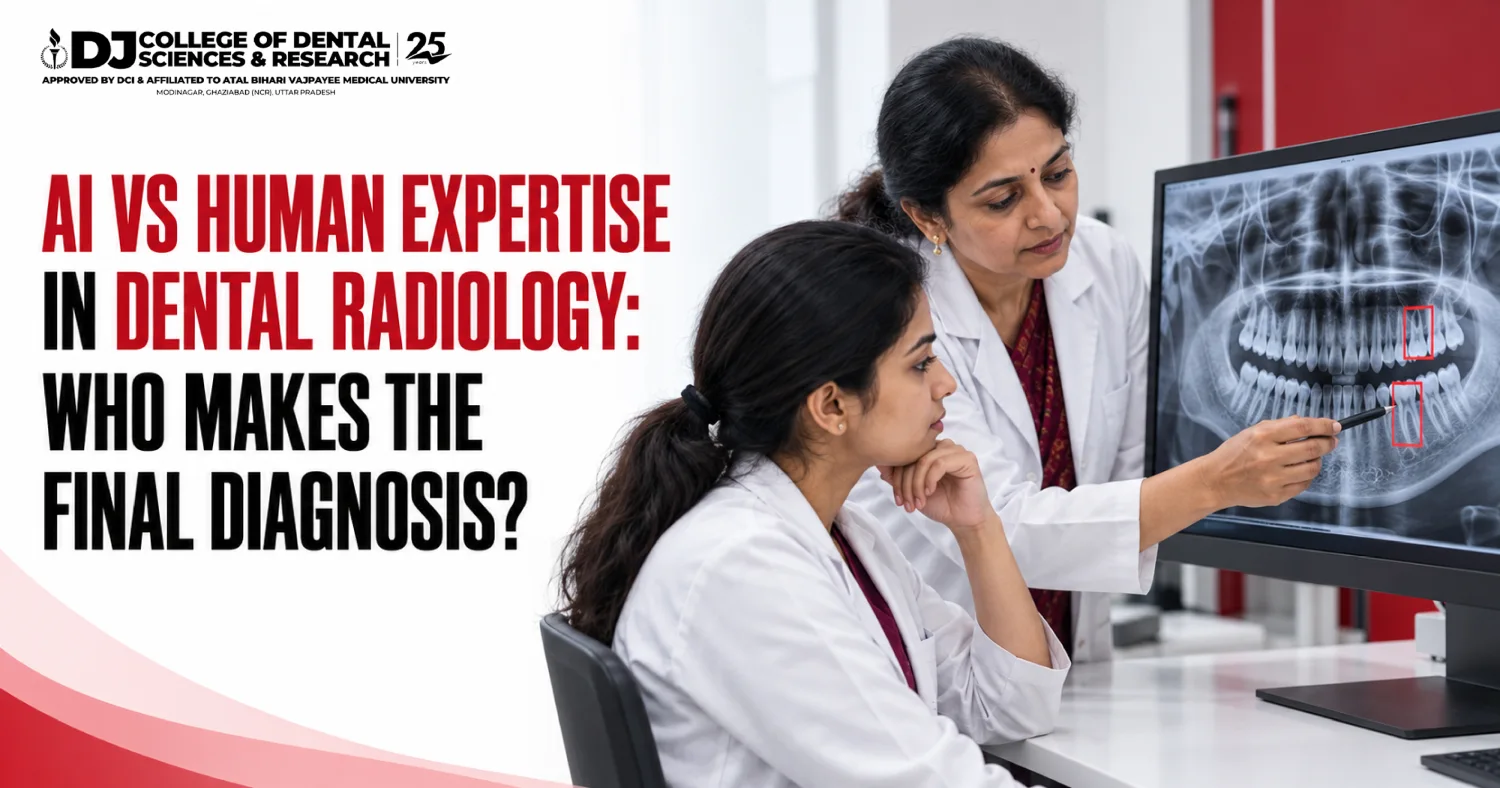
The human specialist makes the final diagnosis. AI reads dental X-rays in seconds and catches about 85 in 100 decayed teeth in studies, but it works as a second reader. The dentist or oral radiologist weighs the scan against the patient’s history, signs the report and carries the responsibility. That judgement is what a department of oral medicine and radiology teaches.
A nineteen-year-old sits in the radiology room, nervous about a dull ache near her jaw. Her panoramic X-ray appears on the screen. Within three seconds, the software draws red boxes around four teeth. Nobody in the room has even picked up a pen.
The postgraduate student looks impressed. The professor leans in. She agrees with two boxes and rejects two as overlapping shadows. Then she points to a faint dark patch near the angle of the jaw, a spot the machine never marked.
So who was right, the software or the specialist? And when the report is signed, whose name goes on it?
Every department of oral medicine and radiology in the country now faces this question. Many parents and students still believe that the machine will soon take over. The reality on the ground is somewhat different.
This blog from DJ College of Dental Sciences & Research, Modinagar, answers the common questions one by one, with studies and numbers.
Who Makes the Final Diagnosis, AI or the Dentist?
The dentist does. AI only suggests.
• The World Health Organization says “humans should remain in control of health-care systems and medical decisions”.
• A 2025 review in PLOS ONE found AI accurate for tooth decay, yet said it “should not be a substitute for human judgment”.
• The first AI cleared in the United States to read dental X-rays was described as software that supports dental professionals.
How Good Is AI at Reading Dental X-Rays?
Good, and getting better. A closer look at the research shows where it shines.
| Task | What studies found |
| Finding tooth decay | 85% sensitivity, 90% specificity across 20 studies and 29,423 tests |
| Dentists judging decay by eye | 83% sensitivity, 81% specificity in separate studies |
| Reading with AI support | Readers found 36% more lesions in the trials of one cleared software |
| Marking skull landmarks | 79.9% of points placed within 2 mm, from 19 studies |
| Finding root-tip lesions | 3D CBCT scans gave the highest accuracy |
Source: named in the last column; links are listed below the FAQs.
• Sensitivity is the share of real problems that are caught.
• Specificity is the share of healthy teeth that are cleared correctly.
Where Does AI Go Wrong?
This is where things become interesting. AI helps, but it also nudges.
• In a trial of 22 dentists, AI support raised the number of decayed spots they found. It also raised drilling decisions for early enamel decay from 17% to 24%.
• The authors warned of false alarms and overtreatment.
• AI learns from collected image sets. In the PLOS ONE review, only 27.3% of the images showed decay, which is lower than in real communities.
• AI sees the picture only. It does not hear the patient’s story.
What Can a Human Expert Do That AI Cannot?
| Point | AI software | Oral medicine and radiology specialist |
| Speed | Seconds | Minutes |
| Tiredness | None | Human limits |
| Patient history and symptoms | Not seen | Weighed with the image |
| Choice of scan and radiation dose | No role | Decides |
| Findings outside its training | Often missed | Trained to look beyond the tooth |
| Responsibility for the report | None | Signs and answers for it |
Source: summary of the studies and guidance quoted in this blog.
What Does a Department of Oral Medicine and Radiology Teach That Software Cannot Learn?
• Listening to the patient and examining the mouth.
• Choosing the right image, from a small tooth X-ray to CBCT, CT, MRI or ultrasound.
• Caring for patients who already have other illnesses.
• Managing mouth lesions and jaw joint problems without surgery.
• Forensic odontology, where dental records help identify people.
How Will a Department of Oral Medicine and Radiology Use AI in the Coming Years?
• AI may act as a quick first reader on routine films.
• The specialist confirms, corrects and signs.
• Time saved goes to difficult cases.
• Students learn to question the software, not to obey it.
Ask any experienced professional in the field, and the reply stays the same: a second pair of eyes is welcome, but it does not hold the pen.
How Much Radiation Do Dental Scans Give?
Choosing the scan is a human decision, and the dose differs widely.
| Scan | Radiation dose (microsieverts) |
| Side-view skull X-ray (lateral cephalogram) | 5.03 |
| Panoramic X-ray | 21.87 |
| CBCT scan, portrait mode | 131.7 |
Source: Journal of Orofacial Orthopedics, 2016.
How Big Is the Business Behind Dental Imaging and AI?
| Global market | Figure in US dollars | In Indian rupees (INR) |
| Dental imaging, 2025 | USD 3.8 billion | About Rs 36,784 crore |
| Dental imaging, 2034 forecast | USD 6.9 billion | About Rs 66,792 crore |
| AI in dentistry, 2025 | USD 1.3 billion | About Rs 12,584 crore |
| AI in dentistry, 2033 forecast | USD 6.6 billion | About Rs 63,888 crore |
Source: IMARC Group and Grand View Research. Converted at Rs 96.8 to one US dollar, the rate on 8 October 2026.
What Do Oral Medicine and Radiology Courses and Careers Look Like?
Stepping into this field sounds good, and the curiosity about the future hovers in the mind of every aspirant. Among oral medicine and radiology courses, the main one is the MDS.
| Point | MDS in oral medicine and radiology |
| Duration | Three years, full time |
| Eligibility | BDS, one-year internship and NEET MDS |
| All India Quota seats, 2026 | 38 |
| Deemed university seats, 2026 | 76 |
| Seats at DJ College | 3 |
| Listed average pay | Rs 4 lakh to Rs 7.5 lakh a year |
Source: Medical Counselling Committee matrix via Medical Dialogues; DJ College department page; GetMyUni.
• An oral medicine and radiology career can lead to imaging centres, hospital diagnosis units, tele-reporting of scans, cancer screening, teaching and forensic work.
• Seats are few among oral medicine and radiology colleges in India, so the branch stays small and specialised.
• For oral medicine and radiology colleges in Uttar Pradesh, students can look within the state’s 815 MDS seats in 25 dental colleges.
Read More: Why Oral & Maxillofacial Surgery Is the Most Exciting MDS Speciality in 2026
Why Do Students Choose DJ College of Dental Sciences & Research for This Branch?
The department of oral medicine and radiology at DJ College calls its aim the training of “physicians of the mouth”. It offers:
• Separate undergraduate, postgraduate, radiology and tobacco cessation clinics.
• Digital and panoramic X-ray machines.
• MDS training that runs from tooth X-rays to CT, MRI, CBCT and ultrasound.
• A Tobacco Cessation Centre that has counselled 8,000+ people since 2014.
• Three MDS seats, so each postgraduate works closely with the faculty.
• A 75-acre campus in Modinagar, Ghaziabad, serving Delhi NCR since 1999, with students from 17+ countries.
• Recognition by the Dental Council of India (DCI), now succeeded by the National Dental Commission (NDC).
Entry is through BDS and NEET MDS. The MDS eligibility page lists the steps.
Conclusion:
In that radiology room, the software found two real problems in three seconds, raised two false alarms and missed the one patch that mattered most. Each part of that story matches what the research shows.
AI is a fast and tireless second reader. The final diagnosis still belongs to a trained human who knows the patient. That is why the department of oral medicine and radiology remains the place where dental diagnosis is learnt. Students who want this path can contact the admissions team at DJ College of Dental Sciences & Research in Modinagar.
Frequently Asked Questions
Can AI diagnose a dental X-ray on its own?
No. AI marks areas that look doubtful. A dentist or oral radiologist checks them against the patient and makes the diagnosis.
Is AI better than dentists at finding tooth decay?
In separate studies, AI showed 85% sensitivity and 90% specificity, against 83% and 81% for dentists judging by eye. These were not head-to-head tests.
Who is responsible if AI misses a problem?
The clinician who signs the report stays responsible. WHO guidance says humans should remain in control of medical decisions.
What is oral medicine and radiology?
It is the dental branch that diagnoses mouth diseases without surgery and reads every kind of dental and facial scan.
What does a department of oral medicine and radiology do?
It examines patients, takes and reads X-rays and scans, manages mouth lesions and jaw joint problems, and trains BDS and MDS students in diagnosis.
What is the eligibility for MDS in oral medicine and radiology?
A candidate needs a BDS degree, a one-year internship, State Dental Council registration and a qualifying NEET MDS score. The course runs for three years.
How many MDS seats are there in oral medicine and radiology?
The 2026 counselling matrices listed 38 All India Quota seats and 76 deemed university seats in this branch. DJ College has three.
Will AI reduce jobs for oral radiologists?
It is unlikely. Every AI marking needs a trained person to confirm it, and scans are growing in number. The work shifts towards checking and complex cases.
Is a dental CBCT scan safe?
One study measured 131.7 microsieverts for a CBCT scan against 21.87 for a panoramic X-ray. A specialist decides when the extra detail is needed.
Does DJ College of Dental Sciences & Research offer MDS in oral medicine and radiology?
Yes. The college in Modinagar, Ghaziabad, offers a three-year MDS in this branch with three seats.
Related Posts