A lot of students always look up BDS course details the moment they clear NEET UG and most articles only talk about fees, seats and admission rounds. Very few explain what actually happens after four years of BDS classes get over. That last year, the rotatory internship, is where the real learning starts. It is the stage where a student stops copying from a textbook and starts treating a real person sitting in the dental chair.
Anyone checking BDS course details after 12th should understand this internship year just as closely as the syllabus and the eligibility rules. At DJ College of Dental Sciences & Research, Modinagar, interns rotate across nine dental departments and the attached hospital sees more than 100 patients per department every day so that kind of patient footfall gives an intern far more practise time than a quiet clinic ever could.
This article lays out full BDS course details for the internship stage which is how long it runs, what departments it covers, which skills it builds and what a student can do once it is over.
What Is a BDS Internship?
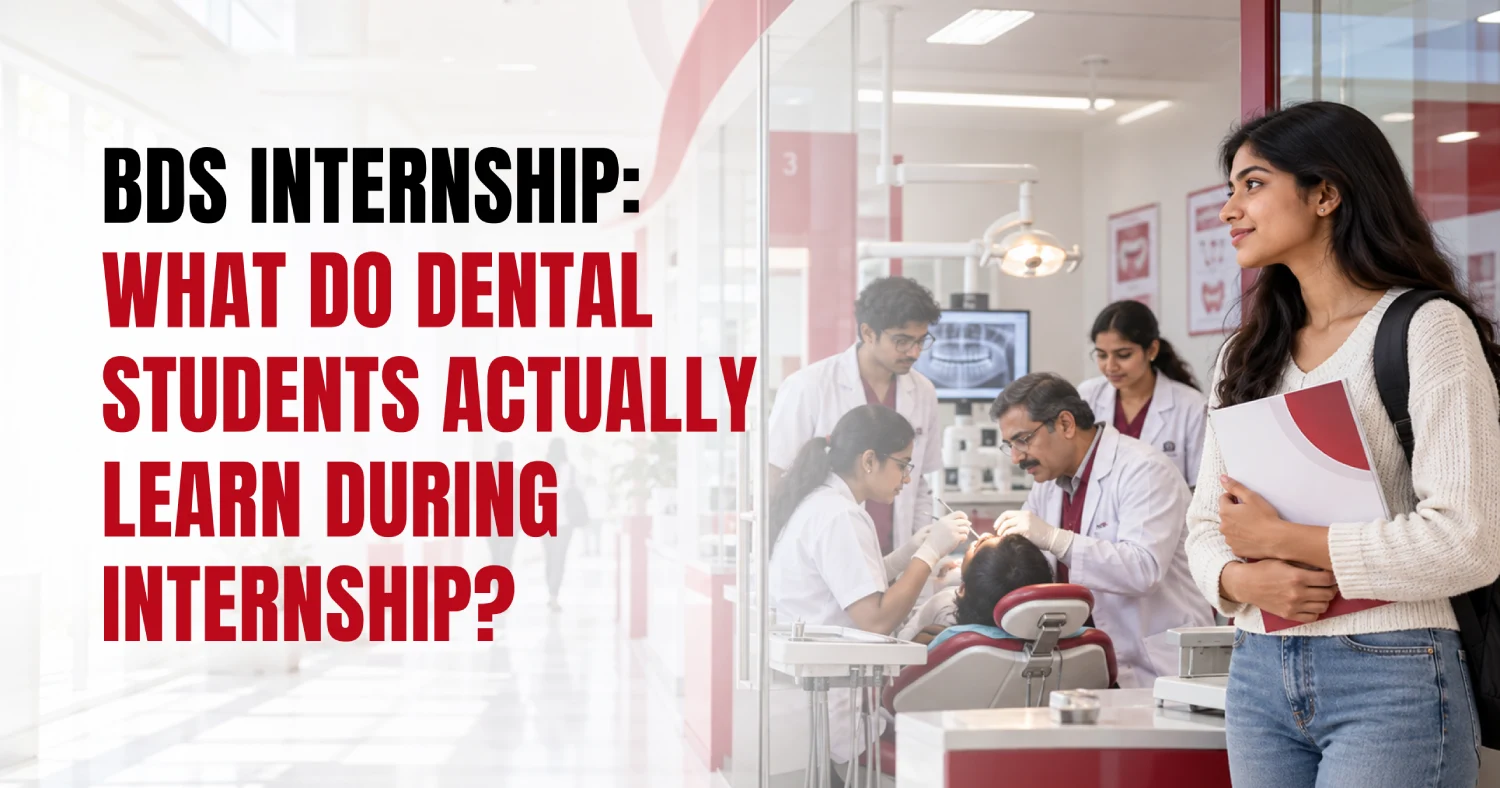
The BDS internship is a compulsory, paid, rotatory clinical training period which comes right after a student clears the final BDS examination. During this year, a student is called an intern, not a student and an intern works inside the dental college hospital, moving through every clinical department in turn.
The Dental Council of India (DCI) has made this internship mandatory. No student gets a final BDS degree or DCI registration without completing it. In short, the internship is not optional. It is the bridge between classroom dentistry and real dentistry.
How Long Is the BDS Internship?
The BDS internship runs for exactly one year. It is added on top of the four academic years of BDS. So the full BDS course duration works out to five years in total.
| Stage | Duration | What Happens |
|---|---|---|
| Academic Years (1st to 4th BDS) | 4 years | Classroom study, pre-clinical labs, and supervised patient work in college clinics |
| Rotatory Internship | 1 year | Compulsory, paid clinical posting across all dental departments |
| Total BDS Course Duration | 5 years | Degree awarded and DCI registration granted after internship completion |
What Do BDS Students Learn During Internship?
Internship shifts a student from watching to doing. A few things every intern learns, listed in point form below:
- How to take a patient’s history and reach a diagnosis without a professor checking every step.
- How to plan treatment for a real patient, not a case study printed in a book.
- How to keep proper case records and maintain a logbook, which examiners and future employers do check.
- How to work inside a hospital system, including duty timings, referrals, and reporting to a senior.
- How to talk to a nervous patient and explain a procedure in simple words.
None of this comes from a lecture hall. It comes from repetition, on real patients, under supervision.
Clinical Skills Students Develop During BDS Internship
By the end of the year, most interns can independently handle the following:
- Tooth extractions and minor oral surgery procedures.
- Restorative fillings for decayed teeth.
- Scaling and basic periodontal (gum) therapy.
- Taking impressions for dentures, crowns and bridges.
- Reading dental X-rays and OPG scans.
- Managing a child patient in the dental chair.
- Running basic oral health screening camps in the community.
Complete BDS Course Details: Year Wise Duration Breakdown
| Year | Focus Area |
|---|---|
| 1st BDS | Human anatomy, physiology, biochemistry, dental anatomy basics |
| 2nd BDS | General pathology, microbiology, pharmacology, dental materials |
| 3rd BDS | Oral pathology, oral medicine, periodontics, community dentistry (start of clinics) |
| 4th BDS | Prosthodontics, conservative dentistry, orthodontics, oral surgery, paediatric dentistry |
| 5th Year (Internship) | One year rotatory posting across all nine clinical departments |
Departments Covered During BDS Internship
At DJ College of Dental Sciences & Research, an intern rotates through nine departments. This wide coverage is what gives a well rounded picture of dentistry before an intern picks an MDS specialisation later.
| Department | Typical Focus During Internship |
|---|---|
| Oral Medicine & Radiology | Diagnosis, X-ray and CBCT interpretation, screening for oral disease |
| Conservative Dentistry & Endodontics | Fillings, root canal treatment |
| Prosthodontics, Crown & Bridge and Implantology | Dentures, crowns, bridges, basic implant-supported cases |
| Periodontology & Oral Implantology | Scaling, gum surgery, implant-site preparation |
| Oral Pathology & Microbiology | Biopsy handling, lab diagnosis of oral lesions |
| Orthodontics & Dentofacial Orthopaedics | Assisting with braces and bite correction cases |
| Paediatric & Preventive Dentistry | Child patient management, preventive treatments |
| Oral & Maxillofacial Surgery | Extractions, minor surgery, trauma and emergency cases |
| Public Health Dentistry | Community camps, school screening, oral health awareness drives |
Role of BDS Interns in Patient Care
An intern is not a spectator in the clinic. Under the supervision of a faculty member, an intern:
- Take the first case history when a patient walks in.
- Records vitals and prepares the case sheet.
- Assists a senior doctor during surgery or a complex procedure.
- Follow up with the patient after treatment, checking healing and giving aftercare advice.
This responsibility is exactly why the internship year matters so much in any honest discussion of BDS course details. It is where confidence is actually built.
Procedures BDS Interns Commonly Assist With
| Department | Common Procedures |
|---|---|
| Oral & Maxillofacial Surgery | Simple and surgical extractions, incision and drainage of abscess |
| Conservative Dentistry | Composite and GIC fillings, root canal procedures |
| Prosthodontics | Complete and partial denture fabrication, crown and bridge cases |
| Periodontology | Scaling, root planing, minor gum surgery |
| Paediatric Dentistry | Pulpectomy, fluoride application, space maintainers |
| Public Health Dentistry | Oral cancer screening camps, school dental check-ups |
How Does BDS Internship Prepare Students for Dental Practice?
A mannequin does not flinch but a real patient does and that single difference is why internship matters so much. During internship, a student learns to work faster, stay calm under pressure and make a decision when a textbook answer does not quite fit the patient in the chair.
This is also the stage where an intern starts to understand the business and ethics side of dentistry: patient consent, honest communication about cost, and knowing when to refer a case to a specialist rather than attempt it alone.
BDS Course Details After 12th: Eligibility Recap
Before internship comes admission. A quick recap of the entry requirements is useful for Class 12 students still planning their NEET UG attempt.
| Requirement | Detail |
|---|---|
| Qualifying Exam | 10+2 with Physics, Chemistry, Biology/Biotechnology and English |
| Minimum Marks | Around 50% in PCB for general category, lower relaxation for reserved categories (colleges may vary slightly) |
| Entrance Exam | NEET UG score is mandatory for BDS admission across India |
| Admission Route | State or central counselling based on NEET UG rank and category |
BDS Internship vs Classroom Learning
| Aspect | Classroom / Pre-Clinical Years | Internship Year |
|---|---|---|
| Mode of learning | Lectures, books, models, supervised practicals | Direct, hands-on patient treatment |
| Patient contact | Limited, closely supervised | Regular, across all departments |
| Decision making | Guided step by step | Student takes the first call, senior confirms |
| Assessment | Written and practical exams | Logbook, case records, department sign-off |
| Main skill built | Knowledge and technique | Confidence and speed under real conditions |
Career Benefits of Completing a BDS Internship
- It is mandatory for DCI registration, meaning it is the actual licence to practise as a dentist.
- It builds a case log and clinical portfolio, which helps a lot during MDS entrance interviews.
- Rotating through all departments helps a student figure out which MDS specialisation genuinely interests them.
- It is paid, so an intern earns a stipend while training, though the amount differs from college to college.
- It gives the confidence needed to either join a clinic, take up a government post, or start independent practice later.
BDS Course Details for Higher Studies: MDS Specialisations
Once the BDS course and internship are complete, many graduates go on to MDS. DJ College of Dental Sciences & Research offers MDS across nine specialisations.
| MDS Specialisation | Area of Focus |
|---|---|
| Oral Medicine & Radiology | Diagnosis, imaging, oral disease detection |
| Conservative Dentistry & Endodontics | Root canal treatment, restorative dentistry |
| Prosthodontics, Crown & Bridge and Implantology | Dentures, crowns, bridges, implants |
| Periodontology & Oral Implantology | Gum disease treatment, implant surgery |
| Oral Pathology & Microbiology | Laboratory diagnosis of oral disease |
| Orthodontics & Dentofacial Orthopaedics | Braces, bite correction, jaw alignment |
| Paediatric & Preventive Dentistry | Dental care for children |
| Oral & Maxillofacial Surgery | Complex extractions, trauma, facial surgery |
| Public Health Dentistry | Community oral health programmes and policy |
What Can Students Do After BDS Internship?
Internship completion opens a few clear paths. Here is a simple breakdown:
| Path | What It Involves |
|---|---|
| Private Practice | Start or join a private dental clinic as a general dentist |
| MDS (Postgraduation) | Appear for NEET MDS and specialise in one of nine dental fields |
| Government Dental Service | Apply for posts in government hospitals, PHCs, or the armed forces dental corps |
| Public Health Roles | Work with community health programmes and oral health awareness drives |
| Academics & Research | Join as a junior faculty member or pursue research and publications |
| Corporate Dental Chains | Work with organised dental clinic chains that are expanding across Indian cities |
Students comparing options often also search for the best BDS colleges in Delhi and the wider Delhi NCR belt, since this region offers a mix of government and private dental colleges with strong hospital tie-ups. DJ College of Dental Sciences & Research sits on the Delhi-Meerut corridor in Modinagar, which keeps it within easy reach of Delhi NCR while offering a full 75-acre campus of its own.
Why the Internship Experience at DJ College of Dental Sciences & Research Stands Out
A few practical points worth knowing if the internship year is the main reason a student is comparing colleges:
- The college is recognised by the Dental Council of India (DCI) and has been operating for more than 25 years.
- The attached hospital records over 100 patients per department every day, which means more real cases per intern.
- The 75-acre campus houses all nine departments along with digital labs and a fully equipped dental hospital.
- Faculty across departments are experienced and involved in ongoing research and publication work.
- The college hosts students from 17+ countries, adding a mixed clinical and cultural learning environment.
Conclusion
Reading up on BDS course details only in terms of fees and seat count misses the most important year of the whole programme. The one-year rotatory internship is where a BDS student turns into a dentist who can actually treat a patient, not just describe how to. For students still working out their full BDS course details before applying, it helps to ask any shortlisted college one direct question: how many departments will I rotate through, and how many real patients will I see each day? At DJ College of Dental Sciences & Research, Modinagar, the answer is nine departments and over 100 patients per department daily, inside a 75-acre, DCI-recognised campus.
Frequently Asked Questions About BDS Internship
1. How long is the BDS internship?
It is exactly one year, done after finishing the four academic years of BDS. This makes the full BDS course duration five years.
2. Is a BDS internship paid?
Yes. DCI rules state it must be a paid rotatory internship. The exact stipend amount is fixed by each college or state, so students should confirm the current figure with the admissions office.
3. Is the BDS internship compulsory?
Yes, it is compulsory. A student cannot get a final BDS degree or DCI registration without completing this one-year internship.
4. When does a BDS internship start?
It starts after a student clears the final BDS examination. The student is then posted department-wise for the one-year internship.
5. Can BDS interns treat patients on their own?
Interns work under the supervision of a faculty member. They handle a large part of patient care themselves, from history taking to treatment, but a senior doctor reviews and signs off on cases.
6. How many departments does a BDS intern rotate through?
At DJ College of Dental Sciences & Research, interns rotate through all nine departments, covering everything from oral surgery to public health dentistry.
7. What is the difference between BDS and MDS?
BDS is the five-year undergraduate dental degree, internship included. MDS is a three-year postgraduate specialisation that a BDS graduate can pursue after clearing NEET MDS.
8. Is NEET UG required for BDS admission?
Yes. NEET UG is mandatory for BDS admission across India, including at DJ College of Dental Sciences & Research.
9. What should students check when comparing BDS colleges in Delhi NCR?
Look at DCI recognition, patient footfall at the attached hospital, number of departments, faculty experience, and how the internship rotation is structured, not just the fee amount.
10. What can a student do right after a BDS internship?
A graduate can start private practice, apply for government dental posts, prepare for NEET MDS, or take up public health and community dentistry roles.
Related Posts