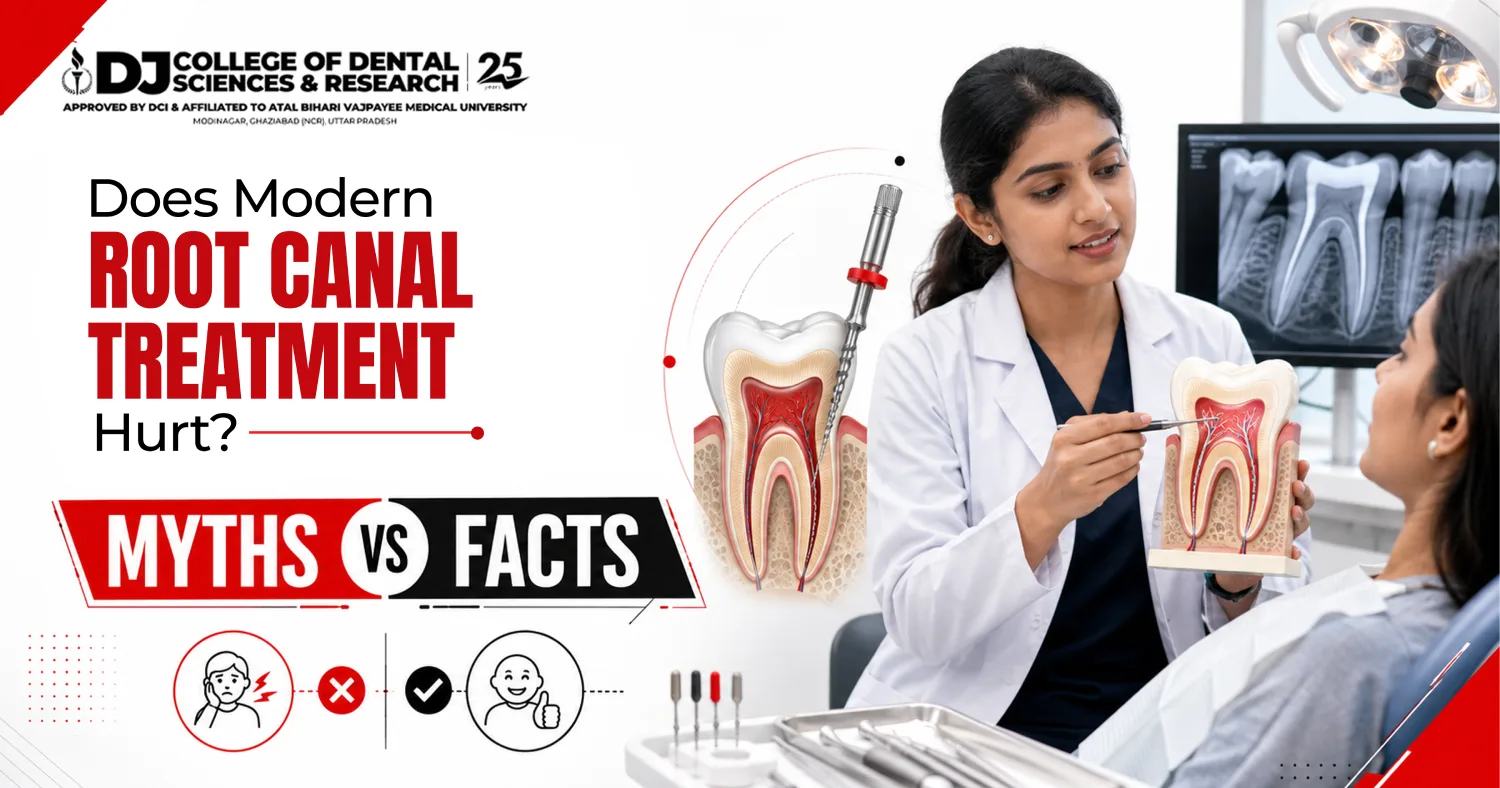
Say the words “root canal” in any Indian living room and watch what happens. Somebody winces. Somebody else remembers an uncle who suffered for a week. A third person, who has never had one, describes the pain in detail.
It is quite common to hear that a tooth extraction would be easier. That belief costs people their teeth every single day.
Here is what the evidence actually says. The American Association of Endodontists surveyed 1,014 adults and found that 63 percent wanted to avoid a root canal, while 69 percent wanted to avoid losing a permanent tooth. The same body found that patients who have been through the treatment are six times likelier to describe it as painless than those who have not.
The gap between the fear and the experience is the whole story of this article.
What follows separates the myths from the facts: what the procedure actually involves, why the reputation stuck, what the discomfort genuinely feels like at each stage, how it compares with other dental work, what it costs in India, and what the departments of Conservative Dentistry and Endodontics at the top 10 dental colleges in India and other recognised centres do differently. Nothing here replaces an examination by a dentist, since every tooth is its own case.
The Biggest Myth: Are Root Canals Extremely Painful?
No. A root canal relieves pain rather than causing it. That is the single most misunderstood point in dentistry.
The tooth being treated is already inflamed or infected, which is why it hurts before the appointment. Once local anaesthesia takes effect, the area is numb, and modern treatment feels roughly like having a large filling placed. Many parents and students still believe otherwise because the reputation was earned decades ago, under very different conditions.
Root canal myths against what the evidence shows
| The myth | What the evidence shows | Source |
| A root canal is agonising | Patients who have had one are six times likelier to call it painless than those who have not | American Association of Endodontists survey of 1,014 adults |
| Pulling the tooth is the easier option | A reader survey found severe pain reported more often after extraction than after a root canal | Consumer Reports reader survey, cited by the AAE |
| Root canals cause cancer and other illness | No valid scientific evidence links treated teeth to systemic disease; the claim comes from 1920s work discredited by the 1930s and 1950s | American Dental Association; UCLA School of Dentistry; American Association of Endodontists |
| Treated teeth do not last | One long-term study recorded 97 percent tooth survival at ten years and 93 percent clinical success | Clinical Oral Investigations, 5 to 37 year retrospective study of 598 teeth |
| It always takes several painful visits | Single-visit treatment is common, and one study found less pain in the first 24 hours after single-visit treatment than after multiple visits | Published endodontic pain studies quoted in Indian tertiary hospital research |
| Root canals are rare and risky | About 25 million endodontic treatments are performed safely each year in the United States alone | American Dental Association |
Sources: American Association of Endodontists; American Dental Association; UCLA School of Dentistry; Clinical Oral Investigations; published endodontic pain research. Full links appear in the sources list below.
What Actually Happens During a Root Canal?
The pulp inside a tooth is soft tissue made of nerves and blood vessels. When decay, a crack or an injury lets bacteria reach it, the pulp becomes inflamed or dies. A root canal removes that tissue, disinfects the space it occupied, and seals it so bacteria cannot return.
Not everyone is aware that the tooth itself is left in place. Nothing is pulled out. The structure that holds the tooth in the jaw stays just where it was.
The steps of a modern root canal
| Step | What the dentist does | What the patient feels |
| 1. Diagnosis | Examination plus a digital radiograph, and a CBCT scan in complex cases, to see the root anatomy | Nothing beyond a small sensor placed in the mouth |
| 2. Local anaesthesia | Numbs the tooth and the surrounding tissue | A brief prick, then numbness within a few minutes |
| 3. Rubber dam placement | Isolates the tooth to keep it clean and dry, and to stop anything reaching the throat | A sheet over the tooth; the mouth stays open comfortably |
| 4. Access opening | A small opening is made through the crown of the tooth | Vibration and sound, but no pain, because the area is numb |
| 5. Cleaning and shaping | Rotary instruments and an apex locator clean the canals to the correct length; irrigants disinfect them | Pressure and movement only |
| 6. Filling and sealing | The canals are filled with gutta-percha and sealer | Nothing noticeable |
| 7. Restoration | A permanent filling, and usually a crown on a back tooth to stop it fracturing later | Normal filling or crown appointment |
Sources: American Association of Endodontists patient education material; standard endodontic clinical protocol as taught under Dental Council of India BDS and MDS curricula.
Why Do So Many People Still Think Root Canals Hurt?
Three reasons, and only one of them has anything to do with the procedure itself.
First, the memory is old. Before rotary instruments, apex locators, rubber dams and modern anaesthetics became routine, treatment was slower and less predictable. The stories circulating in most families date from that era.
Second, people confuse the toothache with the treatment. Somebody arrives at a clinic in genuine agony from an infected pulp, has the root canal, and remembers the whole episode as painful. The pain came first. The treatment ended it.
Third, the internet keeps an old theory alive. In the 1920s a dentist named Weston Price proposed that bacteria sealed inside treated teeth caused disease elsewhere in the body. His methods were criticised at the time, his findings were discredited through the 1930s, and in 1951 the Journal of the American Dental Association published a special review that settled the matter. The theory still circulates online, now attached to claims about cancer. A 2013 study in a Journal of the American Medical Association title found the opposite pattern, reporting a reduced cancer risk among patients with multiple endodontic treatments.
It would not be wrong to say that the fear is inherited rather than experienced.
What Does Root Canal Pain Actually Feel Like?
Before treatment it can be severe. During treatment it should be nothing. Afterwards it is usually a dull soreness that fades within a few days.
Some tenderness after the appointment is normal and expected. The tissue around the root tip has been irritated, and inflammation takes a little time to settle. Published research puts the peak at around the 24-hour mark, after which it falls away steadily.
The pain timeline, stage by stage
| Stage | What is typical | What the research shows |
| Before treatment | Throbbing, lingering sensitivity to hot or cold, pain on biting, sometimes swelling | This is the pain that brings patients in; it is caused by the infection, not the treatment |
| During treatment | Pressure, vibration and sound, but no pain once anaesthesia has taken effect | Comparable to having a large filling placed |
| First 24 hours | Mild to moderate soreness, worst in this window | Post-treatment discomfort peaks at about 24 hours in most published studies |
| 24 to 72 hours | Steady reduction; ordinary painkillers usually enough | Studies record a clear fall in pain scores at 48 and 72 hours |
| One week | Little or nothing | Reported discomfort drops to roughly one patient in ten by the end of the first week |
| Beyond one week | Should be settled | Pain lasting past a week needs a review appointment rather than more painkillers |
Sources: Published endodontic post-operative pain research, including single-visit and multiple-visit comparison studies and rotary instrumentation trials indexed on PubMed Central.
One point is worth stating plainly. Reported post-treatment pain varies widely across studies, from a small minority of patients to well over half, because tooth type, infection severity and prior pain all change the picture. A patient who arrives in severe pain is likelier to feel sore afterwards than one treated before the infection took hold.
How Does Root Canal Pain Compare With Other Dental Procedures?
From a patient point of view, this is the question that settles the decision. The comparison below sets the treatment against the alternatives people usually weigh it against.
Root canal treatment compared with other dental procedures
| Procedure | Discomfort during | Discomfort after | What happens to the tooth |
| Root canal treatment | None once numb; similar to a large filling | Mild soreness for one to three days | The natural tooth is kept and restored |
| Tooth extraction | None once numb | Often greater, with a socket that takes days to weeks to heal | The tooth is gone; a bridge or implant is needed later |
| Deep filling | None once numb | Short-lived sensitivity | Tooth kept, but the pulp may still fail later |
| Scaling and polishing | Mild sensitivity, usually without anaesthesia | Minimal | No change to tooth structure |
| Implant placement after extraction | None once numb | Surgical healing over several days, plus months of integration | An artificial replacement for a tooth that could often have been saved |
Sources: American Association of Endodontists patient information; Consumer Reports reader survey on post-procedure pain, cited by the AAE.
What Are the Signs You Might Need a Root Canal?
A tooth rarely goes quiet before it goes wrong. The warning signs below usually appear well ahead of an emergency.
• Pain that lingers after hot or cold food, rather than fading within a second or two
• A throbbing ache that wakes the patient at night or worsens on lying down
• Pain on biting or on tapping the tooth
• A tooth turning grey or darker than its neighbours
• Swelling or tenderness in the gum beside a particular tooth
• A small pimple-like bump on the gum that may discharge and reappear
• A deep cavity, a cracked cusp or an old filling that has fractured
• A tooth that hurt badly for days and then stopped, which can mean the pulp has died rather than healed
That last one deserves attention. A tooth that stops hurting on its own has not necessarily recovered. Swelling, fever or difficulty swallowing alongside dental pain needs same-day care rather than a wait-and-see approach.
Where Should a Root Canal Be Done in India?
Two routes exist, and both are legitimate. A private dental clinic offers speed and convenience. A dental college hospital offers supervised specialist care at a lower cost, with more appointments.
For the most part, the deciding factors are time, complexity and budget. A straightforward front tooth suits either setting. A retreatment, a curved molar canal or a tooth with an unusual root anatomy benefits from a department where a specialist and a microscope are available.
Private clinic against dental college hospital
| Point | Private dental clinic | Dental college hospital |
| Who treats the patient | A general dentist or an MDS endodontist | A postgraduate student or intern working under a specialist, or a faculty member directly |
| Cost | Market rate | Usually a fraction of the market rate |
| Appointments | Often a single sitting | Usually more visits, with longer waiting time on each |
| Case complexity handled | Depends on the clinic and its equipment | Complex and referred cases are common, since departments see high volumes |
| Equipment | Varies widely between clinics | Departmental microscopes, CBCT and rotary systems in well-run colleges |
| Evidence on outcomes | Wide range reported across settings | One ten-year study of treatment carried out by students recorded 85.1 percent tooth survival |
Sources: Long-term survival study of root canal treatment performed by dental students, published in the Journal of Endodontics; Indian dental clinic pricing surveys, 2026.
How Do the Top 10 Dental Colleges in India Train Endodontists?
Through repetition under supervision, which is the only method that has ever worked.
Root canal treatment sits inside the department of Conservative Dentistry and Endodontics. Undergraduate students begin on extracted teeth and plastic blocks, move to simple front teeth in the third year, and handle molars during the final year and internship. Every case is checked at each stage by a faculty member, and the radiographs are reviewed before the canals are sealed.
Conservative Dentistry and Endodontics is also the largest postgraduate branch in Indian dentistry, with roughly 1,083 MDS seats nationally, ahead of Prosthodontics and Orthodontics. The scale of the branch tells its own story about how much of everyday dental work it accounts for.
The departments that come up in discussions about the top 10 dental colleges in India share a few plain characteristics. They see high daily patient numbers, they run apex locators and rotary systems as standard rather than as showpieces, they keep at least one operating microscope in the department, and they refer complex cases internally rather than sending patients away.
What Should Patients Check at the Top 10 Dental Colleges in India and Other Centres?
The checklist is short, and none of it requires dental knowledge.
1. Is the treatment carried out under a rubber dam? This is the single clearest marker of careful endodontic practice.
2. Is a digital radiograph taken before, during and after treatment? Working length must be confirmed, not estimated.
3. Is rotary instrumentation with an apex locator being used, rather than hand files alone?
4. Is a crown planned for a back tooth after treatment? A treated molar without a crown is at real risk of splitting.
5. Is the total cost, including the crown, given before treatment begins?
A patient who asks those five questions will get a fair answer in any recognised setting, whether that is a private clinic, a district hospital or a department at one of the top 10 dental colleges in India.
Root canal treatment cost in India, 2026
| Tooth or case | Typical cost per tooth | Note |
| Front tooth, single canal | About Rs 2,000 to Rs 4,500 | Simplest anatomy, often a single sitting |
| Premolar | About Rs 3,500 to Rs 7,000 | Two canals in most cases |
| Molar | About Rs 4,000 to Rs 12,000 | Three or four canals; the most technique-sensitive |
| Single-sitting treatment | About Rs 5,000 to Rs 12,000 | Higher because the whole case is completed in one longer appointment |
| Retreatment of a failed root canal | About Rs 6,000 to Rs 15,000 | Old filling material must be removed first |
| Crown after treatment | Adds to the total; combined range about Rs 8,000 to Rs 25,000 and above | Depends on whether the crown is metal, ceramic or zirconia |
| Metro against smaller towns | Roughly Rs 3,500 to Rs 7,000 in metros against Rs 2,000 to Rs 4,500 in smaller cities | Clinic overheads, not clinical standard, drive most of the difference |
Sources: Indian dental clinic pricing surveys and treatment cost guides published in 2026 by Clove Dental, Star Health, Opus Dental Specialities and Dentzz Dental.
Looking at the broader picture, the same treatment costs a great deal more elsewhere, which is why dental care is one of the largest segments of medical travel into India. The conversions below use Rs 95 to the United States dollar, the mid-market rate on 7 August 2026.
Root canal cost abroad against India, with rupee conversions
| Item | Cost abroad as published | Converted to INR | Typical cost in India |
| Microscopic root canal with a premium crown | About USD 4,000 in the USA or UK | About Rs 3,80,000 | About USD 400, or roughly Rs 38,000 |
| Retreatment of a failed root canal | USD 800 to USD 2,500 in the USA, excluding the crown | About Rs 76,000 to Rs 2,37,500 | About Rs 6,000 to Rs 15,000 |
| Molar root canal, standard case | Priced well above the Indian range in the USA, UK and Australia | Not applicable | About Rs 4,000 to Rs 12,000, roughly USD 42 to USD 126 at Rs 95 to the dollar |
Sources: FMS International Dental Centre 2026 cost guide; Gateway of Health international cost comparison; Partha Dental 2026 India against USA, UK and Australia comparison. Conversions calculated at Rs 95 per USD, 7 August 2026.
How Can Discomfort After a Root Canal Be Reduced?
Most of it comes down to sensible habits over the first three days.
1. Take the painkiller the dentist advises before the anaesthesia wears off, rather than waiting for the soreness to build.
2. Chew on the other side until the permanent restoration or crown is fitted. A temporary filling is not built for full biting force.
3. Avoid very hot, very cold and very hard food for the first two days.
4. Keep brushing the area gently. Clean tissue settles faster than neglected tissue.
5. Rinse with warm salt water if the gum feels tender, unless the dentist has advised otherwise.
6. Do not skip the crown appointment on a back tooth. A treated molar left without one can fracture beyond repair.
7. Return if pain is still present after a week, or if swelling appears. That is a review, not a failure.
Antibiotics are not routinely required after a root canal and are prescribed only where there is spreading infection. Ask rather than assume.
What Are the Long-Term Benefits of Root Canal Treatment?
The natural tooth is kept, the bite stays intact, and the jawbone around the tooth is preserved. No replacement performs quite like the original.
The numbers support the decision. Ask any endodontist who has followed cases for a decade, and they will tell you the same thing: a well-treated and properly restored tooth mostly stays quietly in service.
What the outcome research shows
| Finding | Figure | Source |
| Tooth survival ten years after treatment | 97 percent | Clinical Oral Investigations, 5 to 37 year retrospective study of 598 teeth |
| Clinical success ten years after treatment | 93 percent | Same study |
| Tooth survival at twenty years | 81 percent, with 85 percent clinical success | Same study |
| Pooled success across 63 longitudinal studies | Between 68 and 85 percent, depending on how strictly success is defined | Ng et al., International Endodontic Journal, 2007 |
| Success by tooth type in a 640-tooth study | 85.6 percent anterior, 88.8 percent premolar, 79.7 percent molar; 84.1 percent overall | Tikka et al., Clinical Oral Investigations, 2019 |
| Pooled success in a recent meta-analysis | 89 percent | British Dental Journal meta-analysis, 2025 |
| Survival at ten years when treatment was carried out by dental students | 85.1 percent | Journal of Endodontics retrospective study |
| Endodontic treatments performed annually in the United States | About 25 million | American Dental Association |
Sources: Clinical Oral Investigations; International Endodontic Journal; British Dental Journal; Journal of Endodontics; American Dental Association. Full links appear in the sources list below.
Conclusion
The short version is that the fear is out of date. A root canal in 2026 is a numb, ordinary appointment that ends a toothache and keeps a natural tooth in the mouth, usually for decades. The soreness afterwards is mild and brief. The alternative, pulling the tooth, works out costlier over time and creates a gap that has to be filled by something artificial.
Where the treatment is done matters a great deal, and most patients never think to ask. A rubber dam, a radiograph at the right moments, an apex locator and a crown afterwards separate a case that lasts twenty years from one that fails in two. Those habits are drilled into students in the departments of Conservative Dentistry and Endodontics at the recognised institutions people have in mind when they talk about the top 10 dental colleges in India.
DJ College of Dental Sciences & Research has been teaching since 1999 at Modinagar in Ghaziabad district. Its department of Conservative Dentistry and Endodontics runs as a separate clinic within a nine-department college that records over a hundred patients per department every day, with an attached multi-speciality hospital on the same campus. For a patient, that means supervised care. For a student, it means the case volume that turns a syllabus into a skill, which is what any honest discussion of the top 10 dental colleges in India should really be about.
FAQs:
Q1. Does a root canal hurt during the procedure?
No. Local anaesthesia numbs the tooth completely, so the treatment feels like having a large filling placed. Patients notice pressure, vibration and sound rather than pain. Research by the American Association of Endodontists found that people who have had the treatment are six times likelier to call it painless than people who have not.
Q2. How long does pain last after a root canal?
Mild soreness is normal for one to three days and peaks at around 24 hours. It settles steadily after that, and by the end of the first week only about one patient in ten still reports discomfort. Pain that continues past a week, or any swelling, should be reviewed by the dentist.
Q3. Is it better to pull the tooth instead of having a root canal?
Generally no. A reader survey cited by the American Association of Endodontists found severe pain reported more often after extraction than after root canal treatment. Extraction also leaves a gap that later needs a bridge or an implant, which costs several times what saving the original tooth would have.
Q4. Do root canals cause cancer or other illnesses?
No. That claim comes from focal infection theory, proposed in the 1920s and discredited by the 1930s and again in a 1951 review by the Journal of the American Dental Association. The ADA, the American Association of Endodontists and the UCLA School of Dentistry all reject it. A 2013 study reported a reduced cancer risk among patients with multiple endodontic treatments.
Q5. How much does root canal treatment cost in India?
Roughly Rs 2,000 to Rs 12,000 per tooth in 2026. A front tooth sits at the lower end, a molar at the upper end, and retreatment of a failed root canal runs about Rs 6,000 to Rs 15,000. A crown afterwards is charged separately and takes the combined total to about Rs 8,000 to Rs 25,000 or above.
Q6. How long does a root canal treated tooth last?
Usually for decades when it is properly restored. One long-term study recorded 97 percent of treated teeth still in function after ten years and 81 percent after twenty. A crown on a back tooth makes a large difference, because an unprotected treated molar can fracture.
Q7. Can a root canal be completed in one visit?
Often yes. Single-sitting treatment is routine for straightforward cases, and one Indian study found less pain in the first 24 hours after single-visit treatment than after multiple visits. Severe infection, curved canals or retreatment cases may still need two appointments.
Q8. Is a root canal at a dental college hospital as good as one at a private clinic?
For most cases, yes. Treatment is carried out under faculty supervision, and a ten-year study of root canals performed by dental students recorded 85.1 percent tooth survival. The trade-off is more appointments and longer waiting times in exchange for a much lower cost.
Related Posts