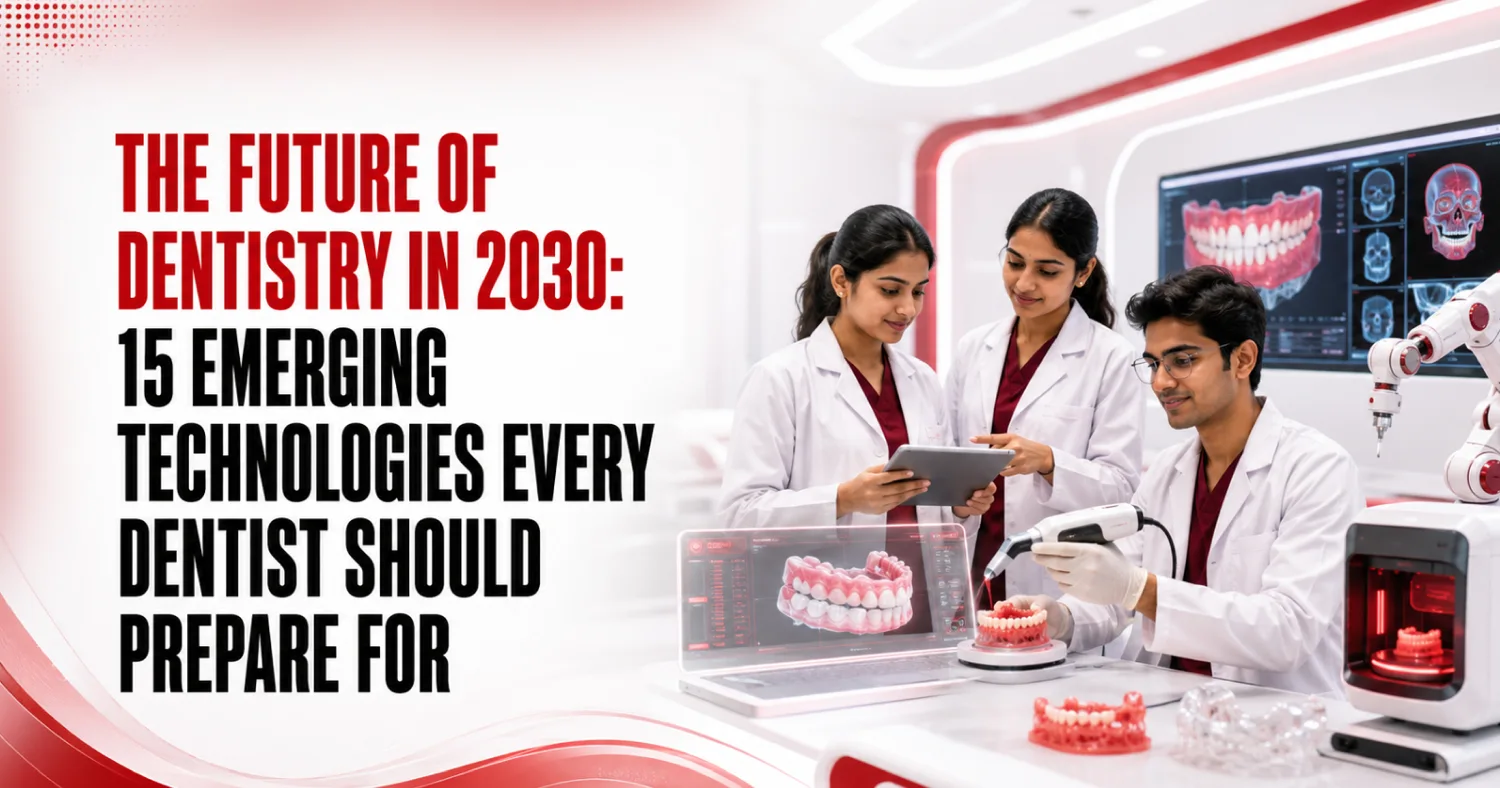
A dentist working in 2030 will pick up a digital scanner instead of a metal tray filled with impression material. Patients will see a 3D image of their own tooth roots on a screen within seconds of sitting in the chair. This change is not far away. It is already happening in clinics across Delhi NCR and other Indian cities.
Many students preparing for NEET wonder what dental practice will actually look like once they finish their degree. The tools a dentist used in 2015 look nothing like the tools used today, and the gap will grow wider by 2030. Artificial intelligence, 3D printing and digital scanning are no longer far off ideas written in research papers. They are already part of daily work inside leading dental hospitals.
For a student comparing the best BDS colleges in India, this shift matters a great deal. A college that teaches only textbook dentistry cannot prepare a student for a career built around digital tools. This article looks at 15 technologies set to shape dentistry by 2030, explains how each dental speciality will change, and shows how DJ College of Dental Sciences and Research, Ghaziabad, is getting its BDS and MDS students ready for that future.
What Is Building the Digital Foundation of Modern Dental Practice?
Modern dental practice now stands on three layers of digital work. The first layer is the patient record. Paper files are being replaced by cloud based systems that store X-rays, treatment history and billing details in one place. The second layer is diagnostic imaging. Intraoral scanners, CBCT machines and digital X-rays capture the mouth in fine detail, without the mess of old fashioned impression trays. The third layer is connection. Teledentistry lets a dentist in a small town speak to a specialist in a city hospital within minutes, and IoT devices such as smart toothbrushes send brushing time and pressure data straight to a dental health app.
These three layers work together in a real clinic. A dentist can pull up a patient’s scan from last year, compare it with today’s image, and share both with a specialist over a video call, all before the patient leaves the chair. This is the digital foundation that every student at DJ College of Dental Sciences and Research, one of the best BDS colleges in India, now learns as part of daily clinical training rather than as a separate subject.
Does Dentistry Have a Bright Future in India?
Yes, dentistry has a bright future in India, and the numbers support this. Oral disease is common across the country. According to the Ministry of Health and Family Welfare, dental caries affects over 60 percent of the Indian population, and periodontal disease affects nearly 85 percent. This large number of patients needing care is one reason dental services keep growing every year.
Market research also points in the same direction. India’s dental care market was valued at around USD 653 million in 2022 and is expected to reach nearly USD 1,339 million by 2030, growing at close to 9.4 percent every year. The dental implants segment alone is forecast to grow at 14.7 percent a year between 2024 and 2030. The Government of India has also set a target under its National Oral Health Policy to increase public oral health facilities in every district by 50 percent by 2030.
For students, this growth means more clinics, more hospitals and more specialist roles opening up every year. A degree from one of the best BDS colleges in India, backed by hands on training in new technology, gives a graduate a strong starting point in this growing field.
India Dental Sector — Key Statistics (2022-2030)
| Statistic | Figure | Source |
| Indians affected by dental caries | Over 60% of population | Ministry of Health & Family Welfare (cited in Grand View Research, 2024) |
| Indians affected by periodontal disease | Nearly 85% of population | Ministry of Health & Family Welfare (cited in Grand View Research, 2024) |
| India dental care market, 2022 | USD 653 million | Insights10, India Dental Care Market Report |
| India dental care market, forecast 2030 | USD 1,339 million (CAGR 9.4%) | Insights10, India Dental Care Market Report |
| India dental implants market growth, 2024-2030 | CAGR 14.7% | Grand View Research, India Dental Implants Market Report |
| National Oral Health Policy target | +50% public oral health facilities per district by 2030 | National Oral Health Policy, 2021, Govt. of India |
What Are the 15 Emerging Technologies Every Dentist Should Prepare For? The Key Role of the Best BDS Colleges in India Matters!
The next few years will bring more change to dentistry than the last two decades combined. Some of these tools are already inside Indian dental colleges and hospitals. Others are still moving from research labs into daily practice. The table below lists 15 technologies every dental student and practising dentist should know about before 2030.
15 Emerging Dental Technologies for 2030
| Technology | What It Does | Dental Use |
| Artificial Intelligence (AI) | Reads X-rays and scans to flag cavities, bone loss and early signs of oral cancer | Faster, more consistent diagnosis |
| Intraoral Digital Scanners | Captures a 3D image of the mouth without a physical impression | Comfortable, accurate crown and aligner planning |
| 3D Printing | Builds crowns, dentures, surgical guides and models layer by layer | Same day restorations, shorter turnaround |
| CAD/CAM Systems | Designs and mills restorations on a computer before manufacture | Same visit crowns and veneers |
| Teledentistry | Connects patients to dentists through video calls and shared images | Wider reach into small towns and villages |
| Cone Beam CT (CBCT) | Produces a detailed 3D X-ray of the jaw and teeth | Precise implant and surgical planning |
| Laser Dentistry | Uses focused light instead of a drill for many procedures | Less pain, faster healing, less bleeding |
| Robotics-Assisted Implant Surgery | Guides implant placement with computer controlled precision | Greater accuracy in complex implant cases |
| Augmented Reality (AR) | Overlays digital information on the mouth during treatment or teaching | Better patient understanding, clearer training |
| Virtual Reality (VR) Simulation | Lets students practise procedures on a virtual patient first | Safer, repeatable hands on training |
| IoT Smart Toothbrushes & Trackers | Sends brushing habits and pressure data to an app or record | Better prevention and patient follow up |
| Nanotechnology in Dental Materials | Uses nano sized particles in fillings and coatings | Stronger, longer lasting restorative materials |
| 3D Bioprinting & Tissue Regeneration | Researches printing of living tissue such as gum or bone | Long term hope for regrowing damaged tissue |
| Cloud Based Practice Management | Stores patient records, billing and appointments remotely | Easy access across clinics and branches |
| Salivary & Wearable Diagnostics | Tests saliva or wearable sensors for early disease markers | Early detection without invasive tests |
How Is Technology Transforming the Nine Dental Specialities?
Every department inside DJ College of Dental Sciences and Research is already feeling the effect of these changes. The table below shows how new technology is reshaping each of the nine dental specialities taught at the college, from diagnosis in Oral Medicine to surgery in Oral & Maxillofacial Surgery.
Technology Across the Nine Dental Specialities
| Speciality | Key Technology | Effect on Patient Care |
| Oral Medicine & Radiology | AI-assisted imaging, CBCT | Faster, more accurate diagnosis of oral disease |
| Conservative Dentistry & Endodontics | Laser therapy, CAD/CAM | Less painful root canal treatment, same day fillings |
| Prosthodontics, Crown, Bridge & Implantology | 3D printing, digital scanning | Faster, better fitting crowns, bridges and dentures |
| Periodontology & Oral Implantology | Laser therapy, robotics-assisted implants | Gentler gum treatment, precise implant placement |
| Oral Pathology & Microbiology | AI-assisted digital pathology | Quicker detection of oral cancer and infection |
| Orthodontics & Dentofacial Orthopaedics | 3D printed clear aligners, AI treatment planning | Shorter, more predictable treatment plans |
| Pediatric & Preventive Dentistry | Teledentistry, IoT toothbrushes | Easier follow up and prevention for children |
| Oral & Maxillofacial Surgery | Robotics, AR-guided surgery, 3D printed guides | Safer, more precise complex surgery |
| Public Health Dentistry | Teledentistry, population health data | Wider outreach into rural and underserved areas |
How Do Students Benefit at DJ Dental College?
DJ College of Dental Sciences and Research, Ghaziabad, was founded in 1999 and is among the first five private dental colleges in Uttar Pradesh. Recognised by the Dental Council of India and affiliated to Atal Bihari Vajpayee Medical University, Lucknow, the college sits on a 75-acre campus in Delhi NCR.
Students here train inside an attached hospital that treats over 100 patients in each department every day, giving BDS and MDS students far more hands on clinical exposure than a classroom alone can offer. The college also holds membership of the American Academy of Developmental Medicine, a distinction it reports as unique among dental colleges in Asia.
When comparing BDS best colleges in India on the basis of cost and infrastructure, prospective students and parents often ask how DJ College of Dental Sciences and Research measures up against nearby institutions. The table below sets out a general comparison based on publicly available third party data. Figures marked [VERIFY] should be confirmed directly with the respective admission office, since fee structures and other details change every academic year and were not consistently available from official sources at the time of writing.
BDS Course Snapshot — DJ Dental College and Competing Institutions
| Institution | Established | Affiliating University/Body | Approx. Total BDS Fees* |
| DJ College of Dental Sciences & Research, Ghaziabad | 1999 | Atal Bihari Vajpayee Medical University, Lucknow | Rs 12.65 Lakhs |
| Inderprastha Dental College & Hospital, Ghaziabad | 2006 | Chaudhary Charan Singh University | Rs 19.78 Lakhs |
| Sharda University, Greater Noida | 2006 | Sharda University | Rs 19.77 Lakhs |
| Subharti Dental College, Meerut | 1996 | Swami Vivekanand Subharti University | Rs 19.81 Lakhs |
| Institute of Dental Studies & Technologies, Ghaziabad | ______ | ______ | Rs 15.62 Lakhs |
| ITS Dental College, Greater Noida | ______ | ______ | Rs 19-20 Lakhs |
| ITS Dental College, Ghaziabad (Murad Nagar) | ______ | ______ | Rs 29-36 Lakhs |
| Kalka Dental College, Meerut | ______ | ______ | Rs 16.48 Lakhs |
*Fee figures are indicative totals for the full BDS course, drawn from third party aggregator listings (Collegedunia, Shiksha, Zollege) rather than official college prospectuses. They change year to year and by category, so students and parents should always confirm the current figure with the college admission office before applying.
Choosing among the best BDS colleges in India is not only about the technology on campus. It is also about the number of real patients a student treats before graduation, the labs available for hands on practice, and the support offered along the way. This is where DJ College of Dental Sciences and Research aims to stand apart.
Why the Aspiring Dentists are choosing DJ College of Dental Sciences and Research
| Top Reasons | What It Means for Students |
| Over 25 years of dental education, since 1999 | Established teaching methods and experienced faculty who have trained many batches of dentists |
| Among the top-ranked dental colleges in UP and Delhi NCR | Strong regional reputation among students and recruiters |
| Recognised by the Dental Council of India (DCI) | A degree that is valid for practice and further study in India |
| 75-acre campus | Room for hostels, sports, labs and hospital together in one location |
| 100+ patients treated per department every day | High patient volume gives students real hands on practice |
| BDS and MDS programmes across multiple specialisations | Students can continue from undergraduate to postgraduate study at the same college |
| Advanced labs and digital academic support | Direct exposure to the same digital tools covered in this article |
| Strong research and publication culture | Students learn to read and contribute to dental research |
| Students from 17+ countries | Exposure to a mixed group of peers from different backgrounds |
| Scholarships and career support | Financial help and guidance for eligible students |
What Are the Key Takeaways on the Future of Dentistry?
Dentistry by 2030 will look different from dentistry today, but the direction is already clear. Students who understand these changes early, and who study at one of the best BDS colleges in India, will step into their careers with a real advantage.
Key Takeaways at a Glance
| Key Takeaway | Why It Matters |
| AI supports diagnosis, it does not replace the dentist | Human judgement, patient communication and hands-on skill remain central to the profession |
| Digital scanning and 3D printing cut chair time | Patients get faster treatment with fewer visits |
| Teledentistry extends care into small towns | More patients in rural India get access to a dentist |
| Prevention is moving into the patient’s home | Smart toothbrushes and apps flag problems before they become serious |
| Training on real technology matters as much as theory | Colleges with labs, patient volume and digital tools prepare students better for practice |
| Career options are widening beyond general practice | Digital dentistry, implantology and public health dentistry are all growing fields |
Frequently Asked Questions
1. Does dentistry have a bright future in India?
Yes. Oral disease affects a large share of the Indian population, and the dental care market is expected to grow from around USD 653 million in 2022 to nearly USD 1,339 million by 2030. This growth, combined with new technology such as AI and teledentistry, is opening more clinical, research and teaching roles for dental graduates every year.
2. Will artificial intelligence take over dentistry?
No. AI helps a dentist read X-rays and scans faster and flag possible problems, but it does not carry out treatment on its own. A dentist still examines the patient, plans the treatment and carries out procedures such as fillings, root canals and surgery. AI works as a support tool, not a replacement for trained hands.
3. What are the biggest dental technology trends to watch before 2030?
The biggest trends include artificial intelligence for diagnosis, digital scanning and 3D printing for same day restorations, teledentistry for remote patients, laser dentistry, and IoT-enabled devices such as smart toothbrushes that track brushing habits at home. Robotics and augmented reality are also entering surgical and teaching settings across Indian dental colleges.
4. Which dental speciality offers the strongest career and earning potential?
Earning potential depends on location, patient volume and years of experience, so no single speciality suits everyone. Prosthodontics, oral and maxillofacial surgery and implantology are generally seen as strong earners because of the technical skill and equipment involved, while orthodontics and cosmetic dentistry are growing fast due to rising patient demand.
5. How does DJ College of Dental Sciences and Research prepare future ready dentists?
The college combines a 75-acre campus, an attached hospital with over 100 patients treated per department every day, and BDS and MDS programmes across nine specialities. Students train directly on digital tools such as CAD/CAM systems and modern imaging, alongside experienced faculty, which places DJ College among the best BDS colleges in India for hands on learning.
6. What is the eligibility for BDS admission in India?
A candidate must have passed Class 12 with Physics, Chemistry, Biology and English, along with a qualifying score in NEET-UG. Admission to government quota and management quota seats at most private colleges, including DJ College of Dental Sciences and Research, is offered through state or central NEET counselling rounds.
7. How long does a BDS course take to complete?
BDS is a five-year programme. It includes four years of academic study covering subjects such as anatomy, pharmacology and the nine dental specialities, followed by one year of compulsory rotating internship in the attached hospital before the degree is awarded.
8. Is DJ College of Dental Sciences and Research counted among the best BDS colleges in India?
DJ College of Dental Sciences and Research is recognised by the Dental Council of India, ranks among the established private dental colleges in UP and Delhi NCR, and has been training dentists since 1999. Students comparing the best BDS colleges in India often look at patient volume, campus size and technology access, and the college performs well on each of these points.
9. What is teledentistry and how does it help patients in rural areas?
Teledentistry uses video calls, shared images and remote monitoring to connect a patient with a dentist without an in-person visit. For patients in small towns and villages, it means a first opinion, follow up advice or a referral to a specialist without travelling long distances for basic consultations.
10. How much does a BDS course cost in India?
Total BDS fees at private dental colleges in India generally range from about Rs 12 Lakhs to over Rs 25 Lakhs for the full course, depending on the college, state quota rules and scholarships available. Government colleges charge far less. Students should always confirm the current fee structure directly with the college admission office.
Related Posts