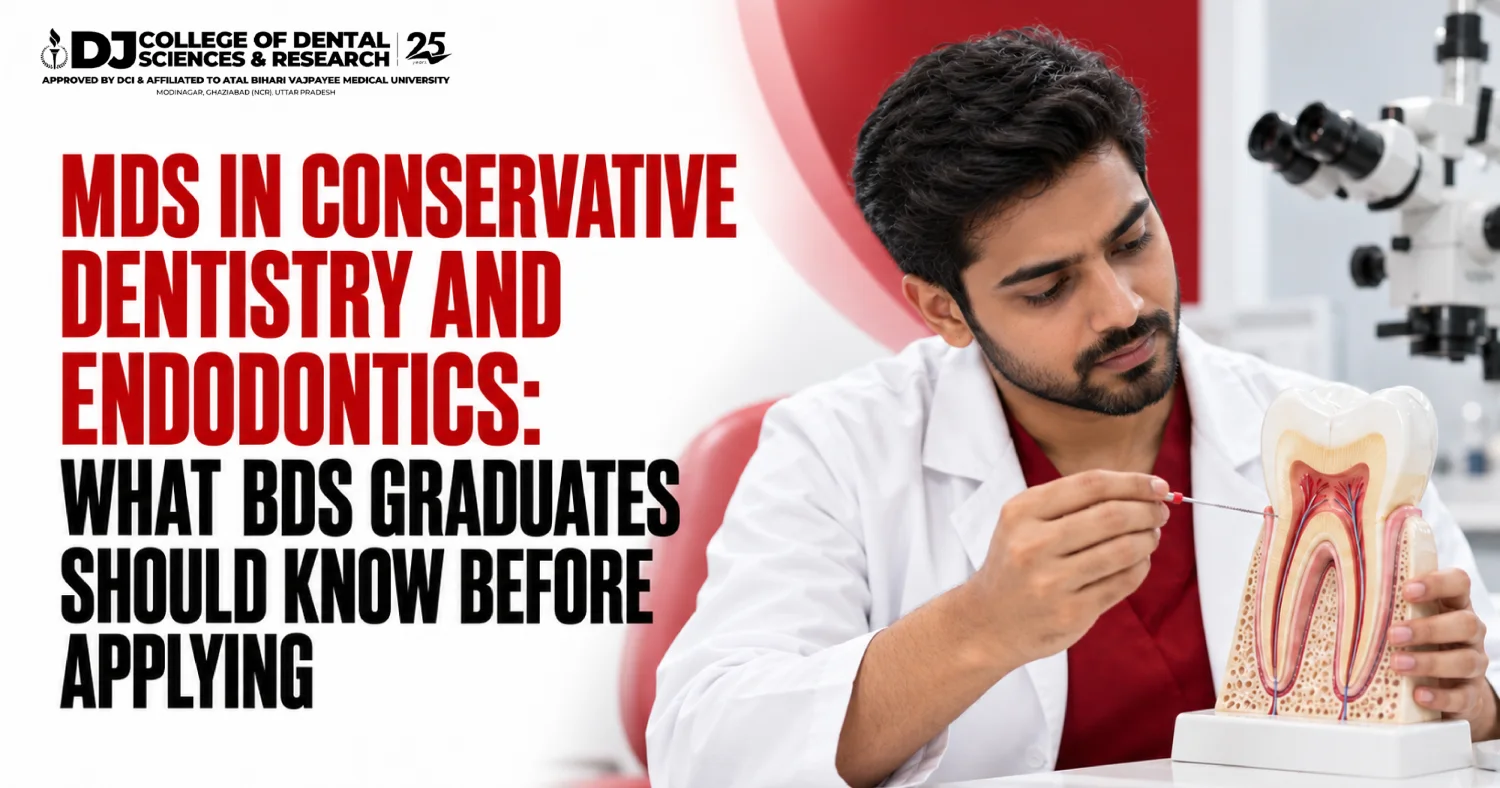
The MDS in Conservative Dentistry and Endodontics is a three-year postgraduate dental programme in India. It trains BDS graduates to save natural teeth through root canal treatment, retreatment, endodontic surgery, fillings, veneers and bleaching.
• Eligibility: BDS from a DCI-recognised college, a finished internship and State Dental Council registration.
• Entrance exam: NEET MDS by NBEMS. There is no other route.
• Duration: 3 years, full-time, with a compulsory thesis.
• Careers: own clinic, consultant endodontist, teaching, hospitals and government service.
• At DJ College of Dental Sciences & Research, Modinagar (Delhi NCR): 6 DCI-approved MDS seats.
Introduction
At some point, most BDS students wonder which branch to pick for their master’s. For many, the answer sits in the root canal room. It is quite common to hear interns say that endo is where a patient walks in holding their jaw and walks out smiling.
Still, picking an endodontics course is a big step. It means three years of study, one tough entrance exam and a lot of patience with canals narrower than a pin.
This guide answers the questions BDS graduates really ask: eligibility, NEET MDS, duration, curriculum, clinical training, thesis work and careers.
What Is MDS in Conservative Dentistry and Endodontics?
In simple words, it is the branch that saves teeth instead of pulling them out. The Dental Council of India (DCI) lists it among the nine MDS specialities.
• Endodontics: treatment of the pulp (the soft tissue inside the tooth) and the area around the root tip. Root canal treatment is the best-known procedure.
• Conservative dentistry: repairing damaged teeth while keeping as much natural tooth as possible, through tooth-coloured fillings, inlays, veneers and bleaching.
Not everyone is aware that short courses in endodontics are also on offer across India. They teach useful skills but do not make a dentist a specialist. In practical terms, the MDS is the only endodontics course that lets a dentist call themselves an endodontist and teach as specialist faculty.
Who Can Apply? Eligibility for MDS Endodontics
Basic Eligibility Checklist
• A BDS degree from a DCI-recognised college.
• A one-year rotatory internship, finished by the NBEMS cut-off date (31 May 2026 for the 2026 cycle).
• Provisional or permanent State Dental Council registration.
• A NEET MDS score at or above the qualifying percentile.
Qualifying Percentile in NEET MDS
| Category | Minimum Percentile |
| General / EWS | 50th |
| General PwBD | 45th |
| SC / ST / OBC | 40th |
It is worth noting that NBEMS sometimes lowers the cut-off later to fill empty seats. In 2025, the General cut-off came down from 261 marks to 197 marks.
NEET MDS: The Only Way In
One question that often comes up is whether any college offers direct admission. The answer is no. Every MDS seat in India is filled through NEET MDS scores and official counselling.
| Feature | NEET MDS 2026 Details |
| Conducted by | NBEMS |
| Questions | 240 MCQs (Part A: 100 in 75 minutes, Part B: 140 in 105 minutes) |
| Total marks | 960 |
| Marking | +4 right, minus 1 wrong, 0 skipped |
| Exam date | 2 May 2026 |
• All India Quota and deemed university seats go through MCC counselling.
• State quota and private college seats go through state counselling. In Uttar Pradesh, DGME UP runs this.
• Conservative Dentistry and Endodontics is usually among the first branches to fill, so a good rank matters.
Course Duration and Curriculum
The course runs for three years, full-time. There is no distance option, because students must treat patients on campus every day.
Year-by-Year Plan of the Endodontics Course
• Year 1: applied basic sciences, pre-clinical work on extracted teeth and phantom heads, a library dissertation and the thesis plan. The Part I exam comes at the end of this year.
• Year 2: full clinical work. Students treat molars, redo failed root canals, place posts and cores, and present cases in seminars.
• Year 3: complex cases, endodontic surgery and smile designing, followed by thesis submission and the final exams.
Core Topics Covered in the Endodontics Course
• Pulp biology and root canal anatomy
• Cleaning and shaping with rotary nickel-titanium files
• Obturation (sealing the canal) and retreatment
• Endodontic surgery, such as apicoectomy
• Care of broken and knocked-out teeth
• Regenerative endodontics for young teeth with open roots
• Veneers, bleaching and smile makeovers
• Reading CBCT (3D dental X-ray) scans
Clinical Training: What a Normal Day Looks Like
For the most part, an MDS student’s day starts in the OPD. Cases are allotted, and each treatment goes into a log-book that faculty sign off.
• Apex locators, pulp testers, rotary motors and digital X-rays are daily tools.
• Seminars and case presentations run alongside clinic work.
• Each student must finish a set number of cases before the final exam.
Ask any experienced professional in the field, and they will tell you that patient numbers decide how good a postgraduate becomes. The true worth of any endodontics course lies in this daily case load: curved molars, blocked canals, failed treatments and injured front teeth.
Clinical Training at DJ College of Dental Sciences & Research
DJ College of Dental Sciences & Research, founded in 1999 in Modinagar, Ghaziabad, is recognised by the DCI. Its department page shares these figures:
| Department Feature | Details |
| MDS seats (DCI-approved) | 6 |
| Patients treated daily | Over 55 |
| Electronic dental units | 34 |
| Phantom heads in pre-clinical lab | 60 |
| Special areas | Micro dentistry, laser dentistry, regenerative endodontics, smile designing |
| Final clinical exam | 2 days |
• The 75-acre campus hosts students from 17+ countries.
• Workshops and continuing dental education (CDE) programmes run through the year.
• A department library and museum support thesis work.
Thesis Work: The Part Many Students Underestimate
This is where things become interesting. Many students plan hard for NEET MDS but forget that the thesis can decide how smoothly the final year goes.
• The topic is chosen in the first few months and cleared by the ethics committee.
• Popular topics compare irrigants, file systems, material bond strength or pain after treatment.
• The thesis must be accepted before the student can sit the final exam.
A simple tip from senior residents: pick a question that can be answered with the patients and machines already in the department.
Why Demand for Endodontists Keeps Growing
Oral Health Need in Numbers
| Indicator | Figure |
| People with oral diseases worldwide | About 3.5 billion |
| Indian adults (35 to 44 years) with tooth decay | 79.2% |
| Indian adults who use dental care | About 24% |
Endodontics Market Size (USD to INR)
| Metric | USD Figure | INR Figure (approx.) |
| Global market, 2025 | USD 1.94 billion | ₹18,624 crore |
| Global market, 2030 (forecast) | USD 2.49 billion | ₹23,904 crore |
| Yearly growth, 2025 to 2030 | 5.2% CAGR | 5.2% CAGR |
Source: MarketsandMarkets. INR figures use about ₹96 per US dollar (September 2026).
Dental Seats in India
| Metric | Number |
| DCI-recognised dental colleges (2025-26) | About 330 |
| BDS seats | 28,116 |
| MDS seats | 7,360 |
| BDS seats for every MDS seat | About 3.8 |
Source: MedBound Times, based on DCI data.
There is little doubt that tooth decay is common in India while use of dental care stays low. That gap points to steady work for root canal specialists, and it explains why MDS seats stay competitive.
Career Options After MDS Endodontics
Where an Endodontics Career Can Lead
• Own clinic: a practice focused on root canals and smile work.
• Consultant endodontist: visiting several clinics and charging per case.
• Teaching: lecturer, reader and later professor in dental colleges.
• Hospitals and dental chains: salaried specialist roles.
• Government service: state health services and the Army Dental Corps.
• Work abroad: possible after clearing that country’s licensing exam.
What Do Endodontists Earn in India?
| Source | Role | Pay (INR) |
| PayScale India, 2026 | Endodontist, median | ₹3.9 lakh a year |
| Collegedunia | Endodontist, average | ₹6.06 lakh a year |
| BapuTalk job post, Delhi | MDS endodontist, fixed | ₹60,000 a month |
The reality on the ground is somewhat different from salary websites. Many endodontists earn per case as consultants, so income often climbs after the first three to five years.
Before You Apply: Questions Worth Asking
Is This Branch the Right Fit?
Students who enjoy slow, careful work, have steady hands and like giving same-day pain relief tend to settle well in this branch.
Questions to Ask a College Before Joining an Endodontics Course
• Are the MDS seats DCI-approved for the current year?
• How many patients does the department see daily?
• How many cases does each PG student finish before exams?
• Is magnification, such as loupes or a microscope, available for PG use?
• What are the stipend, hostel and scholarship arrangements?
Conclusion
For BDS graduates who like precise work, MDS endodontics is a sound choice. The path is clear: finish the internship, clear NEET MDS, choose a college with strong patient flow and plan the thesis early.
An endodontics course at DJ College of Dental Sciences & Research brings these pieces together: 6 DCI-approved seats, a busy department, micro and laser dentistry, over 25 years of dental teaching and a 75-acre campus in Delhi NCR.
Frequently Asked Questions (FAQs)
What is the duration of MDS in Conservative Dentistry and Endodontics?
It is a three-year, full-time course. The first year covers basic sciences and pre-clinical work, and the next two focus on patients and the thesis.
Can a BDS graduate get MDS admission without NEET MDS?
No. Every MDS seat in India, including management seats, is filled through NEET MDS and official counselling.
What is the qualifying percentile for NEET MDS?
It is the 50th percentile for General and EWS, the 45th for General PwBD and the 40th for SC, ST and OBC candidates.
Is the internship compulsory before NEET MDS?
Yes. The one-year internship must be finished by the NBEMS cut-off date, which was 31 May 2026 for the 2026 exam.
What is the difference between conservative dentistry and endodontics?
Conservative dentistry repairs the outer tooth with fillings and veneers. Endodontics treats the pulp and root, mainly through root canal treatment.
Is MDS endodontics a good branch?
It suits dentists who like fine detail. Demand stays steady because tooth decay is very common in India.
Do MDS endodontics students write a thesis?
Yes. The thesis must be accepted before the student can sit the final university exam.
What salary can an endodontist expect in India?
Salary sites place early-career pay at roughly ₹3.9 lakh to ₹6 lakh a year. Consultants who work per case often earn more over time.
Are short-term courses in endodontics enough to become a specialist?
No. They sharpen skills, but only the DCI-recognised MDS makes a dentist a qualified specialist.
How many MDS seats does DJ College offer in this department?
The Conservative Dentistry & Endodontics department has 6 DCI-approved MDS seats.
Where is DJ College of Dental Sciences & Research located?
It is at Ajit Mahal, Niwari Road, Modinagar, Ghaziabad, Uttar Pradesh, within Delhi NCR.
Related Posts