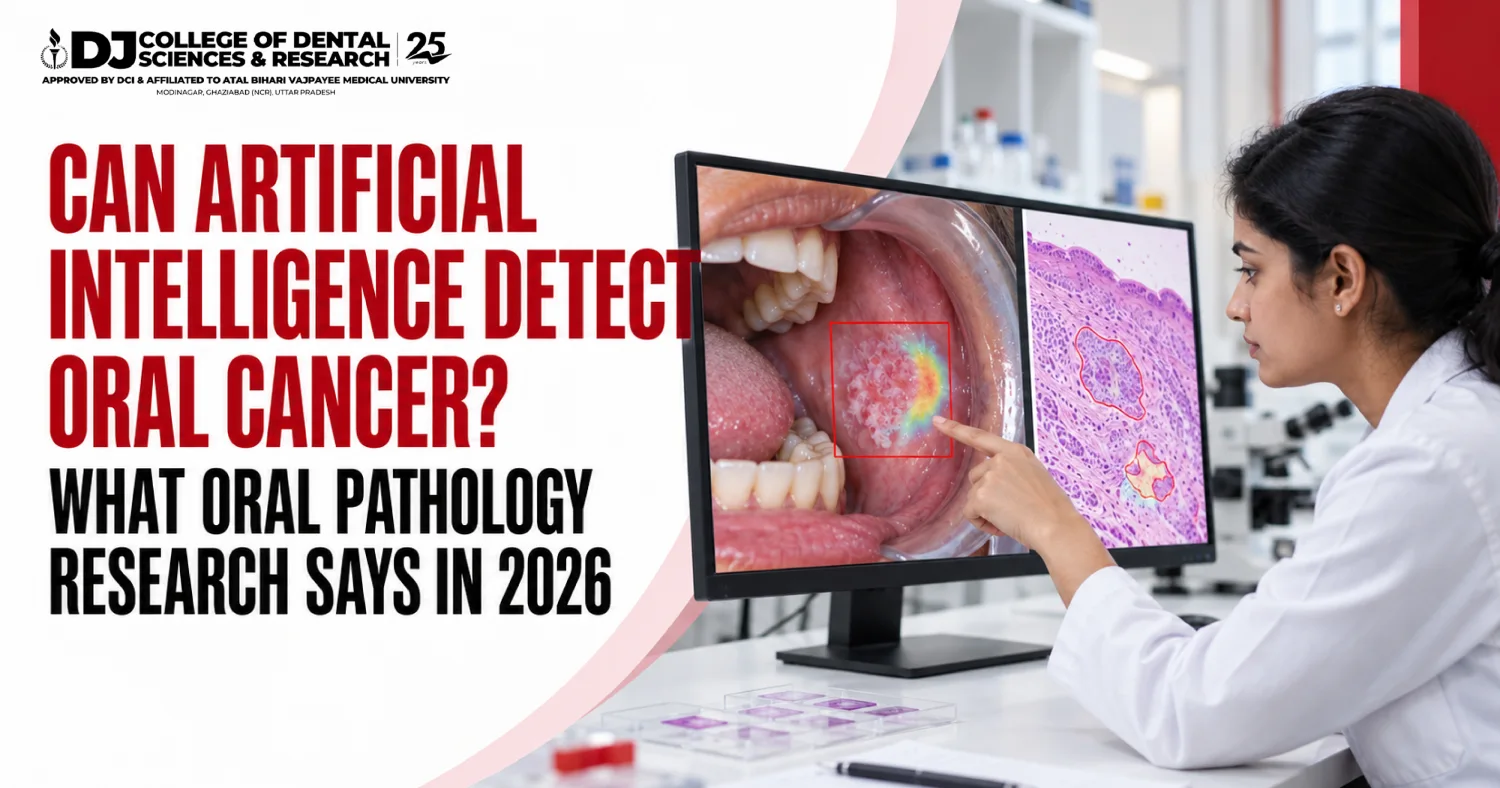
Yes, in part. In research studies, artificial intelligence spots oral cancer on images with about 90% sensitivity, and it does best on biopsy slides. It cannot confirm cancer by itself. A biopsy read by a specialist is still the final word, which is why the oral and maxillofacial pathology specialty matters even in 2026. AI works as a fast first filter, not as the judge.
In a village near Meerut, a health worker holds a phone close to a farmer’s open mouth. He has chewed tobacco for twenty years. The screen thinks for a second and then shows one word: suspicious.
A machine has raised its hand. But who decides whether this is cancer?
That question matters in a country that records over two lakh new mouth cancer cases a year. At one leading cancer hospital, half the patients had already reached stage four when they were diagnosed. Early detection can mean a small operation instead of a lost jaw.
Many parents and students still believe that artificial intelligence will soon do this job alone. The reality on the ground is somewhat different. The final answer still comes from the oral and maxillofacial pathology specialty, the people who read the biopsy.
This blog from DJ College of Dental Sciences & Research, Modinagar, explains what AI can do, what it cannot, and what the research says in 2026.
Can Artificial Intelligence Really Detect Oral Cancer?
Artificial intelligence (AI) here means software that learns patterns from thousands of labelled pictures. In oral cancer work, it can and cannot do the following.
| What AI can do | What AI cannot do |
| Flag a suspicious patch in a mouth photograph | Confirm that the patch is cancer |
| Mark doubtful areas on a biopsy slide | Replace the biopsy itself |
| Sort who needs a referral first | Sign a diagnosis or take responsibility for it |
| Work fast and without tiring | Explain fully why it reached a result |
How Does AI Look at a Mouth?
• Phone photographs: a plain picture of the mouth, taken in a clinic or a camp.
• Special light scans: images that look just under the surface.
• Biopsy slides: thin slices of tissue, scanned from a microscope.
What Does Oral Pathology Research Say in 2026?
This is where things become interesting. Three large reviews of oral pathology research tell a similar story, and each one matters to oral maxillofacial pathology.
| Review | Studies covered | Main result |
| BMC Cancer, May 2026 | 16 | 90% sensitivity, 89% specificity overall. Image-based tools reached 94% and 93%. |
| Front. Oral Health, 2024 | 18 pooled | Biopsy slides: 97% and 95%. Photographs: 82% and 73%. |
| BMC Oral Health, 2024 | 54 | Biopsy slides: 99% and 97%. Only 24.1% of studies had a low risk of bias. |
• Sensitivity is the share of real cancers that the tool catches.
• Specificity is the share of healthy cases that it clears correctly.
• AI reads biopsy slides better than plain photographs.
• With photographs, about 27 in 100 non-cancer cases were flagged wrongly.
• Most studies looked back at old records, and few tested the tool on new patients elsewhere.
Why Does AI Still Need the Oral and Maxillofacial Pathology Specialty?
• AI learns from slides that oral pathologists have already labelled.
• Only a biopsy confirms cancer, and a pathologist reads it.
• A tool trained in one place can slip with new cameras, stains or patients.
• Someone must sign the report and answer for it.
Ask any experienced professional in the field, and the reply stays the same: the machine suggests, the specialist decides.
What Will the Oral and Maxillofacial Pathology Specialty Look Like With AI Beside It?
• AI may pre-screen slides and mark the areas worth a second look.
• The pathologist checks, corrects and signs.
• Routine slides move faster, which leaves time for hard cases.
• New skills come in: digital slides, image analysis and testing AI tools.
Why Does This Matter So Much in India?
| Fact | Figure | Source |
| New lip and oral cavity cancer cases in India (2024 estimate) | 2,05,878 | IARC GLOBOCAN |
| Deaths from lip and oral cavity cancer in India | 86,307 | IARC GLOBOCAN |
| Patients already at stage four, Tata Memorial Hospital study | 50.18% of 1,895 | ecancer, 2024 |
| Five-year survival, stage one against stage four | 83% against 55% | ecancer, 2024 |
| Oral cancer screenings recorded till 31 October 2025 | 31.88 crore | MoHFW, Govt of India |
India is already testing AI in the field. The Indian Institute of Science has built a phone-based tool named Aarogya Aarohan.
• It works offline and sorts images into suspicious and non-suspicious.
• Its first phase, before the AI was added, screened nearly 30,000 high-risk people in a year.
• It was field-tested at nine sites, and the AI version is planned for five districts.
Money is following the idea as well.
| Global AI in dentistry market | Figure in US dollars | In Indian rupees (INR) |
| Size in 2025 | USD 1.3 billion | About Rs 12,584 crore |
| Forecast for 2033 | USD 6.6 billion | About Rs 63,888 crore |
Converted at Rs 96.8 to one US dollar, the rate on 8 October 2026.
Which Oral Maxillofacial Courses and Careers Connect With This Work?
Stepping into this field sounds good, and the curiosity about the future hovers in the mind of every aspirant. Several oral maxillofacial courses feed into cancer detection.
| Course | Duration | Link with oral cancer work |
| BDS | 4 years + 1 year internship | First lessons in oral pathology |
| MDS Oral Pathology & Microbiology | 3 years | Biopsy diagnosis and research |
| MDS Oral Medicine & Radiology | 3 years | Spotting early patches in the clinic |
| MDS Oral & Maxillofacial Surgery | 3 years | Biopsy and cancer surgery |
| MDS Public Health Dentistry | 3 years | Screening camps and tobacco control |
An oral maxillofacial career in the years ahead may include cancer hospitals, digital pathology laboratories, AI testing projects, teaching and research.
How Does DJ College of Dental Sciences & Research Prepare Students for It?
AI is only as good as the cases it learns from and the people who check it. At DJ College, the oral and maxillofacial pathology specialty is taught in the Oral Pathology & Microbiology department, which offers:
• An Oral Cancer Detection Centre and a Tobacco Intervention Clinic.
• A research wing with photomicrography and image analysis.
• Training in immunohistochemistry, microbial culture and bioinformatics.
• 3,000+ archived cases and an e-library with 170+ journals.
• A publishable research paper from every MDS resident.
• A 75-acre campus in Modinagar, Ghaziabad, serving Delhi NCR since 1999, with students from 17+ countries.
• Recognition by the Dental Council of India (DCI), now succeeded by the National Dental Commission (NDC).
Students of oral maxillofacial pathology enter through BDS and NEET MDS. The MDS eligibility page lists the steps.
Conclusion: So, Who Decides Whether It Is Cancer?
The phone in that village did its job. It raised a flag early. But the answer to the farmer’s real question still waits for a biopsy and a trained eye.
Research in 2026 shows that AI is a quick and useful helper, strongest on biopsy slides and weaker on plain photographs. It does not replace the oral and maxillofacial pathology specialty. It makes that specialist more needed, because every flag has to be checked by someone trained in oral maxillofacial pathology. Anyone with a mouth patch or ulcer that does not heal should see a dentist, and can visit the dental hospital at DJ College of Dental Sciences & Research in Modinagar.
Frequently Asked Questions
1. Can artificial intelligence detect oral cancer?
Yes, in part. AI can flag suspicious patches in photographs and biopsy slides with high accuracy in studies. It cannot confirm cancer. A biopsy read by a specialist does that.
2. How accurate is AI in detecting oral cancer?
A 2026 review of 16 studies found about 90% sensitivity and 89% specificity overall. AI did best on biopsy slides and less well on plain photographs.
3. Can AI replace a biopsy for oral cancer?
No. AI can point to a doubtful area, but only tissue studied under a microscope confirms cancer and guides treatment.
4. Will AI replace oral pathologists?
It is unlikely. AI learns from slides that pathologists label, and a pathologist must still check the result and sign the report.
5. What is the oral and maxillofacial pathology specialty?
It is the branch of dentistry that studies diseases of the mouth, jaws and face, and confirms conditions such as oral cancer through biopsy.
6. Can a phone app detect mouth cancer?
A phone-based tool from the Indian Institute of Science sorts mouth images into suspicious and non-suspicious. A suspicious result still needs a dentist and a biopsy.
7. Why is early detection of oral cancer so important in India?
In a Tata Memorial Hospital study, five-year survival was 83% at stage one and 55% at stage four. Half the patients were already at stage four.
8. Which oral maxillofacial courses lead to this work?
BDS introduces oral pathology. The three-year MDS in Oral Pathology & Microbiology trains specialists, and other MDS branches treat and screen patients.
9. What does an oral maxillofacial career look like with AI?
Specialists will still diagnose, teach and research. Many will also test AI tools, work with digital slides and join cancer screening projects.
10. Does DJ College of Dental Sciences & Research have an oral cancer detection centre?
Yes. Its Oral Pathology & Microbiology department in Modinagar, Ghaziabad, runs an Oral Cancer Detection Centre and a Tobacco Intervention Clinic.
Related Posts