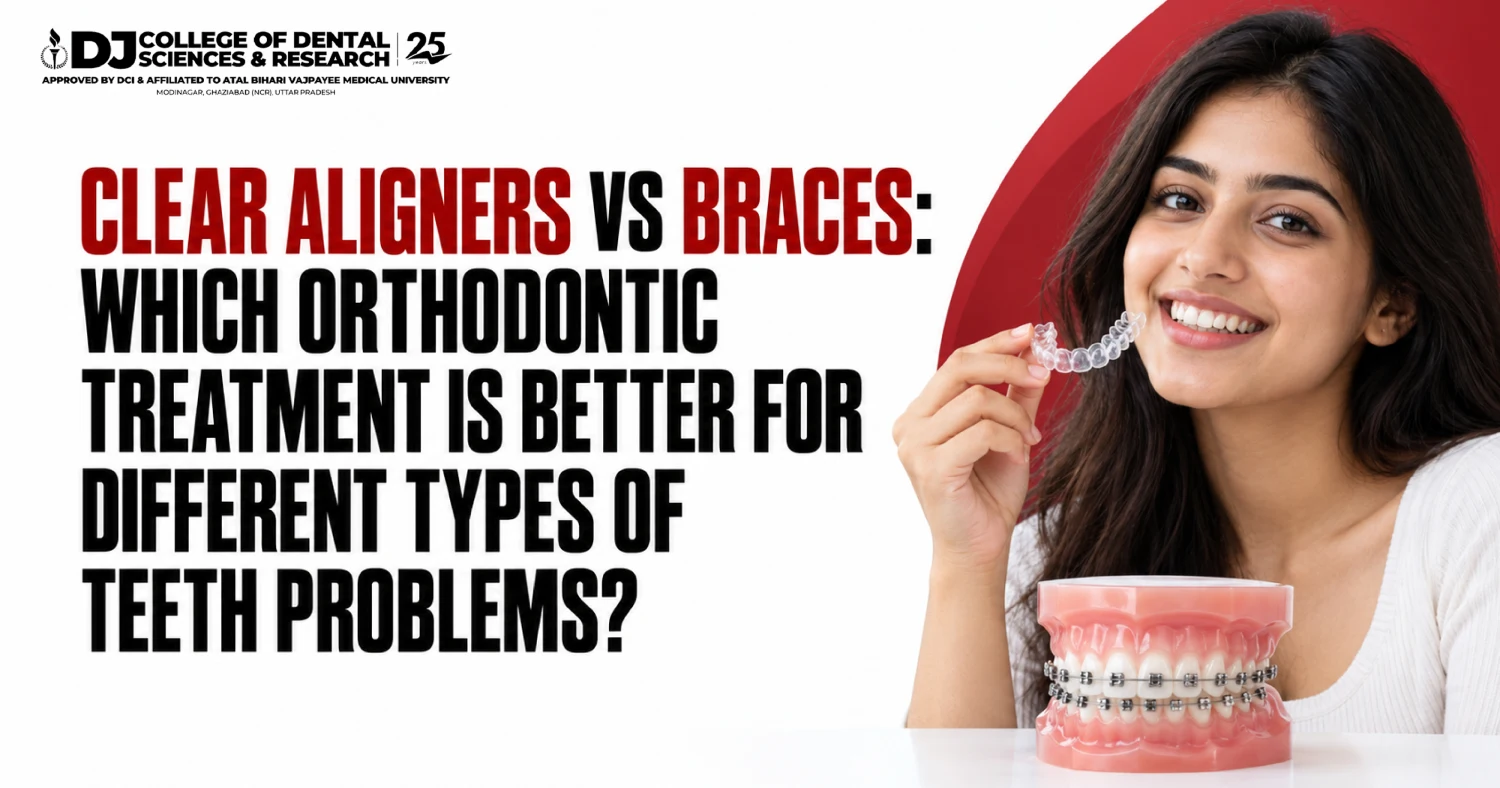
Neither one wins for every mouth. Clear aligners suit mild to moderate crowding and small gaps, as long as the patient wears them about 22 hours a day. Braces give stronger control over severe crowding, rotated teeth, deep bites and jaw-linked problems. A dental orthopedic check-up settles the choice, because the problem picks the appliance.
A fifteen-year-old in Ghaziabad smiles with her lips shut in every school photo. Her father has spent three nights reading about “invisible braces” on his phone. Her cousin, a 27-year-old bank officer, wonders if it is too late for him as well.
At some point, most families land on the same question: clear aligners or braces?
It is quite common to hear that aligners are simply braces without the metal, and that both do the same job. The reality on the ground is somewhat different. In dental orthopedic care, the appliance does not come first. The problem does. A crooked front tooth, a deep bite and a small lower jaw are three different stories, and each one asks for a different tool.
This blog from DJ College of Dental Sciences & Research, Modinagar, takes the common teeth problems one by one. It shows where each treatment works, where it struggles and what it costs in India.
What Is the Difference Between Clear Aligners and Braces?
• Braces are small brackets fixed to the teeth and joined by a wire. The orthodontist adjusts the wire to move the teeth. They stay on day and night.
• Clear aligners are thin, see-through trays made for each patient. Each tray stays in for one to two weeks, about 22 hours a day, and comes out for meals and brushing.
Both are forms of orthodontic treatment, and both move teeth with gentle, steady pressure. Readers who want the basics first can see how orthodontics improves oral health.
| Point | Clear aligners | Braces |
| Look | Almost invisible | Visible; ceramic ones show less |
| Removable | Yes | No |
| Daily wear | About 22 hours | Fixed, all day |
| Eating | Trays come out for meals | Hard and sticky food can break brackets |
| Control over tough movements | Limited | Strong |
| Depends on the patient | Heavily | Very little |
What Does a Dental Orthopedic Check-Up Look For Before Any Appliance Is Chosen?
Not everyone is aware that a crooked smile can come from two places: the teeth or the jaws.
• Orthodontics moves teeth into line.
• Dentofacial orthopedics guides the growth of the jaws and facial bones, mostly in children.
The orthodontist studies photographs, X-rays and models to find which one is at fault. The American Association of Orthodontists advises a first check-up no later than age 7.
Which Orthodontic Treatment Is Better for Which Teeth Problem?
This is where things become interesting. The table below follows published reviews and daily clinical practice. The final call always rests with the orthodontist.
| Teeth problem | Usually works better | Reason |
| Mild to moderate crowding | Clear aligners or braces | Both correct it well |
| Small gaps between teeth | Clear aligners or braces | Simple movements |
| Minor relapse after old braces | Clear aligners | Small corrections only |
| Severe crowding | Braces | Needs strong control and often tooth removal |
| Rotated canines and premolars | Braces | Trays grip round teeth poorly |
| Deep bite | Braces | Pushing front teeth up into the gum is hard for trays |
| Narrow upper jaw or crossbite | Expander, then braces | Trays widen the arch less |
| Jaw too far forward or back in a child | Growth-guiding appliance first | A jaw problem, not a tooth problem |
| Impacted tooth | Braces | The tooth must be pulled into place |
When Do Clear Aligners Work Well?
• Crowding or spacing of about 1 to 6 mm.
• Adults and older teenagers who will not skip wear time.
• Patients who want a discreet look at work or college.
One catch remains. A tray left in its box moves nothing.
When Do Braces Do the Job Better?
• Severe crowding, rotated teeth and deep bites.
• Cases where the back teeth must meet properly.
• Children and patients who may forget removable trays.
A 2019 review of eight studies in BMC Oral Health found braces better at controlling tooth angle, widening the arch and holding the result.
Is It a Dental Orthopedic Problem or Only a Teeth Problem?
If the upper jaw is narrow, or the lower jaw sits too far back, straight teeth alone will not fix the face. In such cases:
• Palate expanders widen a narrow upper jaw.
• Activators and headgear guide jaw growth.
• The best window is roughly ages seven to nine.
• Braces or aligners follow later to finish the teeth.
Adults whose jaws have stopped growing may need jaw surgery along with braces.
What Do the Numbers Say About Aligners, Braces and Indian Smiles?
| Finding | Figure | Source |
| Indian children aged 8 to 15 with malocclusion (badly placed teeth) | 35.40% across 54 studies | J Oral Biol Craniofac Res, 2021 |
| Daily wear needed for clear aligners | About 22 hours | Wikipedia, clear aligners |
| Treatment time in mild to moderate crowding | No clear difference (10 studies) | Clinical Oral Investigations, 2024 |
| Largest miss in canine rotation with aligners | 3.05 degrees | AJODO, 2018 |
| Age for a first orthodontic check-up | By age 7 | American Association of Orthodontists |
| Adults in the global aligner market, 2025 | 65.1% | Grand View Research |
It is worth noting that the 2019 review found aligner cases finished about 6.3 months sooner, while the newer 2024 review found no clear gap. So speed should not decide the choice.
How Much Do Braces and Clear Aligners Cost in India?
| Type | Listed price in India (INR) |
| Metal braces | Rs 31,900 to Rs 52,900 |
| Ceramic braces | Rs 59,900 to Rs 71,900 |
| Self-ligating braces | Rs 71,900 to Rs 1,08,900 |
| Clear aligners | From Rs 69,999 |
These are the published prices of one national dental chain. Fees change with the clinic and the case.
The aligner business is also growing fast, which matters to students who plan a career here.
| Clear aligner market | Figure in US dollars | In Indian rupees (INR) |
| Global, 2025 | USD 5.5 billion | About Rs 53,240 crore |
| Global forecast, 2033 | USD 17.9 billion | About Rs 1.73 lakh crore |
| India, 2025 | USD 124.4 million | About Rs 1,204 crore |
| India forecast, 2033 | USD 1,128.3 million | About Rs 10,922 crore |
Converted at Rs 96.8 to one US dollar, the rate on 8 October 2026.
Where Can Students and Patients See Both Treatments Under One Roof?
Students who plan a dental orthopedic career need a clinic that handles every kind of case, not only the easy ones. The Department of Orthodontics & Dentofacial Orthopedics at DJ College of Dental Sciences & Research offers:
• Aligners, ceramic brackets, lingual and surgical orthodontics, and mini implants.
• Dolphin software and CBCT scans for planning.
• A postgraduate clinic with 22 dental chairs.
• 1,000+ orthodontic patients a month and 500+ new cases a year.
• A three-year MDS in Orthodontics with six seats. Entry is through BDS and NEET MDS.
• A 75-acre campus in Modinagar, Ghaziabad, serving Delhi NCR since 1999, with students from 17+ countries.
• Recognition by the Dental Council of India (DCI), now succeeded by the National Dental Commission (NDC).
After MDS, graduates work as consultant orthodontists, teach in dental colleges, advise aligner companies or open their own practice.
Conclusion: So, Clear Aligners or Braces?
There is little doubt that both forms of orthodontic treatment work. Clear aligners handle mild to moderate crowding and gaps quietly. Braces take on the tough cases. And when the jaw is the culprit, growth-guiding appliances come first.
The honest answer to “which is better” starts with a proper dental orthopedic diagnosis, not with an advertisement. Families in Delhi NCR can book a check-up at the dental hospital of DJ College of Dental Sciences & Research in Modinagar.
Frequently Asked Questions
Which is better, clear aligners or braces?
Neither is better for everyone. Clear aligners suit mild to moderate crowding and small gaps. Braces suit severe crowding, rotated teeth, deep bites and complex bite problems.
Can clear aligners fix severe crowding?
Usually not on their own. Severe crowding needs stronger control and often tooth removal, so orthodontists mostly choose braces for it.
Are clear aligners faster than braces?
Not clearly. A 2024 review of ten studies found no real difference in treatment time for mild to moderate crowding.
How many hours a day should clear aligners be worn?
About 22 hours a day. Each tray stays in for one to two weeks and comes out only for meals and brushing.
What is dentofacial orthopedics?
Dentofacial orthopedics is the part of orthodontics that guides the growth of the jaws and facial bones, mainly in children, with expanders, activators and headgear.
What is a dental orthopedic problem?
It is a problem where the jaw, not only the teeth, sits out of place. A narrow upper jaw or a lower jaw set too far back are common examples.
What is the right age for a first orthodontic check-up?
The American Association of Orthodontists advises a first check-up no later than age 7, when baby teeth and adult teeth are mixed.
Can adults get braces or clear aligners?
Yes. Adults held 65.1% of the global clear aligner market in 2025. What counts is healthy teeth and gums, not age.
How much do braces and clear aligners cost in India?
One national dental chain lists metal braces at Rs 31,900 to Rs 52,900 and clear aligners from Rs 69,999. Fees change with the clinic and the case.
How can a student become an orthodontist in India?
A student completes BDS and a one-year internship, qualifies NEET MDS and then studies a three-year MDS in Orthodontics & Dentofacial Orthopedics.
Related Posts